



4 Essential Types of Coil Springs Explained
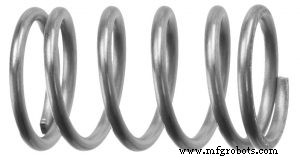
Coil springs are the most ubiquitous type of spring in mechanical engineering, thanks to their simple yet powerful helical design. A single strand of metal—often stainless steel or alloy steel—is wound around a cylinder, producing a spring that can compress, extend, or twist depending on its specific geometry. The helical structure allows these springs to absorb and return energy efficiently, making them indispensable in automotive suspension, industrial machinery, aerospace components, and consumer products.
#1) Volute
A volute spring is a specialized compression coil that takes its name from its conical shape, resembling the scroll of a snail shell. The gradually narrowing profile concentrates force at the apex, allowing the spring to handle exceptionally heavy loads and high pressures. Engineers typically employ volute springs in hydraulic cylinders, heavy‑equipment tooling, and crane hoist assemblies where both strength and precise load distribution are critical.
#2) Arc
Also called bow or arch springs, arc springs were originally developed for automotive and mechanical drivetrain applications. Their distinct arched geometry means the spring is not straight end‑to‑end; instead, the middle section curves to form an elegant arc. This shape enables the spring to connect two separate points while exerting a pulling force, a property that makes arc springs ideal for suspension linkages, shock absorber housings, and even decorative furniture hinges.
#3) Variable (Progressive Rate)
Variable, or progressive‑rate, springs feature non‑uniform spacing between turns. As the spring is compressed, the distance between successive coils changes, causing the force required to compress each additional turn to increase gradually. This variable stiffness is perfect for applications that demand low resistance at light loads but high resistance under heavier conditions—common in automotive suspension, bicycle forks, and precision positioning devices.
#4) Torsion
Torsion springs are engineered to resist or deliver twisting forces. Their most familiar example is the classic mouse‑trap, where a coiled strip of steel stores energy when twisted and releases it instantly when the trap is triggered. Beyond toys, torsion springs are used in door hinges, split‑rail beds, and industrial clutches, where controlled torque and rapid energy release are essential.
In Conclusion
While all coil springs share a fundamental helical structure, each of the four types—volute, arc, variable, and torsion—offers unique mechanical advantages tailored to specific engineering challenges. By selecting the right spring geometry, designers can optimize performance, durability, and cost across a wide spectrum of products.
Industrial equipment
- Top 3 Tungsten Alloys and Their Key Applications
- Understanding the Three Most Common Hose Clamp Types
- The 5 Most Common Non‑Ferrous Metals & Their Key Uses
- Understanding the Four Most Common Types of Plungers
- The 6 Most Common Screw Drives Explained – Torque, Usage, and Selection
- 6 Essential Woodworking Joints Every Craftsman Should Master
- 5 Common Types of Knobs and Their Practical Applications
- Three Essential Laser Marking Systems Explained
- Top 5 CNC Machine Types Every Manufacturer Should Know
- Four Essential CNC Machine Types for Precision Manufacturing