



Understanding C++ Type Conversion: Implicit, Explicit, and Casting Techniques
C++ Type Conversion
Explore how C++ handles data type changes, from automatic conversions to safe casting techniques, with practical code examples.
C++ lets you transform a value from one type to another—a process called type conversion. Understanding the rules behind these conversions helps you write clearer, safer code.
There are two primary categories:
- Implicit (automatic) conversion
- Explicit conversion (type casting)
Implicit Type Conversion
When the compiler automatically promotes or demotes a value to a compatible type, that’s implicit conversion. It happens behind the scenes, so you don’t see a cast in your source.
Example 1: int >> double
#include <iostream>
using namespace std;

int main() {
    int num_int = 9;
    double num_double = num_int;  // implicit conversion

    cout << "num_int = " << num_int << endl;
    cout << "num_double = " << num_double << endl;
    return 0;
}
Output
num_int = 9
num_double = 9
The compiler widened the int to a double automatically before assignment.
Example 2: double >> int (truncation)
#include <iostream>
using namespace std;

int main() {
    double num_double = 9.99;
    int num_int = num_double;  // implicit conversion

    cout << "num_int = " << num_int << endl;
    cout << "num_double = " << num_double << endl;
    return 0;
}
Output
num_int = 9
num_double = 9.99
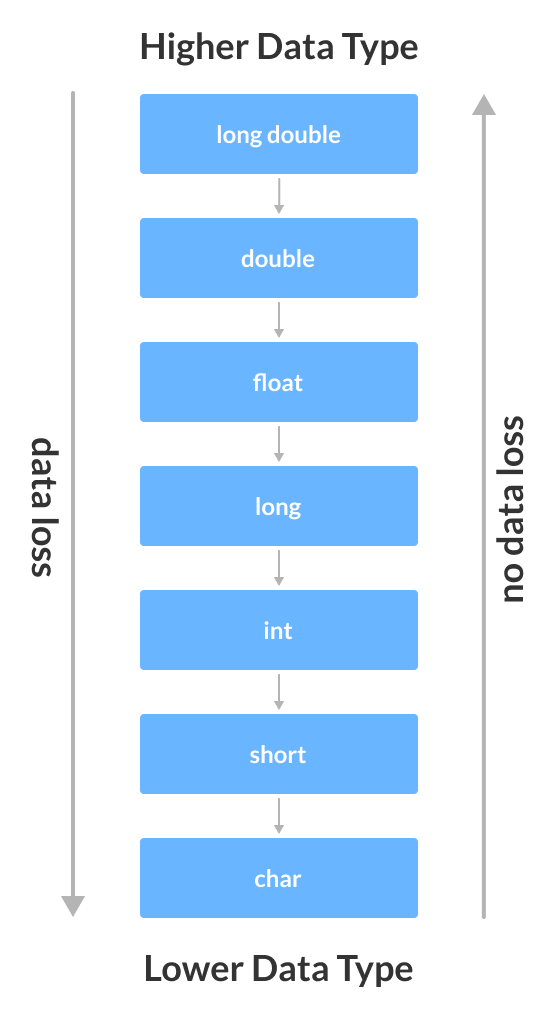
Because int has no fractional part, the decimal component is discarded—an example of narrowing conversion.
Tip: Converting from a wider to a narrower type can lose precision. Always be explicit when the loss matters.
Narrowing Conversion and Data Loss
When a larger type is assigned to a smaller one, the compiler may truncate data. Visualizing the range mismatch helps prevent unexpected bugs.
Explicit Conversion (Type Casting)
When you need to control the conversion, you use explicit casts. C++ offers several syntaxes to achieve the same goal, each with its own style guidelines.
- C‑style cast notation
- Function‑style cast (old C++ style)
- Modern C++ casts:
static_cast,dynamic_cast,const_cast,reinterpret_cast
C‑style Type Casting
This traditional form is inherited from C:
(data_type)expression;Example:
#include <iostream>
using namespace std;

int main() {
    int num_int = 26;
    double num_double = (double)num_int;  // C‑style cast
    cout << "num_double = " << num_double << endl;
    return 0;
}
Function‑style Casting
A more explicit alternative that reads like a constructor call:
data_type(expression);Example:
#include <iostream>
using namespace std;

int main() {
    int num_int = 26;
    double num_double = double(num_int);  // function‑style cast
    cout << "num_double = " << num_double << endl;
    return 0;
}
Both C‑style and Function‑style Casting
#include <iostream>
using namespace std;

int main() {
    double num_double = 3.56;
    cout << "num_double = " << num_double << endl;

    int num_int1 = (int)num_double;   // C‑style
    int num_int2 = int(num_double);   // function‑style

    cout << "num_int1 = " << num_int1 << endl;
    cout << "num_int2 = " << num_int2 << endl;
    return 0;
}
Output
num_double = 3.56
num_int1 = 3
num_int2 = 3
The two casts yield identical results, but the function‑style cast is preferred in modern C++ because it is clearer and less error‑prone.
Modern C++ Cast Operators
Beyond the classic forms, C++ offers four dedicated cast operators that provide better type safety and intent:
static_cast– compile‑time conversions that respect inheritancedynamic_cast– safe downcasting in polymorphic hierarchiesconst_cast– removing or adding constnessreinterpret_cast– low‑level reinterpretation of bit patterns
We’ll dive into each of these in dedicated tutorials.
Recommended Tutorials:
- C++ string to int and Vice‑versa
- C++ string to float, double and Vice‑versa
C Language
- Mastering C# Type Conversion: Implicit, Explicit, Parse, and Convert Methods
- Mastering C++ Operators: A Complete Guide with Practical Examples
- C++ Comments: Best Practices for Readable, Maintainable Code
- Mastering the C++ break Statement
- Mastering Python Type Conversion & Casting: A Comprehensive Guide
- Mastering Numbers, Type Conversion, and Mathematics in Python
- Mastering C++ Char Data Types: Declaration, ASCII, and Conversion Techniques
- C Typecasting: Mastering Implicit and Explicit Conversions with Code Examples
- C++ Variable Types Explained: Memory, Limits, and Operations
- Understanding Type Conversion in C#: Implicit & Explicit Casting Explained