



C Typecasting: Mastering Implicit and Explicit Conversions with Code Examples
What Is Typecasting in C?
In C, typecasting—or data conversion—is the process of converting a value from one data type to another. It’s a fundamental concept that every C programmer should master.
Implicit Type Casting
Implicit (or automatic) type casting occurs when the compiler silently converts one data type to another without any developer intervention. This happens only when the conversion preserves the value’s meaning and the target type can represent the source value.
- Implicit conversion is performed automatically during assignment, function calls, and arithmetic operations.
- When two operands have different types, the operand with the smaller rank is promoted to the type with the higher rank.
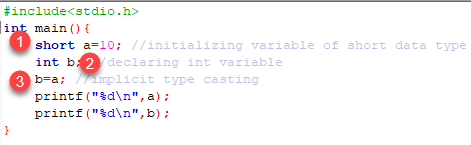
Consider this example:
#include<stdio.h>
int main() {
    short a = 10;   // short
    int   b;        // int
    b = a;          // implicit cast
    printf("%d\n", a);
    printf("%d\n", b);
    return 0;
}
Output:
10
10
The compiler promotes the short value to int automatically, ensuring that no information is lost.
Character to Integer Promotion
When a char participates in an arithmetic expression, the compiler promotes it to int using its ASCII code:
#include <stdio.h>
int main() {
    int number = 1;
    char character = 'k';  /* ASCII 107 */
    int sum = number + character;
    printf("Value of sum : %d\n", sum);
    return 0;
}
Output:
Value of sum : 108
Arithmetic Conversion Hierarchy
The C standard defines a hierarchy that determines the target type for mixed‑type arithmetic. If the operands differ after any character promotion, the compiler converts them to the type at the top of the following chart:
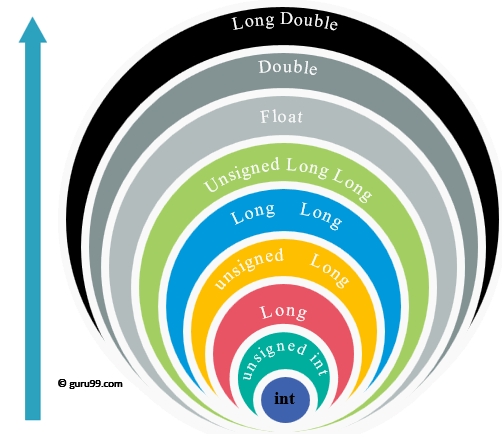
Arithmetic Conversion Hierarchy
Example:
#include <stdio.h>
int main() {
    int num = 13;
    char c = 'k';     /* 107 */
    float sum = num + c;
    printf("sum = %f\n", sum);
    return 0;
}
Output:
sum = 120.000000
Here, c is first promoted to int, then both operands become float before the addition.
Key Points About Implicit Conversions
- They’re also called standard conversions; no cast operator is required.
- Promoting a smaller type to a larger one is known as type promotion.
- Only compatible types can be converted implicitly; otherwise the compiler emits a warning or error.
- Incompatible conversions that lose information (e.g.,
doubletofloat) should be avoided or explicitly casted.
Explicit Type Casting
Explicit casting forces a conversion that the compiler wouldn’t perform automatically. This is essential when you need the exact representation, such as truncating a fractional part or converting between unrelated types.
The syntax is straightforward:
(type-name) expression
Example of explicit casting in a division that would otherwise truncate the result:
#include <stdio.h>
int main() {
    int var1 = 10, var2 = 3;
    int result = var1 / var2;          // 3, fraction lost
    int result2 = (int)((float)var1 / var2); // 3.333… cast to int -> 3
    printf("result = %d\n", result);
    printf("result2 = %d\n", result2);
    return 0;
}
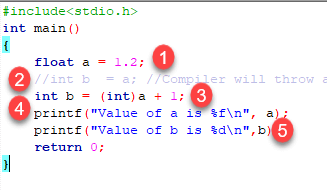
Explicit casts are also useful when converting between unrelated types, as shown below:
#include <stdio.h>
int main() {
    float a = 1.2;
    int b = (int)a + 1;   // cast float to int
    printf("Value of a is %f\n", a);
    printf("Value of b is %d\n", b);
    return 0;
}
Output:
Value of a is 1.200000
Value of b is 2
Summary
- Typecasting converts a value from one type to another.
- Implicit conversions are automatic and safe when types are compatible.
- Explicit conversions use a cast operator to force a change.
- Always review conversions for potential data loss.
Best‑Practice Guidelines
- When possible, convert
inttofloatbefore performing division to preserve precision. - Prefer
floattodoubleonly when memory constraints dictate. - Use
intfor integer arithmetic; reservecharfor textual data.
C Language
- Mastering C# Type Conversion: Implicit, Explicit, Parse, and Convert Methods
- Understanding C++ Type Conversion: Implicit, Explicit, and Casting Techniques
- Mastering Python Type Conversion & Casting: A Comprehensive Guide
- Mastering Java Type Casting: From Widening to Narrowing and Beyond
- Mastering C++ Char Data Types: Declaration, ASCII, and Conversion Techniques
- Encapsulation in Java: A Comprehensive Guide with Practical Example
- Java Variables and Data Types – A Comprehensive Guide with Examples
- C Programming: Mastering Type Casting & Conversion
- Comprehensive Guide to C# Data Types: Value, Reference, and Pointer
- Understanding Type Conversion in C#: Implicit & Explicit Casting Explained