



Mastering C Functions: User-Defined and Standard Library Basics
C Functions
This guide walks you through both user‑defined and standard library functions in C, explaining why functions are essential for clean, maintainable code.
A function is a self‑contained block of code that performs a specific task. By decomposing complex problems into smaller, focused functions, you make your programs easier to read, test, and reuse.
For example, if you need to draw a circle and color it, you could write two separate functions: create_circle() and apply_color(). Each handles one responsibility, keeping the logic modular and straightforward.
Types of Functions
C programs can use two kinds of functions:
- Standard library functions – pre‑written, tested routines provided by the language.
- User‑defined functions – routines you create to meet specific needs.
Standard Library Functions
Standard library functions are built into C and are declared in header files. Common examples include:
printf()– prints formatted text to the console. Declared instdio.h. To use it, add#include <stdio.h>at the top of your file.sqrt()– computes the square root of a number. Declared inmath.hand typically used with#include <math.h>.
For a deeper dive, visit standard library functions in C programming.
User‑Defined Functions
These are custom routines you write to perform tasks specific to your application.
How a User‑Defined Function Works
#include <stdio.h>

void functionName()
{
    // implementation details
}

int main()
{
    // program entry point
    functionName();
    return 0;
}
Execution starts at main(). When the compiler encounters functionName();, control jumps to functionName(), executes its body, and then returns to main().
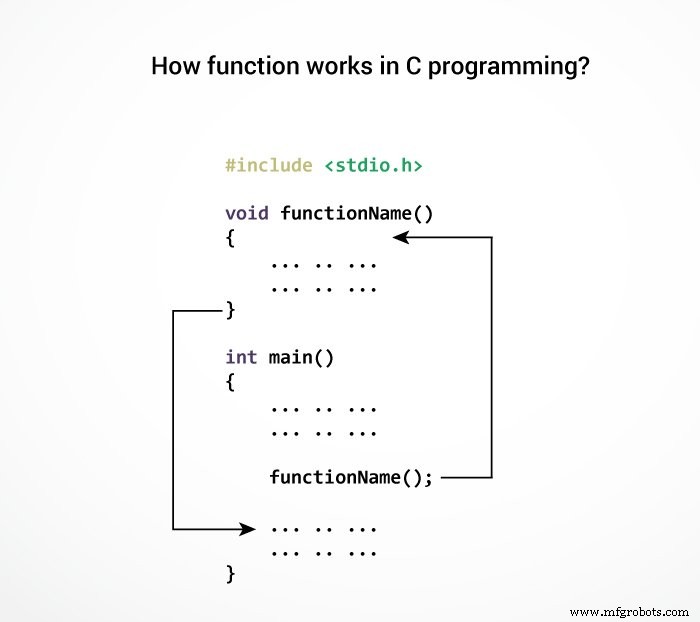
Remember, function names must be unique identifiers.
Explore more on User‑Defined Function in C programming and Types of User‑Defined Functions.
Advantages of User‑Defined Functions
- Improves readability, maintenance, and debugging.
- Encourages code reuse across projects.
- Facilitates modular development, allowing teams to work on distinct components.
C Language
- Mastering C++ Functions: From Basics to Advanced Usage
- Mastering C++ Virtual Functions: Concepts, Examples, and the Override Keyword
- Mastering User-Defined Functions in C: A Step‑by‑Step Guide
- Master Python Functions: Syntax, Types, and Practical Examples
- 10 Essential Insight Features for Optimizing Stratasys FDM Printing
- C++ Functions Explained with Practical Code Examples
- Mastering Verilog Functions for Efficient RTL Design
- Mastering C Functions: Structure, Declaration, and Best Practices
- MATLAB Functions: Definition, Workspace, Inputs & Outputs
- Python Functions Explained: Building Reusable Code Modules