



C Recursion Made Easy: Writing and Using Recursive Functions
C Recursion Made Easy
This tutorial walks you through the fundamentals of recursion in C, from the core concept to a practical example that sums natural numbers.
A recursive function is one that calls itself. This self‑referential technique—recursion—lets you solve problems by breaking them down into smaller, identical sub‑problems.
How Recursion Works
void recurse()
{
    /* pre‑processing */
    recurse();
    /* post‑processing */
}

int main()
{
    /* initial setup */
    recurse();
    /* follow‑up */
}
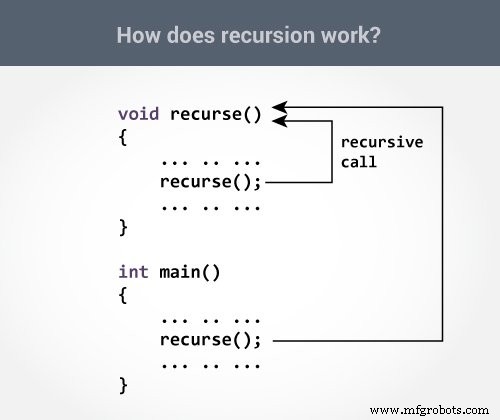
Recursion repeats until a stopping condition—often called the base case—is reached. Using an if…else guard or a similar construct ensures the function eventually terminates and avoids an infinite loop.
Example: Sum of Natural Numbers Using Recursion
#include <stdio.h>

int sum(int n);

int main() {
    int number, result;

    printf("Enter a positive integer: ");
    scanf("%d", &number);

    result = sum(number);

    printf("sum = %d", result);
    return 0;
}

int sum(int n) {
    if (n != 0)
        return n + sum(n-1);  // Recursive call
    else
        return 0;             // Base case
}
Output
Enter a positive integer: 3
sum = 6
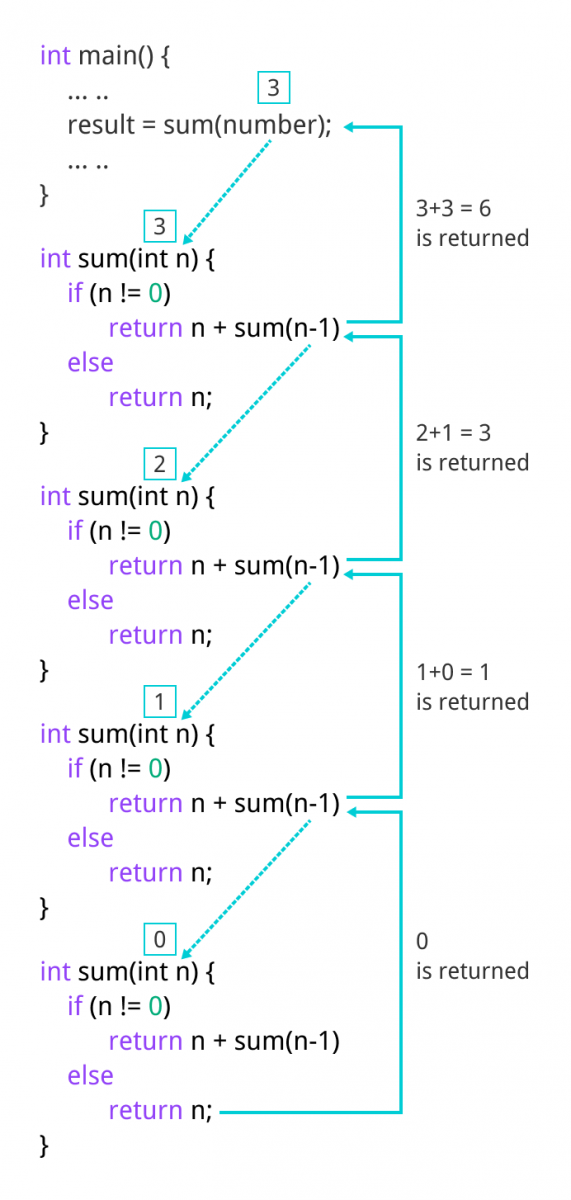
In this example, sum() is invoked from main() with the user’s input. The function calls itself with a decremented value of n until n reaches zero. At that point, the base case returns 0, and the recursive calls unwind, adding each intermediate value back up to main().
Advantages and Disadvantages of Recursion
Recursion often yields cleaner, more readable code, especially for problems that map naturally onto recursive structures—such as tree traversals, factorial calculation, or the Fibonacci sequence. However, recursion can be slower than iterative loops due to the overhead of function calls and increased memory usage from the call stack. In performance‑critical code, consider an iterative solution or memoization to mitigate these costs.
Despite its potential drawbacks, recursion remains a foundational concept in computer science, underpinning many algorithms and data‑structure operations. Mastering recursion equips you to tackle complex problems with elegance and precision.
C Language
- Minterms & Maxterms in Karnaugh Maps: Clear Notation & Practical Examples
- Mastering C++ Recursion: Concepts, Examples, and Best Practices
- Mastering C Control Flow: Break and Continue Statements Explained
- Mastering Python Recursion: How Functions Call Themselves
- Java Recursion: Understanding, Examples, and Trade‑Offs
- Generate Fibonacci Sequence in Java: For, While, and Recursive Examples
- Reverse a String in Java Using Recursion – Step‑by‑Step Guide
- Verilog Full Adder Design & Implementation Guide
- C Programming: Mastering Type Casting & Conversion
- Mastering Recursion in C: Best Practices & Exit Conditions