



Java OOP Concepts: Fundamentals, Examples, and Advantages
What is OOP?
Object‑Oriented Programming (OOP) is a design paradigm built on four core principles: abstraction, encapsulation, inheritance, and polymorphism. It enables developers to model real‑world entities as objects and define methods that operate on them. The goal is to create reusable, modular code that mirrors the structure of the problem domain.
Key OOP Concepts in Java with Practical Examples
Below are the foundational concepts that every Java developer should master:
1) Class
A class is a blueprint for objects. It defines attributes (data) and behaviors (methods). For instance, a Car class might have properties like make, model, and speed, and methods such as drive(), brake(), or reverse(). Objects instantiated from this class—Mercedes, BMW, Toyota—inherit these attributes and behaviors.
2) Object
An object is a concrete instance of a class, containing actual data and executable methods. Examples include a specific Chair, Bike, or Pen. In Java, objects hold both state and behavior.
3) Inheritance
Inheritance lets a subclass inherit fields and methods from a superclass, establishing a parent‑child relationship. This promotes code reuse and logical hierarchy. For example, a Sedan class can inherit from Car and add specialized features.
4) Polymorphism
Polymorphism allows a single interface to represent different underlying forms (subclasses). Overriding and method overloading are common Java implementations. For instance, a Vehicle interface can be implemented by both Car and Truck, each providing its own move() logic.
5) Abstraction
Abstraction hides complex implementation details behind a simple interface. In a car, users interact with a steering wheel and accelerator, not the engine mechanics. Java achieves abstraction through abstract classes and interfaces.
6) Encapsulation
Encapsulation bundles data and methods within a class and restricts direct access to the internal state. Fields are typically marked private, accessed via public getters/setters. This protects data integrity and supports modular design.
7) Association
Association describes a relationship where two objects are aware of each other but maintain independent lifecycles. For example, a Student can be associated with multiple Teacher objects, and vice versa.
8) Aggregation
Aggregation is a special form of association indicating a “has‑a” relationship where the contained object can exist independently. A Department may contain Teacher objects that remain even if the department is removed.
9) Composition
Composition is a strong “has‑a” relationship where the lifetime of the contained object is tied to its parent. If a House object is destroyed, all Room objects are automatically removed.
Advantages of OOP in Java
- Clear, modular structure that aligns with real‑world concepts.
- Reusability of classes across multiple projects, reducing development time.
- Enhanced maintainability for large codebases through encapsulation and abstraction.
- Improved collaboration among developers thanks to well‑defined interfaces and contracts.
Comparing OOP with Other Programming Paradigms: A Banking Example
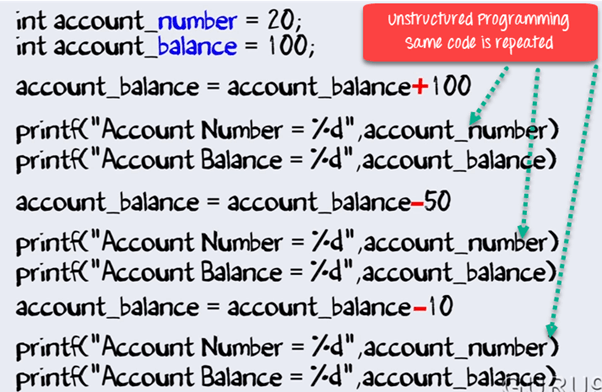
Let’s illustrate how Java’s OOP approach differs from unstructured and structured programming when building a simple banking application featuring deposit, withdraw, and showBalance operations.
Unstructured Programming
Early languages followed a linear flow, repeating code for each operation:
int account_number = 20;
int account_balance = 100;

// Deposit 100
account_balance = account_balance + 100;

// Display balance
printf("Account Number=%d", account_number);
printf("Account Balance=%d", account_balance);

// Withdraw 50
account_balance = account_balance - 50;

// Display balance again
printf("Account Number=%d", account_number);
printf("Account Balance=%d", account_balance);
Structured Programming
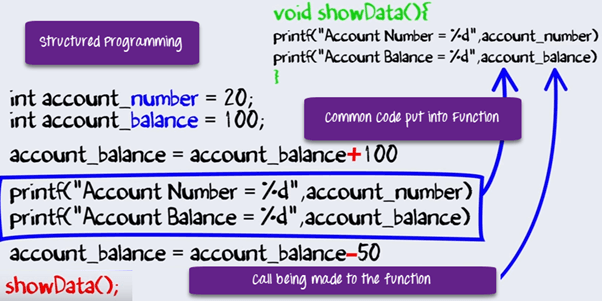
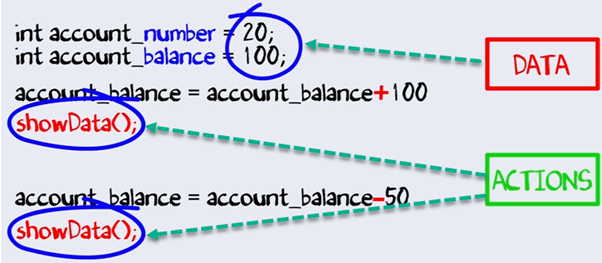
Functions or procedures encapsulate repeated logic, improving readability:
void deposit(int amount) {
    account_balance += amount;
}

void withdraw(int amount) {
    account_balance -= amount;
}

void showBalance() {
    printf("Account Number=%d", account_number);
    printf("Account Balance=%d", account_balance);
}
Object‑Oriented Programming (Java)
Data and operations are bundled into a class, offering the full spectrum of OOP benefits:
public class Account {
    private int accountNumber;
    private int accountBalance;

    public Account(int number, int balance) {
        this.accountNumber = number;
        this.accountBalance = balance;
    }

    public void deposit(int amount) {
        accountBalance += amount;
    }

    public void withdraw(int amount) {
        accountBalance -= amount;
    }

    public void showBalance() {
        System.out.println("Account Number: " + accountNumber);
        System.out.println("Account Balance: " + accountBalance);
    }
}
By coupling data and behavior, Java OOP introduces:
- Abstraction: Users interact with a simple API.
- Encapsulation: Internal state is protected.
- Inheritance: Future account types can extend
Account. - Polymorphism: The same method name can behave differently in subclasses.
These features collectively enhance code clarity, reduce duplication, and simplify maintenance.
Java
- Mastering Abstraction in OOP: Java Abstract Classes & Methods Explained
- Encapsulation in Java: A Comprehensive Guide with Practical Example
- Understanding Java Classes and Objects: Clear Concepts, Practical Examples
- Mastering Java String.indexOf(): Locating Substrings & Practical Examples
- Mastering Java's String compareTo() Method: Syntax, Use Cases, and Practical Examples
- Polymorphism in Java: A Comprehensive Guide with Practical Examples
- Java Interfaces Explained: How to Define and Implement Them with Practical Examples
- Constructor Overloading in Java – Explained with Practical Code Examples
- Java Multithreading Explained: Concepts, Lifecycle, and Practical Code Examples
- Industrial Advertising Explained: Strategies, Examples & ROI