



Understanding Java Classes and Objects: Clear Concepts, Practical Examples
Classes and objects form the core of Java’s object‑oriented programming. Although they are closely related, they serve distinct roles. This guide clarifies their differences and illustrates how to implement them with real‑world examples.
What Is a Class in Java?
A class is a blueprint that defines the structure and behavior common to a group of objects. It specifies which data fields (attributes) and methods (functions) an object will have.
Class Syntax
class <ClassName> {
    // fields
    // methods
}
What Is an Object in Java?
An object is an instance of a class. It is a concrete entity with its own memory location, holding the values of the fields defined by its class. When you invoke a method on an object, you are asking that specific instance to perform an action.
Object Creation Syntax
ClassName obj = new ClassName();
Key Differences Between Class and Object
- Class – the abstract definition (blueprint) of a type.
- Object – a concrete instance created from that blueprint.
Illustrative Example: Pet Management System
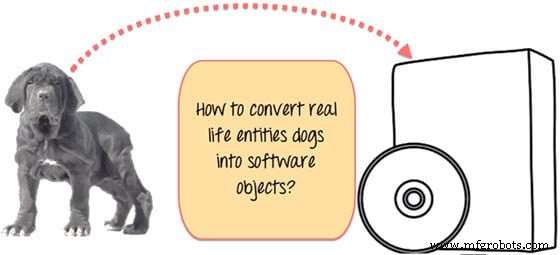
Imagine building a system to manage dog data. First, identify common attributes (breed, age, size, color) and behaviors (eat, sleep, sit). These become the data members and methods of a Dog class.
For each dog in the system, you instantiate a new Dog object with specific values for those attributes.
Design Principles for Java Classes
- Single Responsibility Principle (SRP) – A class should have one reason to change.
- Open/Closed Principle (OCP) – Classes should be open for extension but closed for modification.
- Liskov Substitution Principle (LSP) – Derived classes must be substitutable for their base classes.
- Dependency Inversion Principle (DIP) – Depend on abstractions, not concretions.
- Interface Segregation Principle (ISP) – Provide fine‑grained interfaces tailored to client needs.
Example Program: Dog Class with Main Inside
// Class Declaration
public class Dog {
    // Instance Variables
    String breed;
    String size;
    int age;
    String color;

    // Method to return dog info
    public String getInfo() {
        return "Breed is: " + breed + " Size is:" + size + " Age is:" + age + " color is: " + color;
    }

    public static void main(String[] args) {
        Dog maltese = new Dog();
        maltese.breed = "Maltese";
        maltese.size = "Small";
        maltese.age = 2;
        maltese.color = "white";
        System.out.println(maltese.getInfo());
    }
}
Output:
Breed is: Maltese Size is:Small Age is:2 color is: white
Example Program: Main in a Separate Class
// Dog class definition
class Dog {
    String breed;
    String size;
    int age;
    String color;

    public String getInfo() {
        return "Breed is: " + breed + " Size is:" + size + " Age is:" + age + " color is: " + color;
    }
}

// Separate class with main method
public class Execute {
    public static void main(String[] args) {
        Dog maltese = new Dog();
        maltese.breed = "Maltese";
        maltese.size = "Small";
        maltese.age = 2;
        maltese.color = "white";
        System.out.println(maltese.getInfo());
    }
}
Output:
Breed is: Maltese Size is:Small Age is:2 color is: white
Summary
- A Java class defines the structure and behavior common to all objects of that type.
- An object is an instance of a class, holding specific data and capable of executing its methods.
- Inheritance, method overriding, and other OOP concepts allow you to extend classes and build complex systems.
Java
- C++ Classes & Objects: A Practical Guide with Code Examples
- Understanding C# Interfaces: Definition, Example, and Practical Use
- Java OOP Concepts: Fundamentals, Examples, and Advantages
- Encapsulation in Java: A Comprehensive Guide with Practical Example
- Java HashMap: A Comprehensive Guide
- Java Inheritance Explained: Types, Syntax, and Practical Examples
- Polymorphism in Java: A Comprehensive Guide with Practical Examples
- Java Interfaces Explained: How to Define and Implement Them with Practical Examples
- Python OOP Fundamentals: Classes, Objects, Inheritance, and Constructors Explained
- Master Java: Understanding Objects, Classes, and Core OOP Concepts