



Understanding C# Interfaces: Definition, Example, and Practical Use
What is a C# Interface?
An interface in C# is a contract that defines a set of members—methods, properties, events, or indexers—that a class or struct must implement. It specifies the what but not the how, allowing different types to expose the same set of operations while keeping implementation details hidden.
Interfaces promote loose coupling, enable polymorphism, and support multiple inheritance of type definitions, which is essential for writing testable, maintainable code.
Concrete Example
Below is a minimal console program that demonstrates how an interface is declared, implemented, and used.
using System;
namespace DemoApplication
{
    // 1. Declare the contract
    interface IGuru99Interface
    {
        void SetTutorial(int id, string name);
        string GetTutorial();
    }

    // 2. Implement the contract
    class Guru99Tutorial : IGuru99Interface
    {
        private int tutorialId;
        private string tutorialName;

        public void SetTutorial(int id, string name)
        {
            tutorialId = id;
            tutorialName = name;
        }

        public string GetTutorial() => tutorialName;

        static void Main(string[] args)
        {
            var tutor = new Guru99Tutorial();
            tutor.SetTutorial(1, ".Net by Guru99");
            Console.WriteLine(tutor.GetTutorial());
            Console.ReadKey();
        }
    }
}
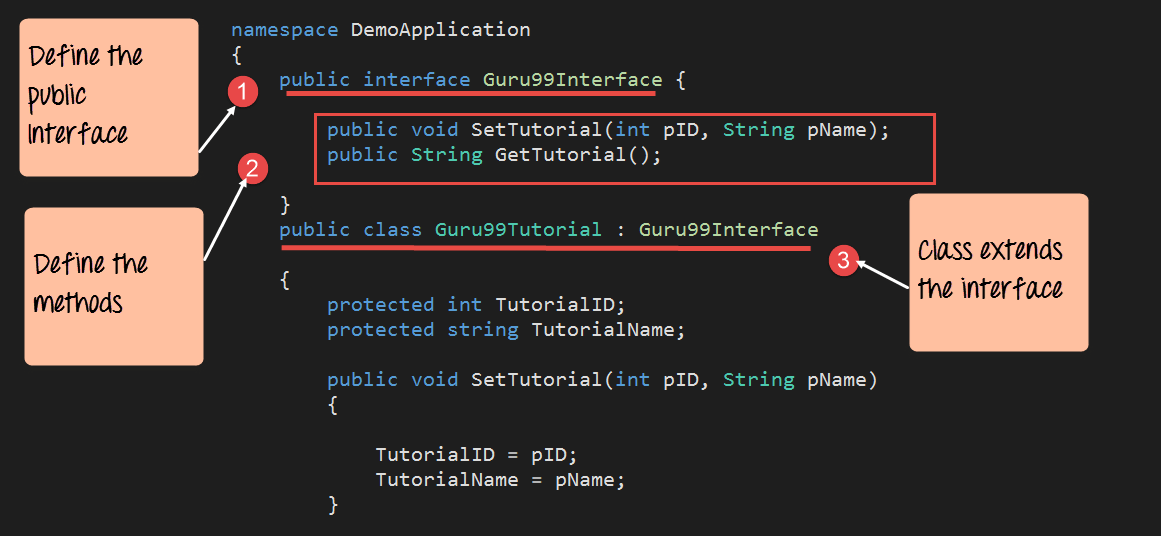
Key takeaways:
- Interfaces are declared with the
interfacekeyword. - They contain only signatures; implementation is provided by the class.
- A class that implements an interface must define all its members, ensuring compliance with the contract.
Why Use Interfaces?
- Abstraction – Separate the “what” from the “how.”
- Polymorphism – Treat different implementations uniformly.
- Testability – Swap real implementations for mocks or stubs in unit tests.
Summary
An interface specifies the operations a type must support. By implementing an interface, a class guarantees adherence to that contract, facilitating clean architecture and scalable design.
C Language
- C++ Operators Explained: Types, Examples, and Sample Programs
- C++ Classes & Objects: A Practical Guide with Code Examples
- C# Abstract Classes: A Practical Tutorial with Code Examples
- C# Serialization & Deserialization: A Practical Example
- Understanding Java Classes and Objects: Clear Concepts, Practical Examples
- Polymorphism in Java: A Comprehensive Guide with Practical Examples
- Java Abstraction: Mastering Abstract Classes, Methods, and Practical Examples
- Java Interfaces Explained: How to Define and Implement Them with Practical Examples
- Interface vs Abstract Class in Java: How to Choose the Right Abstraction
- Master Java Reflection API: A Practical Guide with Code Examples