



Mastering C# Variables & Operators: Practical Examples & Explanations
C# Variables
A variable in C# is a named storage location that holds a value of a specific data type. The data type determines the memory layout and the operations that can be performed on the variable.
For instance, a variable declared as string will store textual data, while an int holds whole numbers. Understanding the type is essential for effective coding and for avoiding runtime errors.
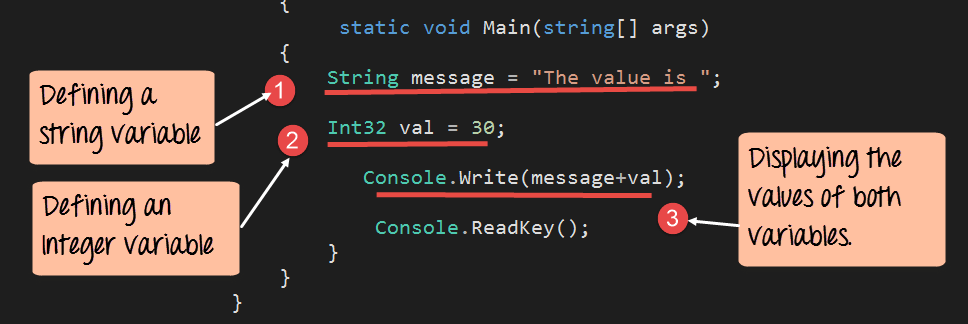
Below is a concise example that declares two variables of different types and displays their values:
using System;

namespace DemoApplication
{
    class Program
    {
        static void Main(string[] args)
        {
            string message = "The value is ";
            int val = 30;

            Console.Write(message + val);
            Console.ReadKey();
        }
    }
}
Code Breakdown
- Declare a
stringvariable namedmessageand assign the text "The value is ". - Declare an
intvariable namedvaland assign the numeric value 30. - Concatenate and output both values to the console.
Running the program produces the following output:
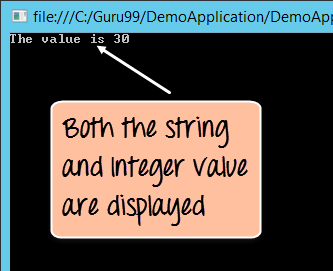
As shown, the string and int values are correctly combined and displayed.
C# Operators
Operators perform operations on variables and values. C# offers a wide range of operators categorized into arithmetic, relational, and logical groups.
Arithmetic Operators
| Operator | Description |
|---|---|
| + | Adds two operands. |
| - | Subtracts the second operand from the first. |
| * | Multiplies both operands. |
| / | Divides the numerator by the denominator. |
| % | Returns the remainder of integer division. |
| ++ | Increments an integer value by one. |
| -- | Decrements an integer value by one. |
Relational Operators
| Operator | Description |
|---|---|
| == | Checks if two operands are equal. |
| != | Checks if two operands are not equal. |
| > | Checks if left operand is greater than right. |
| < | Checks if left operand is less than right. |
| >= | Checks if left operand is greater than or equal to right. |
| <= | Checks if left operand is less than or equal to right. |
Logical Operators
| Operator | Description |
|---|---|
| && | Logical AND – true if both operands are true. |
| || | Logical OR – true if at least one operand is true. |
| ! | Logical NOT – inverts a Boolean value. |
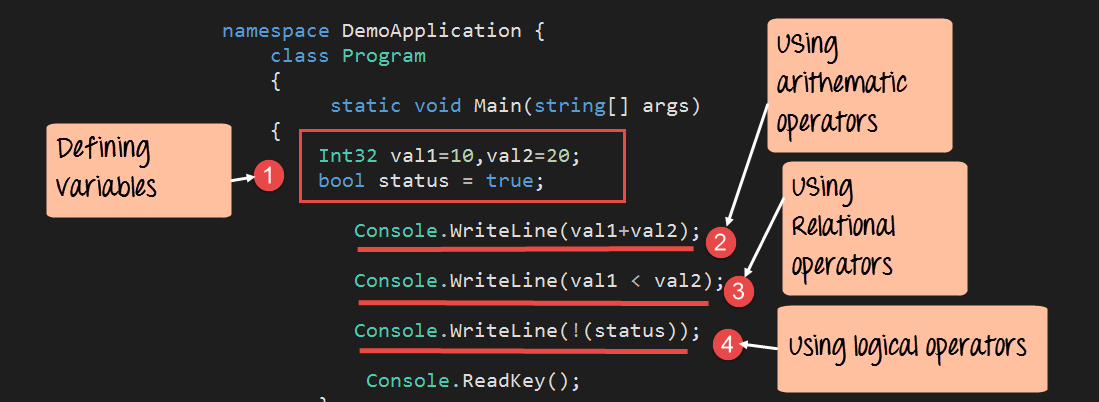
To illustrate operator usage, consider the following sample program:
using System;

namespace DemoApplication
{
    class Program
    {
        static void Main(string[] args)
        {
            int val1 = 10, val2 = 20;
            bool status = true;

            Console.WriteLine(val1 + val2);      // Arithmetic: 30
            Console.WriteLine(val1 < val2);      // Relational: True
            Console.WriteLine(!status);          // Logical NOT: False
            Console.ReadKey();
        }
    }
}
Explanation
- Two
intvariables (val1andval2) and oneboolvariable (status) are declared. - The addition operator (
+) computes the sum ofval1andval2. - The less‑than operator (
<) comparesval1andval2. - The logical NOT operator (
!) inverts thestatusvalue fromtruetofalse.
Executing the program yields:
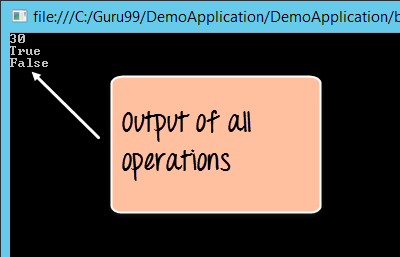
This concise demonstration covers basic arithmetic, relational, and logical operations, laying a solid foundation for more advanced C# programming.
For deeper insight, refer to the official Microsoft Docs on C# Operators.
C Language
- VHDL Variables Explained: Practical Examples & Rules for Reliable Design
- C Variables, Constants, and Literals: A Complete Guide
- Understanding C Storage Classes: Scope, Lifetime, and Performance
- C++ Operators Explained: Types, Examples, and Sample Programs
- C++ Structs Explained with a Practical Example
- Mastering std::list in C++: Syntax, Functions & Practical Examples
- C# Enumerations (Enums) – Definition, Example, and Usage
- C# Hashtable Explained: Key-Value Storage, Operations, and Practical Examples
- Java Variables and Data Types – A Comprehensive Guide with Examples
- Understanding Variables in C: Types, Naming Rules, and Memory Management