



Master Django: Beginner's Guide to Features, Architecture & History
Django Tutorial Summary
This comprehensive guide walks you through Django from the ground up. You’ll discover what Django is, its historical evolution, core features, architectural patterns, essential components, and the pros and cons of using it in production.
What Is a Web Framework?
A web framework is a library that abstracts the common tasks involved in building dynamic, data‑driven websites. It provides reusable components for routing, templating, database access, authentication, and more, enabling developers to focus on application logic rather than boilerplate code.
What Is Django?
Django is a high‑level Python framework that follows the “batteries‑included” philosophy. It equips developers with ready‑made tools for building secure, scalable, and maintainable web applications quickly.
In this tutorial you’ll learn:
- Why choose Django? Key advantages and trade‑offs
- The evolution of Django over time
- Core features that make Django unique
- Architectural patterns: MVC vs. MVT
- Essential Django components and how they work together
- Real‑world companies that rely on Django
- Limitations to keep in mind when selecting Django for a project
Key Advantages of Django
- Rapid setup with a single command
- Built‑in administrative interface for CRUD operations
- Full‑stack support for internationalization and localization
- Scales to handle high traffic loads with proper configuration
- Ideal for content‑rich sites, social networks, and scientific applications
- Integrated testing framework for end‑to‑end validation
- Automatic API documentation with HTML output
- Robust authentication and permission handling via Django REST Framework
- Built‑in rate limiting and throttling for APIs
History of Django
| Year | Milestone |
|---|---|
| 2003 | Project started by Adrian Holovaty and Simon Willison as an internal tool at the Lawrence Journal‑World newspaper |
| July 2005 | Public release as “Django,” named after jazz guitarist Django Reinhardt |
| June 2008 | Creation of the Django Software Foundation (DSF) to steward the project |
| 29 July 2009 | Release of Django 1.1 with aggregates and transaction‑based tests |
| 17 May 2010 | Release of Django 1.2 adding support for multiple databases, email backends, and session improvements |
| 23 Mar 2011 | Version 1.3 introduced class‑based views and static file handling |
| 23 Mar 2012 | Version 1.4 added time zone support and in‑browser testing utilities |
| 26 Feb 2013 | Version 1.5 brought Python 3 support and a configurable user model |
| 6 Nov 2013 | Version 1.6 introduced transaction management and connection pooling |
| 2 Sep 2014 | Version 1.7 added app loading, migrations, and improved configuration |
| 1 Apr 2015 | Native support for multiple template engines |
| 1 Dec 2015 | Version 1.9 added automatic password validation |
| 1 Aug 2016 | Version 1.10 introduced full‑text search for PostgreSQL |
| 4 Apr 2017 | Version 1.11 became the last release supporting Python 2.7 |
| 2 Dec 2017 | Version 2.0 became the first Python 3‑only release |
| 1 Aug 2018 | Version 2.1 added model‑view‑permission support |
| 2021 | Support for Django 3.0 was dropped; Django 3.2 became the new stable version |
Core Features of Django
- Declarative URL routing for clean, readable endpoints
- Built‑in authentication system with password hashing and session management
- Object‑relational mapper (ORM) that abstracts database interactions
- Automatic admin interface for managing database records
- Extensible caching framework with multiple back‑ends
- Internationalization framework for multilingual sites
- Comprehensive security features against CSRF, XSS, SQL injection, and more
Key Characteristics of Django
- Loose coupling: each component can evolve independently
- Less code: rapid development with minimal boilerplate
- DRY (Don’t Repeat Yourself): logic lives in one place
- Fast iteration: built‑in tools speed up the development cycle
- Consistent design: follows a clean, modular architecture
Django Architecture: MVC vs. MVT
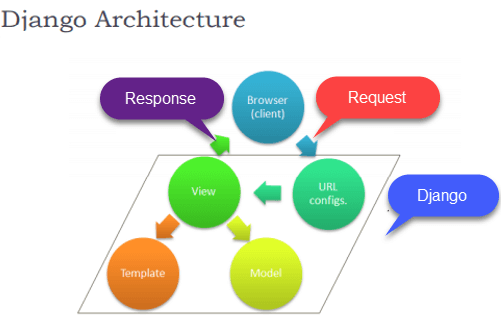
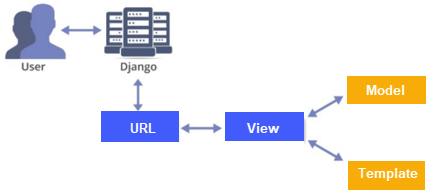
Django follows the Model‑View‑Template (MVT) pattern, which is a variation of the classic Model‑View‑Controller (MVC) architecture. In MVT, Django itself acts as the controller, routing requests to the appropriate view, which then interacts with the model and renders a template.
Understanding MVC
In a traditional MVC setup, the Model handles data, the View presents data, and the Controller manages user input.
Understanding Django’s MVT
The Controller is hidden within Django’s request‑handling framework. The Template is an HTML file mixed with Django Template Language (DTL), and the View is a Python function or class that returns an HTTP response.
Essential Components of Django
Forms
Pythonic form handling that renders HTML, validates input, and converts data to Python types.
Authentication
Built‑in support for user accounts, groups, permissions, and session management.
Admin
Automatic CRUD interface generated from your models, highly customizable.
Internationalization
Tools for translating text, formatting dates, numbers, and handling time zones.
Security
- Cross‑Site Request Forgery (CSRF) protection
- Cross‑Site Scripting (XSS) mitigation
- SQL injection prevention
- Clickjacking defense via X‑Frame‑Options
- Protection against remote code execution
Companies That Use Django
- Bitbucket
- DISQUS
- NASA
- PBS (Public Broadcasting Service)
- Mozilla
- The Washington Post
- NY Times
- LA Times
- The Guardian
- National Geographic
- Discovery Channel
Limitations of Django
- Not inherently asynchronous; concurrent requests are handled via separate processes or workers
- Monolithic design can increase complexity for very large applications
- All components are tightly coupled; moving to microservices requires additional effort
- Requires a good understanding of the framework’s full stack for effective customization
- Some tasks may feel verbose compared to lighter frameworks
Takeaway
- Django is a Python framework that speeds up the creation of robust, database‑driven sites.
- Its history dates back to 2003, and it has evolved through numerous releases.
- Key strengths include an admin interface, ORM, security features, and excellent internationalization.
- Familiar with its MVT architecture and component interactions.
- Major brands such as Instagram, Pinterest, and NASA trust Django for mission‑critical applications.
- Be aware of its synchronous nature and monolithic architecture when planning large‑scale deployments.
Python
- Top 5 Must‑Have Features for Industrial Padlocks: Boost Security & Durability
- The Evolution of SPICE: From CANCER Roots to Modern Circuit Simulation
- Build a Raspberry Pi Obstacle‑Avoiding Robot – A Beginner’s Guide
- CNC Routers for Beginners: Master the Market with Effortless Precision
- Comprehensive .NET and C# Version History Guide
- Master PowerShell: Beginner's Guide to Powerful Scripting
- Master C Programming: Comprehensive PDF Tutorial for Beginners
- Mastering Groovy: A Beginner’s Guide to Scripting on the Java Platform
- Beginner’s Guide to Using a 3D Pen: Easy Steps & Tips
- Essential Servo Motor Guide for Beginners: Learn Basics & Applications