



Run-to-Failure Culture: U.S. Infrastructure Is Collapsing Under Maintenance Debt
Recent high‑profile failures illustrate the cost of neglecting proactive maintenance.
In February, officials evacuated 188,000 residents downstream of California’s Oroville Dam after erosion threatened uncontrolled flooding. The National Parks Service faced scrutiny for its mounting maintenance backlog, and a national audit recently labeled the U.S. infrastructure—from schools to drinking water, energy, and hazardous waste—as “at risk.”
Run-to-Failure Management Earns America a D+ on Infrastructure
Earlier this year, the American Society of Civil Engineers released its 2017 Infrastructure Report Card, rating U.S. infrastructure a D+.
The report, issued quadrennially by a volunteer panel of 28 civil engineers, evaluates eight critical criteria—funding, condition, operations & maintenance, public safety, and resilience—to assign the grade.
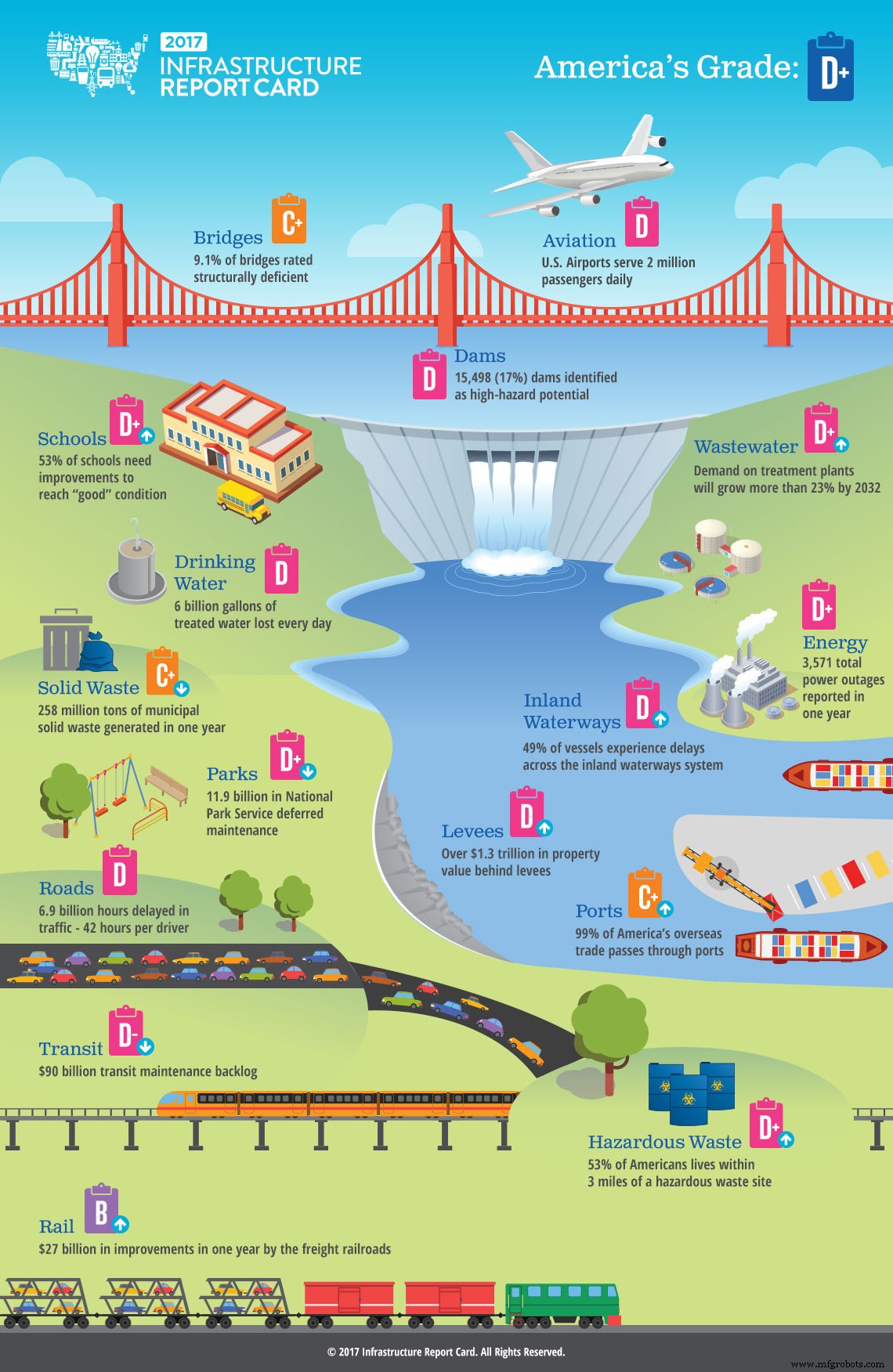
Source: ASCE 2017 Infrastructure Report Card
While the gradual decline may not spark an apocalyptic crisis, its hidden costs are staggering. The ASCE estimates that by 2025 the U.S. will need to invest $4.59 trillion to raise infrastructure to a passing B.
Why does this matter?
Infrastructure failures ripple through every sector. When roads, waterways, ports, and airports deteriorate, shipping times lengthen and costs rise. Businesses and consumers shoulder higher transportation fees, squeezing domestic manufacturers and eroding U.S. competitiveness abroad.
The ASCE’s Failure to Act report projects that if the infrastructure investment gap isn’t addressed by 2025, it could have a significant impact on the nation’s economy, including:
- $4 trillion loss in GDP
- 2.5 million jobs lost by 2025
- $3,400 decline in disposable income per household annually from 2016‑2025
At their core, America’s infrastructure woes are a maintenance issue
The root causes are multifaceted, political, and elusive. How did we arrive here, and why hasn’t a pragmatic approach prevailed?
We’ll examine one key factor: a chronic marginalization of maintenance.
Professionals note that maintenance is routinely viewed as a cost center, sacrificed to tight budgets and schedules. While its value is acknowledged in theory, real‑world implementation lags far behind.
In the essay “Hail the Maintainers,” Andrew Russell and Lee Vinsel—dean at SUNY Polytechnic Institute’s College of Arts & Sciences and assistant professor at Stevens Institute of Technology—trace the origins of this disconnect.
They highlight historical shifts that have primed society to prioritize flashy innovation over the quieter, yet essential, work of maintenance.
Russell and Vinsel argue that relentless focus on new technology sidelines the maintenance of existing, often older, systems that underpin daily life.
They contend that while novel inventions capture attention and profit, the most compelling stories of ingenuity—and care—lie in the everyday stewardship of mature technologies.
Innovation‑First Culture Undermines Maintenance & Asset Management
Modern generations prioritize creating new systems over caring for existing ones, threatening a looming shortage of skilled maintenance professionals.
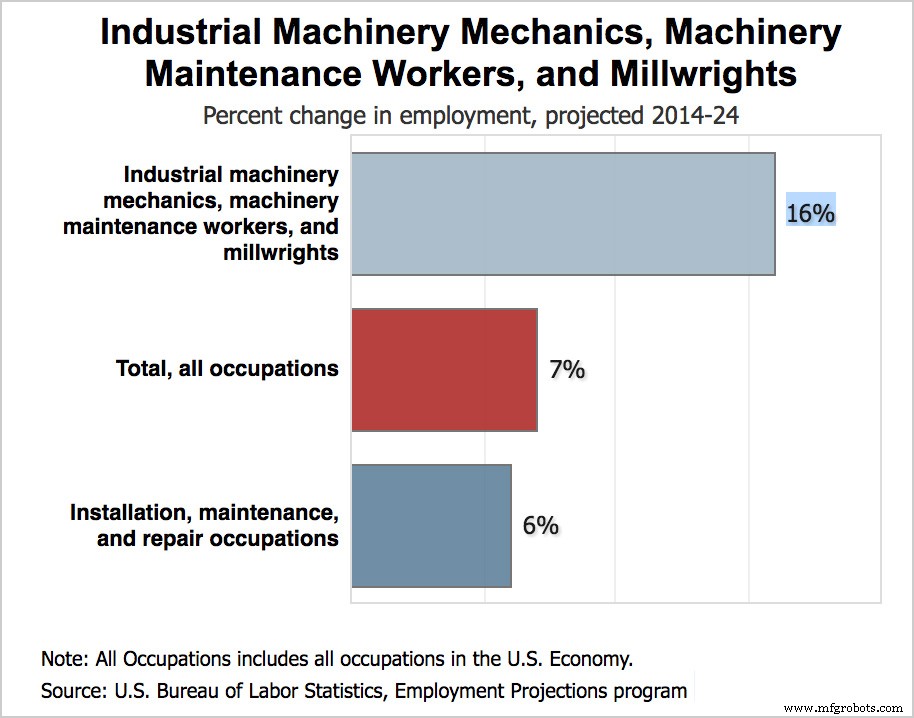
Source: Bureau of Labor Statistics, Occupational Outlook Handbook
Asset‑management experts anticipate a critical skills gap over the next four years. The root cause? The career path of maintenance and asset management remains largely unknown to the public.
Demand for maintenance professionals is accelerating far faster than the average U.S. job market, making this knowledge gap particularly alarming.
The Bureau of Labor Statistics reported 464,400 skilled maintenance positions in 2014—including industrial mechanics, machinery maintenance workers, and millwrights. The sector is projected to grow 16 % through 2024, adding roughly 73,400 jobs. Yet, with declining interest in the field, many of these roles remain vacant.
Another obstacle is the lack of executive awareness. When leadership misinterprets or ignores maintenance, the discipline becomes invisible within the organization.
Misunderstanding & Underfunding Fuel Reactive Maintenance Culture
MarketsandMarkets’ five‑year forecast for the global enterprise asset‑management market reveals that executive ignorance breeds misunderstandings between regulatory mandates, corporate goals, and maintenance operations. When leadership undervalues maintenance, budgets shrink and minor repairs are postponed until crises emerge.
Consequently, both private firms and public infrastructure are trapped in a reactive maintenance cycle, prioritizing immediate fixes over proactive planning. This costly, risky approach is avoidable with the right tools—such as maintenance‑management software and predictive strategies that shift focus from run‑to‑failure to timely intervention.
Yet, the gap between maintenance staff and senior leadership can obscure the clear ROI of these tools. Crafting a compelling business case often falls on overworked technicians, leading to missed investment opportunities and persistent maintenance gaps.
Ignoring Maintenance Will Not Hide the Problem
Wear and tear follows use; the more we rely on a system, the faster it degrades. Despite this obvious principle, underfunded maintenance remains a national crisis.
U.S. infrastructure problems illustrate the damage of undervaluing maintenance. Among ASCE’s 13 recommendations to bridge the investment gap, four explicitly call for increased maintenance funding and prioritization.
At its core, the solution is simple: abandon the ‘fix it when it breaks’ mindset and embrace preventive maintenance as a strategic asset.
Want more from Fiix? Read our article on the state of American manufacturing.
Equipment Maintenance and Repair
- How Industrial Maintenance Has Evolved: From Reactive to Predictive
- Your Comprehensive Predictive Maintenance Checklist: Boost Efficiency, Cut Downtime & Drive ROI
- Biomanufacturing: Harnessing Nature to Revolutionize Modern Manufacturing
- How Predictive Maintenance Drives Efficiency and Cuts Downtime
- The Evolution of Maintenance Practice: From Reactive Fixes to Proactive, Risk‑Based Strategies
- Optimizing Maintenance: Cost‑Effective Predictive Strategies for Manufacturing Leaders
- What Maintenance & Reliability Leaders Are Prioritizing Right Now
- How Maintenance KPIs Drive Asset Reliability and Business Value
- Unlocking Reliability: How Condition‑Based Maintenance Drives Predictive Success
- Mastering Proactive Maintenance: Elevate Reliability and Reduce Downtime