



Energizer Battery Plant: Integrating Lean and Reliability to Drive Efficiency and Performance
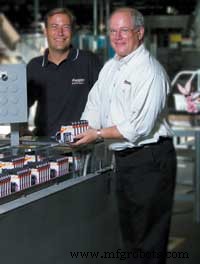
Global lean enterprise director Steve Hockridge (left) and lean coordinator Dana Billings demonstrate the tangible gains of unifying lean and reliability.
Manufacturing firms typically fall into one of three lean adoption categories:
Those that use the term purely for marketing, with lean referenced only in annual reports and investor communications.
Those that implement superficial changes—creating a few U‑shaped cells, repainting walls, and removing a handful of items—then declare victory.
Those that embed lean into their core operations and culture.
According to a recent QAD Inc. survey, 80% of companies report having a lean initiative, yet only 1% can demonstrate documented lean practices. The gap highlights a need for deeper, measurable implementation that translates into real performance gains.
Integrating reliability into a lean transformation elevates the entire value chain. Strong, dependable machinery underpins flow, flexibility, and the ability to reduce inventory, throughput time, and defects while boosting uptime and productivity.
Energizer, the world’s largest battery manufacturer, exemplifies the 1% of firms that execute lean correctly. Within a short period, it has achieved remarkable results by aligning people, processes, and production around a shared reliability objective.
"We set ambitious lean goals, but without reliable equipment those goals are unattainable," says Steve Hockridge, Energizer’s Global Lean Enterprise Director. "You cannot improve labor productivity, reduce lead times, or shrink inventory if equipment reliability forces you to carry safety stock."
Joe Tisone, Vice President of Global Operations, echoes this sentiment. "Speed and flexibility hinge on reliability. If a machine fails, the entire flow collapses. Our lean strategy is therefore a holistic business strategy, not a siloed initiative."
This article outlines the lean techniques Energizer’s Maryville, MO, plant uses to maintain mechanical reliability and outlines how these practices have made the facility a benchmark for flexibility, creativity, and teamwork.
MARYVILLE ROOTS
Unlike some companies that adopt lean after a crisis, Energizer’s journey began with a proactive vision. Founded in 1886, the company spun off from Ralston Purina in the early 2000s, and its revenues, profitability, and market share continued to grow. Nevertheless, Energizer never settled into complacency.
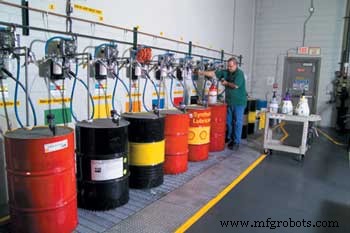
Predictive maintenance analyst Clyde Henry transforms the plant’s oil drum storage into a clean, color‑coded lubricant hub.
"If you don’t evolve, you’ll be left behind," says Tisone. Key customers—Wal‑Mart, Target, and others—demand continuous improvement, while domestic and Asian competitors intensify market pressure.
Maryville’s plants, built in the early 1970s, began showing age‑related wear. Downtime and reactive maintenance surged, prompting a shift from large batch, scale‑efficient production to lean‑driven, flexible operations.
"Traditional methods served us in the past, but the market demands a new approach," notes Hockridge. "We must adapt to remain competitive."
Energizer’s lean journey, coupled with a focus on machinery reliability, started in Maryville and extended across the Pacific to other global sites.
Assistant Plant Manager Dana Billings first discovered lean through Toyota‑style 5‑S workplace organization. He then disseminated best practices to senior leaders, including Joe Tisone, who subsequently championed lean throughout Energizer’s 22 plants worldwide.
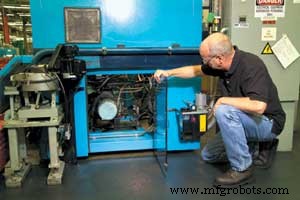
Modern nail machines feature transparent doors, interior lighting, and external lubrication systems.
Billings described the culture shift: "Lean moves from surface tweaks to a deep, company‑wide strategy that yields broad, lasting benefits."
THREE LITTLE LETTERS
Reliability was integrated early through the Autonomous Care Workshop (ACW) initiative. ACW blends Kaizen, Reliability‑Centered Maintenance, technical training, root‑cause analysis, and Total Productive Maintenance.
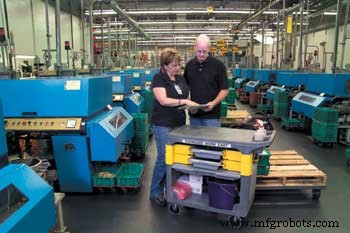
Operator Vicki Cady and mechanic Steve Piveral collaborate on preventive maintenance in the nail production area.
During a week‑long ACW event, mechanics and operators jointly develop a reliability plan for equipment, share insights, identify defects, troubleshoot root causes, and craft preventive maintenance (PM) strategies. The result is a shared ownership model where operators actively participate in equipment care.
“Previously, maintenance and production operated in silos,” says Global Maintenance Manager Joe Plagens. “ACW has forged a partnership that turns operators into proactive guardians of their machinery.”
The program has shifted the plant from reactive to planned maintenance. Planned maintenance now represents 60% of work orders—up from 20% four years ago—while unplanned work costs four times as much.
Mechanic Steve Piveral illustrates the impact: “I now spend 10 minutes on each machine for technical tasks, compared to 30 hours of PM work last year. The time saved allows me to complete critical tasks that were previously impossible.”
KEEP IT SIMPLE
Maryville’s engineering team has embraced simplicity. Complex machines with 15+ functions are replaced by streamlined processes that eliminate waste and reduce reliability risks.
“We’re learning to separate value‑added steps from non‑value‑added,” says Hockridge. “By removing redundant equipment, we simplify the process, improve quality, and enhance reliability.”
Several projects have removed more than 30 pieces of equipment each, reducing complexity and the number of PM tasks.
“You can’t simply apply reliability tools without lean, and vice versa,” cautions Hockridge. “Integrating both disciplines is essential for true operational excellence.”
KITS, KAIZEN, AND SMALL‑K
To cut waiting and motion, the plant adopted kitting: a mechanic receives all required tools and parts in one kit, eliminating back‑and‑forth trips.
“Kitting has doubled our wrench time in the past three years,” says Plagens.
Energizer has also executed more than 800 week‑long Kaizen events, generating over $10 million in cost savings, and its Indonesia plant now documents 500 small‑kaizen activities monthly.
VISIBLY CREATIVE
Lean initiatives unlock frontline creativity. Operators now feel empowered to propose solutions that enhance reliability and reduce waste.
“Creativity was once hidden in our traditional approach,” says Billings. “Now, staff confidently tackle recurring problems and devise practical fixes.”
One notable improvement involved the oil drum repository. Predictive analyst Clyde Henry redesigned the storage into a color‑coded, filtered lubricant center, eliminating contamination and excess inventory.
“We filter oil to 3 microns and color‑code containers and components,” Henry explains. “This ensures that each machine receives 100% clean oil.”
Visibility tools—inspection points, labels, gauges, and tags—further enhance communication between mechanics and operators.
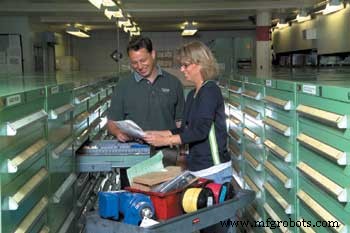
Global maintenance manager Joe Plagens and tool crib attendant Deb Hayes evaluate a kitting project.
In the nail production area, transparent Plexiglas doors, internal lighting, absorbent sheets, and external lubrication systems replaced opaque, labor‑intensive setups, enabling rapid maintenance without shutdowns.
“We experiment and learn,” says Piveral. “Even if an idea fails, we gain insights that guide future improvements.”
A TRUE 1 PERCENTER
Energizer’s commitment to lean and reliability has transformed its workforce. The number of mechanics engaged in reactive firefighting has dropped, while those focused on planned, predictive, and preventive work have risen.
“Our resources are now used more efficiently and in a lean manner,” says Staley.
“Looking back three years, the ownership culture and process improvements have changed dramatically,” adds Tisone. “Lean is an ongoing journey, not a destination.”
Like the Energizer battery bunny, the plant continues to evolve, drive, and excel.
Equipment Maintenance and Repair
- Celebrating Excellence: Reliable Plant’s First‑Year Awards and Milestones
- 2024 Lubed, Reliable & Lean Conference – Elevate Manufacturing Excellence in Columbus, OH
- Marinette Plant Sets New Standards for Reliability and OEE Excellence
- Alcoa Warrick Power Plant: From Reliability Crisis to $440M Capital Success
- Worthington Industries: Zero Injuries, Zero Harm – The Delta Plant’s Safety Excellence
- Why Plant Reliability Is the Foundation for Lean Manufacturing Success
- Kauai’s Wainiha Hydropower Plant Boosts Efficiency & Reliability with GE Digital Controls
- GE Deploys Advanced Mark VIe Control System at Saudi Electricity Company's 2,000‑MW PP10 Power Plant
- GE’s Wireless Vibration Sensors Boost Reliability at NV Energy’s Ft. Churchill Plant
- Optimized Power Solutions for Arduino Projects