



Mastering Work Order Design: Boost Preventive Maintenance, Data Accuracy, and Operational Reliability
Read the full work order academy series, including toolkits for better maintenance schedules, defeating backlog, using work order data, and more
How a bad work order can wreak havoc
A few words can make or break a maintenance team. Work orders are proof of that.
“In the past, bad decisions were made because we didn’t have accurate work order information,” said Tim Davison, Asset CARE planner for MillerCoors, in this case study by Reliable Plant.
A failure‑prone fan at a MillerCoors site is proof of this. The fan failed three times in 18 months. A vibration analysis had found anomalies a month before the third failure, but maintenance wasn’t scheduled or prioritized before the fan failed.
The lesson: Work orders weren’t set up properly, causing important maintenance to be missed.
If this can happen to one of the world’s biggest brewers, it can happen to anyone. That’s why this article is going back to basics and exploring strategies for creating world‑class work orders. It will provide the building blocks for great work order processes, from start to finish.
Five key strategies for managing maintenance work orders
Just like every asset at your company, your work orders need standard operating procedures. SOPs give you a baseline for creating, reviewing, and optimizing every job you do.
#1: Deciding on goals and measurements for your work orders
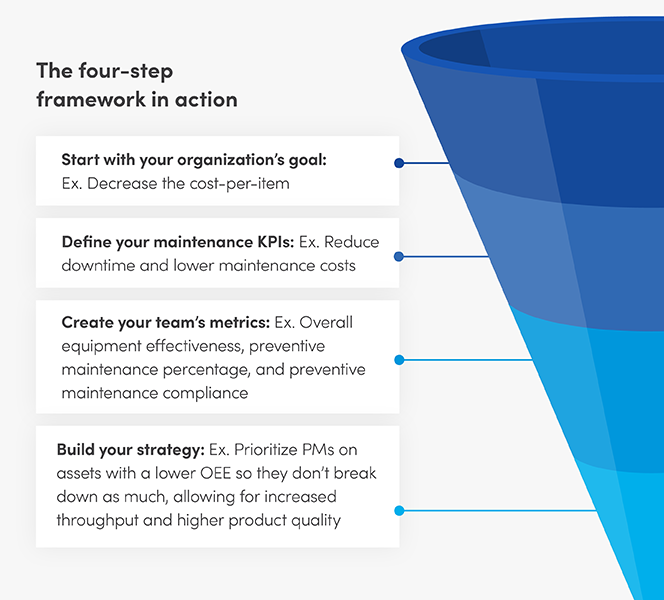
It’s important to know what information you want from a work order when you set them up. Work order and maintenance metrics deserve their own article entirely, but the chart below will give you a good framework to start from.
Start connecting maintenance goals to business goals with this free goal‑setting template
#2: Define roles and responsibilities
Create clearly defined roles and responsibilities for each part of the work order process. Outline who can create, assign, prioritize, complete, and review work orders. This will help you avoid duplicate or unauthorized work and miscommunication.
#3: Decide on your work order frequencies
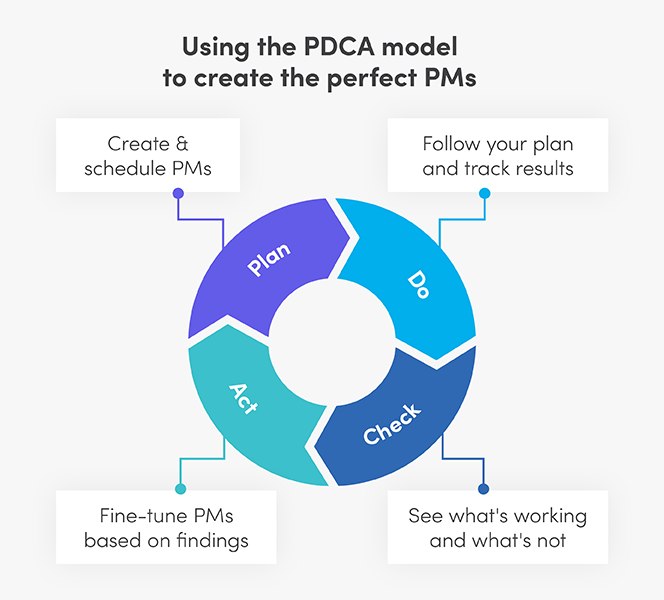
OEMs and the knowledge of veteran staff usually decide the frequency of scheduled maintenance. This can give you a good baseline, but it’s not an exact science. Decide how often to review frequencies so you can spot work you’re doing too often or not often enough.
Learn all about optimizing your maintenance schedule
#4: Build work orders triggers
Outline how work orders can be triggered at your operation. This includes triggers that create the initial work request as well as follow‑ups for failed PMs, compliance documentation, or extra work that needs to be done on the asset.

#5: Conduct work order post‑mortems
Big projects and big problems deserve hindsight. Create a plan to find what went right and what went wrong on these major jobs. Then apply your learnings to the work order process.
Get to the bottom of failures and fix them quickly with this RCA template
How to create work orders in nine steps
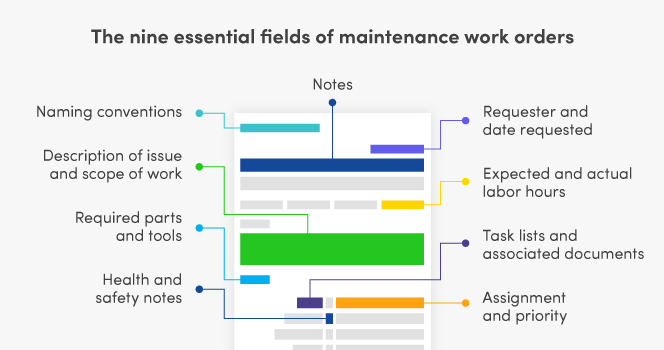
Creating and optimizing work orders means reviewing, tweaking, and optimizing thousands of fields. Pro tip: Start small. Pick one field, review one group of work orders with it, and apply improvements to them as needed. Then move on to the next group.
- Naming conventions: Define clear, consistent labels that identify the maintenance type, work order, and asset. Effective conventions combine consistency, clarity, and meaning.
- Issue description and scope: Provide precise details. Rather than a generic “leak,” specify severity, location, and required skills, personnel, contractors, and permits.
- Parts and tools: Include information that aids technicians in locating components and applying best practices. Build emergency kits for critical assets to ensure rapid response.
- Health & safety: List required PPE and highlight common hazards, procedures, and any compliance obligations with follow‑up actions.
- Requester & date: Track who initiated the request and when to assess workload distribution and potential bottlenecks.
- Labor hours: Record estimated hours per task and compare with actuals to identify inefficiencies and refine scheduling.
- Task details & attachments: Replace generic tasks with specific actions, quantities, and attach relevant manuals, SOPs, or other resources.
- Assignment & priority: Align priority levels with maintenance type and ensure clarity across the team.
- Notes: Capture insights from seasoned technicians to standardize recurring issues and make knowledge readily available.
Learn how to use work orders to boost health and safety
Build the perfect work order with this free work order template

How to make maintenance work orders that give you better data
Completed work orders are the cornerstone of process optimization. Standardizing fields—such as labor hours and parts used—ensures you capture the data you need. Additional sections must also be refined to yield actionable insights.
- Failure codes: Restrict the list to the most frequent codes, preventing technicians from defaulting to “other” when pressed for time.
- Completion notes: Provide clear prompts to standardize technician reporting, such as questioning task duration and root causes.
- Costs: Offer a concise template for recording additional resources, simplifying both data entry and cost analysis.
- Follow‑up actions: Define appropriate next steps for frequent scenarios—e.g., a fault discovered during a PM—to streamline technician workflow and enhance compliance tracking.
Everything you just read in three sentences
- Begin by refining the most frequent or high‑criticality work orders.
- Consistency underpins reliable habits, scalable success, and clean data; ensure all templates and follow‑up guidelines are airtight.
- Balance clarity with brevity so technicians receive all necessary information without feeling overwhelmed.
See Part III: Best practices for scheduling and prioritizing work orders
Equipment Maintenance and Repair
- Eight‑Step Blueprint for a Robust Preventive Maintenance Program
- Transforming Preventive Maintenance: Proven Tactics for Reliable Asset Management
- U.S. Army Advances Condition‑Based Maintenance with Innovative Sensors and Predictive Analytics
- Deming & Drucker: A Proven Framework for Effective Maintenance Planning & Scheduling
- Leveraging Work Order Data: A Proven Path to Maintenance Excellence
- Mastering Work Order Design: Boost Preventive Maintenance, Data Accuracy, and Operational Reliability
- Mastering Maintenance Work Orders: A Complete Guide
- Maximizing Asset Reliability with Advanced Maintenance Work Order Software
- Six Proven Strategies for Smarter Maintenance Decisions
- Mastering Preventive Maintenance: A Step-by-Step Guide to Scheduling Work Orders