



Leveraging Work Order Data: A Proven Path to Maintenance Excellence
Explore the full Work Order Academy series, featuring toolkits that help you build superior work orders, optimize maintenance schedules, eliminate backlog, and more
A Tale of Lost and Found Work Order Data
No Data Means Working in the Dark
The maintenance team at Voltalia faced a daunting challenge: they closed more than 104,000 work orders annually without a single data point to reference. Without insights into preventative maintenance (PM) outcomes, labor allocation, or parts usage, the company could not determine whether its maintenance activities were preventing failures or merely reacting to them.
Vasco Vieira, Voltalia’s Maintenance Engineering Director, notes that the organization’s goal was a “100 % improvement in measuring maintenance KPIs.” The breakthrough came when the team implemented a data‑centric approach that revealed key inefficiencies—such as one crew spending 40 hours weekly commuting to an off‑site facility. The solution was a strategically located satellite office, which cut travel time and costs.
The Moral of the Story
Work order data can transform maintenance operations, turning incremental wins—easier jobs for technicians—into larger gains like reduced overall costs. Yet the sheer volume of work orders often leads to data being overlooked. This article outlines best practices for extracting actionable insights from thousands of work orders, enabling organizations to make informed, data‑driven decisions.
How to Obtain Reliable Maintenance Data from Work Orders
Unreliable or nonexistent data is the most common barrier to effective work order analysis. “Before you do anything with work order data, you need to know that it’s there and clean. If not, all the decisions you make afterward will be flawed,” says Vishakha Shah, Solutions Consultant, Fiix.
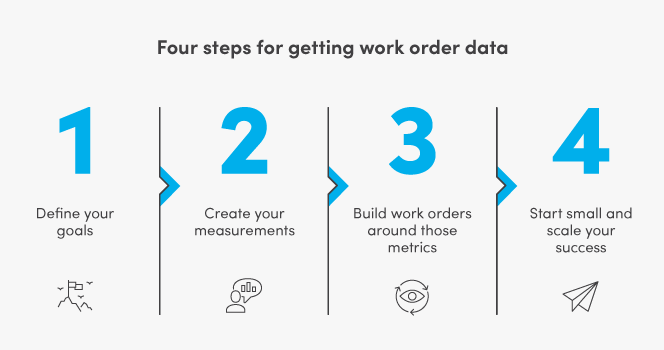
The foundation for success involves a four‑step process:
#1: Define Your Goals
Clear objectives filter useful data from noise. Typical goals include:
- Developing a world‑class preventive maintenance program
- Implementing a lean maintenance strategy
- Leveraging maintenance to increase overall throughput
#2: Create Your Measurements
Identify metrics that track progress toward your objectives. Common measurements derived from work orders are:
- Percentage of reactive versus preventive work orders
- Number of faults identified during PMs
- Frequency of reactive work on critical assets
- Expected versus actual labor hours
- Size of the backlogged work order queue
#3: Build Work Orders Around Those Metrics
Design work orders to capture the data you need, keeping the three Ss in mind:
- Standard: Consistent fields and processes for creating, reviewing, assigning, prioritizing, and completing orders.
- Specific: Detailed requests—e.g., record time per task rather than total time—to generate clean, actionable data.
- Simple: Involve frontline staff in the design to ensure the forms are intuitive and likely to be filled out correctly.
Learn how to build world‑class work orders from start to finish
#4: Start Small and Scale Your Success
Pilot the approach on a single asset or facility area to capture quick wins, refine metrics, and then expand across the organization.
Using Work Order Data to Identify and Resolve Issues
Collecting data is only valuable if it drives problem resolution. Three common challenges—unplanned downtime, delayed critical work, and over‑resource consumption—can be tackled with data‑driven insights.
Preventing Equipment Downtime
Ask these questions to uncover root causes of reactive maintenance:
- Did a follow‑up task fail to be created or completed? Ensure inspections trigger high‑priority follow‑ups and alerts.
- Was a defective part used? Verify spares quality and follow up with vendors.
- Were previous tasks missed or performed incorrectly? Review task lists for clarity and attach relevant diagrams or manuals.
- Was scheduled maintenance missed? Highlight critical work and make it visible until completion.
- Did production changes influence maintenance? Adjust schedules and SOPs in collaboration with operations.
Stopping Work From Being Delayed
Identify delays through data analysis:
- Parts shortages—refine purchasing processes and set minimum order quantities.
- Incomplete problem identification—improve descriptions, failure codes, and task lists.
- Emergency work orders diverting resources—consider breaking large jobs into smaller, prioritizable tasks.
- Scheduling conflicts with production—engage operators in minor maintenance responsibilities.
- Incorrect skill assignment—specify required certifications in the work request.
Reducing Over‑Time on Work Orders
Data reveals why tasks run longer than planned:
- Wrong personnel assignment—standardize requests to match skill sets.
- Underestimated completion times—adjust expected labor hours based on historical data.
- Complex or unclear task lists—document step‑by‑step procedures and assign expected hours per task.
- Insufficient technicians—allocate adequate staffing levels.
- Unexpected additional work—encourage separate work orders for corrective actions.
- Hard‑to‑find parts—bundle common supplies for quick access.
Learn how to weed out all the inefficiencies in your maintenance schedule
Scaling Your Success with Work Order Data
When analyzing hundreds or thousands of orders, consider:
- Prioritize work orders that matter most.
- Allocate more analysts.
- Invest in a dedicated analytics system.
Prioritizing Work Orders
Focus first on reactive work orders to understand failure contributors. Next, target high‑risk or high‑cost jobs—those involving critical assets, long downtimes, or extensive labor.
Justifying More Resources
Use tangible results—such as the number of failures prevented or cost savings achieved—to build a business case for additional staff. Quantify ripple effects: if one labor hour is saved per order, multiply across the portfolio.
Software for Work Order Analytics
Fiix Foresight’s Work Order Insights can process thousands of orders in minutes, identifying the work that causes breakdowns, overdue tasks, or extra labor. The insights report highlights outliers—such as a PM with half the expected task count—allowing you to correct schedules before critical failures occur.
Discover more about the report’s capabilities here.
Key Takeaways in Three Sentences
- Effective work order data strategy starts with clear goals, relevant metrics, standardized orders, and pilot testing.
- Analyzing delayed or prolonged orders reveals areas for process refinement and prevents future incidents.
- Scaling success involves prioritizing work orders, quantifying ROI to justify resources, and adopting specialized analytics tools.
Equipment Maintenance and Repair
- Drywall Anchors Explained: How They Work & When to Use Them
- 12 Essential Maintenance Templates to Streamline Operations and Reduce Admin Burden
- Master Work Order Planning & Scheduling: Proven Strategies of Top Maintenance Teams
- Mastering Work Order Design: Boost Preventive Maintenance, Data Accuracy, and Operational Reliability
- Mastering Maintenance Work Orders: A Complete Guide
- Maximizing Asset Reliability with Advanced Maintenance Work Order Software
- Creating Effective Maintenance Work Orders: A Complete Guide
- Streamline & Automate Maintenance: Proven Strategies for Reliable Operations
- Mastering Preventive Maintenance: A Step-by-Step Guide to Scheduling Work Orders
- Understanding Work Orders: Essentials and Best Practices for Operations Management