



How Precise Belt Alignment Boosts Performance and Longevity
Introduction
Misalignment is a leading cause of premature belt failure. Even minor deviations can erode belt performance by increasing wear, fatigue, and noise, ultimately shortening the service life or causing sudden breakdowns. Understanding the types of misalignment, how to measure them, and the acceptable limits is essential for maintenance teams seeking to keep drives running reliably.
Types of Alignment
Both angular and parallel misalignment reduce the expected life of a belt drive, but they manifest differently and have distinct effects on V‑belts and synchronous belts.
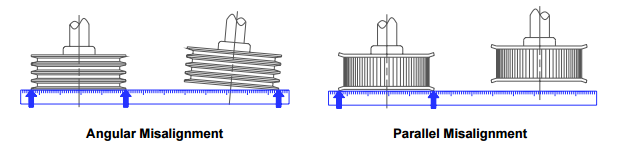
Angular misalignment leads to accelerated belt and sheave wear, uneven load sharing across multiple belts, and in some cases, tie‑band separation in joined V‑belts. Gates’ Power Transmission Product Application engineers note that angular misalignment severely impacts synchronous belt performance. Symptoms include high belt tracking forces, uneven tooth wear, edge wear, increased noise, and potential tensile failure.
Parallel misalignment also hastens wear but is typically less critical for synchronous belts, provided the belt is not pinched between flanges. V‑belts, which run in fixed grooves, are more sensitive to parallel offsets because they cannot self‑float like synchronous belts.
Synchronous sprockets are designed with face widths larger than the belt width to absorb small mounting offsets. As long as the belt is not trapped and tracks fully on both sprockets, parallel misalignment is usually not a concern. The belt naturally aligns itself when the distance between opposite flanges exceeds the belt width.
Measuring Misalignment
Laser alignment devices are the gold standard for precision, but a straightedge (long level, extruded aluminum strip, or ruler) can serve as a reliable alternative when a laser is unavailable. The tool projects the orientation of one sheave or sprocket face relative to the other.
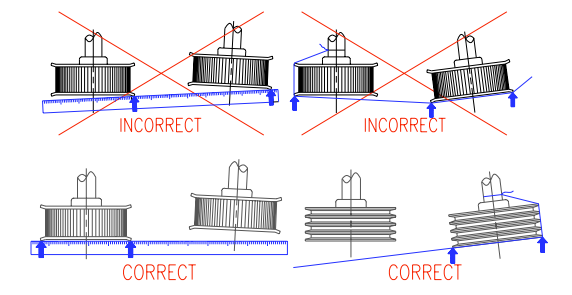
Before measuring parallel misalignment, confirm that both sheaves or sprockets have equal flange thickness, or record any difference. Align the grooves or faces directly rather than the outer flanges. Inspect flanges for true running; a bent flange can skew measurements.
Once measured, compare the quantified misalignment to the belt manufacturer’s recommended limits found in drive design manuals.
Quantifying Misalignment
Using a straightedge, angular misalignment is the difference in clearance between the straightedge and the outer surface of the second sheave or sprocket across the diameter. Parallel misalignment is the clearance difference across the separation distance.
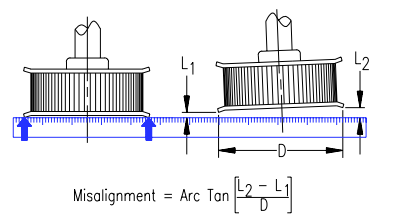
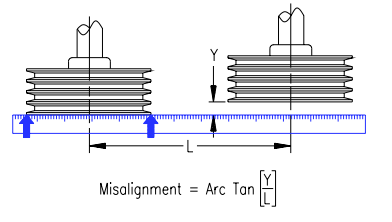
The industry standard allows a maximum of ½‑degree for V‑belts. While some V‑belts can tolerate more, keeping the misalignment within ½‑degree maximizes longevity. Synchronous, urethane 60‑degree (Polyflex), and poly‑V (Micro‑V) belts accept only ¼‑degree. For V‑type systems, sum the angular and parallel values and compare to the manufacturer’s tolerance.
Because synchronous belts are prone to being pinched, ensure clearances between belt edges and flanges. If such clearance exists, parallel misalignment does not need to be added to the angular component.
Rules of Thumb
Visual estimates can expedite checks:
- V‑belt drives: ½‑degree ≈ 1/10" per foot of travel.
- Synchronous, 60‑degree, and V‑ribbed drives: ¼‑degree ≈ 1/16" per foot.
For example, a 12" diameter sprocket should not show more than a 1/16" difference between the straightedge and the outer surface. A 6" sprocket allows no more than 1/32". Exceeding these thresholds warrants realignment.
Conclusion
Misalignment can undermine belt performance, especially in complex systems. Technicians should also inspect brackets and platforms for adequate rigidity to resist peak forces. By maintaining alignment within specified limits, operators can reduce noise, prevent premature wear, and extend belt life.
Read the original article here.
At J/E, we are an authorized Gates distributor, offering belts, hoses, and sprockets. info@je-bearing.com or visit our contact page for inquiries.
Equipment Maintenance and Repair
- 5 Proven Ways Maintenance Teams Can Boost Production Efficiency
- Boost Uptime with Expert Belt Drive Maintenance
- Expert Insights on Common Mistakes in Selecting Power Transmission Belts
- Optimizing MRO Inventory Drives Profitability for Utilities
- How Targeted Training Drives Reliability and Profitability
- How Precise Belt Alignment Boosts Performance and Longevity
- Boost HVAC Efficiency: Replace V‑Belts with Synchronous Belts for Lower Energy Use
- Do Drive Chains Truly Need Lubrication? Inside Modern Lube‑Free Technologies
- Ensuring Peak Performance: The Critical Role of Precise Alignment in Rotating Equipment
- Boost Pump Efficiency: Proven Strategies to Reduce Energy Costs and Improve Performance