



Understanding a Powertrain: How It Powers Your Vehicle
A vehicle’s movement relies on several interconnected components that together transfer energy from the engine to the wheels.
A high‑quality powertrain is essential for achieving proper acceleration and overall vehicle performance.
How Does a Powertrain Work?
The powertrain is a cohesive system that converts the engine’s energy into motion, delivering it to the wheels. While “drivetrain” is often used interchangeably, it specifically refers to all powertrain components except the engine.
The major powertrain components include:
- Engine: Generates the power required to propel the vehicle. Pistons move within cylinders to initiate combustion.
- Transmission: Transforms the engine’s rotational output into usable torque through a series of gears and clutches, adjusting power for varying driving conditions.
- Driveshaft: Conveys the torque from the transmission to the differential.
- Differential: Found in the front or rear axle assembly, it splits torque between wheels, allowing them to rotate at different speeds during turns.
- Axles: Support vehicle weight and transmit power from the differential to the wheels.
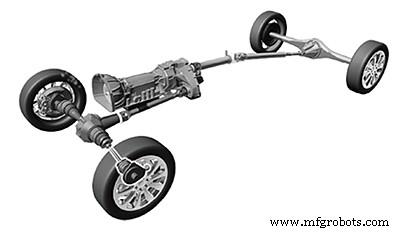
Types of Drivetrains
The drivetrain—the subset of the powertrain that includes the driveshaft, transmission, differential, and axles—comes in four primary configurations.
Front‑Wheel Drive
In a FWD vehicle, the engine sits transversely (horizontally), placing the entire drivetrain over the front axle. This placement enhances traction and acceleration while improving fuel efficiency.
Rear‑Wheel Drive
RWD channels power from a longitudinally mounted engine, through a driveshaft, to the rear differential and wheels. RWD offers lighter front‑end weight, sharper handling, and is favored in sports and luxury models.
All‑Wheel Drive
AWD systems typically split power between front and rear axles, often via a center differential. AWD provides superior traction in variable conditions and can operate semi‑automatically, adjusting torque distribution as needed.
Four‑Wheel Drive
4WD delivers power to all four wheels, usually via a transfer case and low‑range gearing, making it ideal for off‑road use. 4WD systems are built for durability and robust torque distribution.
FWD and AWD offer excellent traction on challenging roads, but their handling on normal roads may not match that of RWD or 4WD.
Signs Your Powertrain May Be Worn
Regular maintenance is key. When powertrain components deteriorate, you’ll notice specific warning signs:
- Shaking or grinding: Unusual vibrations or grinding noises may indicate transmission trouble.
- Burning smells: A burning odor often points to overheated fluids or component failure.
- Gears slipping: If the vehicle slips out of gear, it could signal issues with the PCM/ECM or mechanical wear.
- Leaking fluid: Red or other colored fluid pooling under the vehicle suggests a leak in a gasket, hose, or component.
A check‑engine light is a clear indicator that a diagnostic scan is required.
Train on Powertrain Components at UTI
With auto technician jobs projected to exceed 705,000 by 2030, gaining expertise in powertrain systems positions you for high‑demand roles.47
UTI’s 51‑week Automotive Technology program equips students with hands‑on experience across all vehicle systems, including powertrains and transmissions.
Interested in a career that powers the future? Click here to connect with an Admissions Representative today and start building the skills that set you apart.
Industrial equipment
- Understanding the Oxygen (O2) Sensor: Role, Placement, and Failure Signs
- Engine Braking Explained: How It Works and Why It Matters
- Understanding the Alternator: How It Powers Your Car and Signs of Failure
- Why Metal Shavings in Engine Oil Occur – Causes, Symptoms, and Prevention
- Understanding Car Engine Coolant: Purpose, Types, and Maintenance
- Understanding Chassis Ground: Purpose, Function, and Importance
- Engine Pulley Explained: Functions, Types, and Maintenance
- What Is a Gudgeon Pin? The Essential Wrist Pin in Engine Design
- Powertrain vs. Drivetrain: What They Are and Why It Matters
- Engine Lathes Explained: History, Features, and How They Differ from Standard Lathes