



Understanding Direct Injection Engines: How GDI Drives Fuel Efficiency and Power
The engine is the heart of any vehicle, and its design directly influences performance, fuel economy, and emissions. Among the many engine configurations available, gasoline direct injection (GDI) has emerged as a leading technology, especially as automakers push for stricter fuel‑efficiency standards.
What Is Gasoline Direct Injection?
GDI is a fuel‑delivery method that injects high‑pressure gasoline straight into each cylinder, bypassing the intake manifold. Traditional port or throttle‑body systems mix fuel with air in the intake tract before the mixture reaches the cylinder. By delivering fuel directly into the combustion chamber, GDI allows for finer atomization, improved combustion, and the use of higher compression ratios.
How Direct Injection Works
Direct injection engines employ a dual‑pump system: a low‑pressure pump draws fuel from the tank, and a high‑pressure pump, driven by the camshaft, boosts the pressure to roughly 2,500 psi. This pressurized fuel travels through a dedicated rail and is injected into the cylinder by a precision injector. The high pressure must overcome the cylinder’s own pressure, ensuring a consistent and atomized spray regardless of engine speed.
Physically, GDI engines differ from port‑injected ones by adding an extra inlet for the injector and a high‑pressure fuel rail. They also include relief valves that safeguard the system if a fault occurs.
Advantages of Direct Injection
- Improved cold‑start performance
- Higher fuel economy and lower emissions from superior atomization
- Compatibility with E85 flex fuel, offering high ethanol blends
- Reduced turbo lag on turbocharged engines
- Fuel acts as a coolant, enabling higher compression ratios
Disadvantages of Direct Injection
- Dirtier intake valves because fuel no longer lubricates them
- Limited fuel flow for high‑performance tuning
- Design optimized for pressure rather than volume
- Potential loss of power and efficiency at very high RPMs
- More complex systems increase repair cost and difficulty
Direct Injection Modes
Manufacturers use two primary injection strategies to guide fuel toward the spark plug:
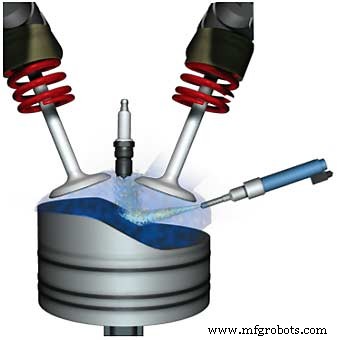
- Wall‑guided: The injector sits between the intake valves and a specially shaped piston dome directs the spray toward the spark plug. The piston further pushes the mixture along the combustion chamber.
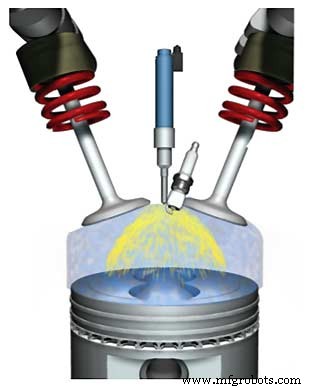
- Spray‑guided: The injector is centrally located at the top of the chamber, spraying fuel directly onto and around the spark plug. This method typically yields better combustion efficiency than wall‑guided designs.
Dual Injection
To mitigate some GDI drawbacks, many modern engines use a hybrid approach—combining direct and port injection. The engine control module (ECM) selects the appropriate injector(s) based on operating conditions, improving valve cleanliness and high‑RPM performance while retaining the benefits of direct injection.
Train to Work on Direct Injection Engines at UTI
As automotive regulations evolve, proficiency with GDI technology becomes essential. Universal Technical Institute (UTI) offers an Automotive Engines Service & Repair course that covers GDI and other major engine types. Students gain hands‑on experience with the latest diagnostic and repair tools, preparing them for a career in a market where direct injection is increasingly common.
Classes start every three to six weeks across 11 UTI campuses nationwide. For more details, visit the program page and request information to connect with an admissions representative today.
1
Industrial equipment
- What Are Bi‑Fold Hinges? Features, Benefits, and Applications
- Deck Screws Explained: Types, Benefits, and How They Compare to Wood Screws
- What Are Split Washers? A Deep Dive Into Vibrational Locking Fasteners
- Set Screws Explained: Design, Differences, and Applications
- Spring‑Energized Seals: Design, Function, and Industrial Benefits
- Carburetor Explained: How It Works, Its History, and Why It’s Been Replaced by Fuel Injection
- Unlocking Efficiency: Key Benefits of Plastic Injection Molding
- How Fuel Injection Systems Power Modern Car Engines
- Mastering Common Rail Direct Injection: Fuel Efficiency, Emission Control, and Performance
- Types of Fuel Injection Systems in Compression Ignition Engines