



Raspberry Pi Unveils RP2040 MCU and $4 Pico Board
Raspberry Pi has unveiled the RP2040, its first in‑house microcontroller, and launched the affordable Raspberry Pi Pico board at just $4. The RP2040 powers a wide range of projects, from simple hobby kits to advanced machine‑learning prototypes.
Engineering the RP2040
The chip packs a dual‑core Arm Cortex‑M0+ @ 133 MHz, 264 KB of on‑chip RAM, and supports up to 16 MB of external Flash via a dedicated QSPI bus. In a compact 7 × 7 mm QFN‑56 package, the 40 nm silicon delivers high integer performance, flexible I/O, and a low‑cost footprint.
James Adams, Raspberry Pi’s COO, explained three core design goals: high performance for integer workloads, flexible I/O to interface with virtually any peripheral, and low cost to broaden accessibility. The RP2040’s architecture—six independent RAM banks and a fully connected bus fabric—lets its two cores, DMA engines, and peripheral controllers operate in parallel without contention.
Because the Cortex‑M0+ lacks a floating‑point unit, the team licensed highly optimized floating‑point routines from Mark Owen, author of the Qfplib libraries. These functions run noticeably faster than the standard GCC implementations and are free for any RP2040‑based product.
Software and Ecosystem
For advanced users, Raspberry Pi offers a complete C SDK, a GCC‑based toolchain, and Visual Studio Code integration. Beginners and high‑level language enthusiasts can rely on a polished MicroPython port crafted with Damien George, the creator of MicroPython. The popular Thonny IDE has also added RP2040 support thanks to Aivar Annamaa.
Because many projects pair a Raspberry Pi with a microcontroller to handle analog input or low‑latency I/O, the new silicon brings those capabilities directly to the board, reducing power consumption (the RP2040 can run on less than 100 mW) and eliminating the need for external MCU co‑processors.
Key Technical Features
- Dual‑core Arm Cortex‑M0+ @ 133 MHz
- 264 KB on‑chip RAM
- Up to 16 MB off‑chip Flash via QSPI
- Dedicated DMA controller
- Integer divider and interpolator peripherals
- 30 GPIO pins (4 analog inputs)
- 2 UARTs, 2 SPI controllers, 2 I²C controllers
- 16 PWM channels
- USB 1.1 controller with host and device support
- 8 Raspberry Pi Programmable I/O state machines
- USB mass‑storage boot mode (UF2) for drag‑and‑drop programming
The $4 Raspberry Pi Pico Board
The Pico pairs the RP2040 with 2 MB of Flash and a power‑management IC that accepts 1.8 – 5.5 V input. This allows power from two or three AA cells or a single lithium‑ion cell.
Board features include a push button that triggers USB mass‑storage mode at boot and serves as a general input, a single status LED, and 26 of the 30 GPIOs exposed on 0.1‑inch pitch pads. Headers can be soldered directly to these pads, or the castellated edges enable a clean fit onto carrier boards.
Raspberry Pi collaborated with partners such as Adafruit, Arduino, Pimoroni, and Sparkfun to develop additional RP2040‑based boards and accessories, expanding the ecosystem.
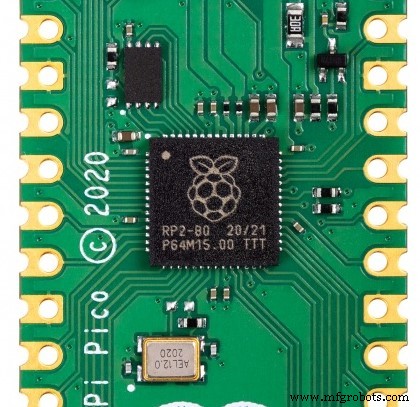
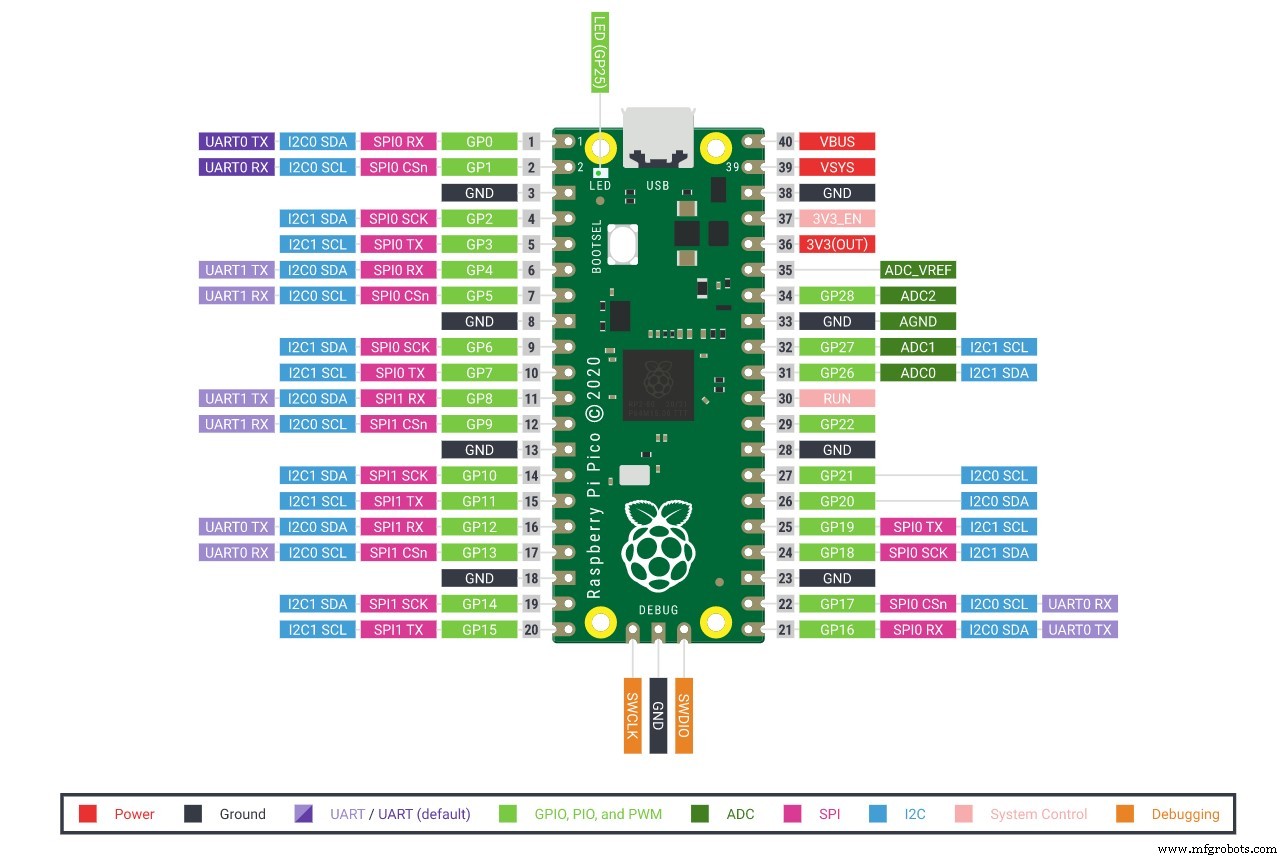
Full technical specifications of the RP2040, the Raspberry Pi Pico, and the SDK—available for both C/C++ and MicroPython—can be found here.
Embedded
- 7 Cutting‑Edge 3D‑Printed Designs That Redefined Engineering
- Synopsys Unveils Complete HBM3 IP Suite for Multi‑Die Systems, Boosting Bandwidth to 921 GB/s
- DATA MODUL Launches 23.1” Ultra‑Slim TFT Display with Smart Wi‑Fi Control
- Renesas Launches 28 nm Automotive MCU with Virtualization‑Assisted Safety Features
- How to Read Temperature with a DS18B20 on Raspberry Pi 2
- Measuring Temperature on Raspberry Pi with Maxim 1‑Wire Sensors and DS2482 I2C Bridge
- Accurate Temperature Monitoring in a Server Closet with Raspberry Pi
- RasPiRobot Board V2: Expand Your Raspberry Pi Into a Powerful Robot Controller
- Build a Self‑Balancing Segway with Raspberry Pi
- Mastering Power Management with NXP i.MX RT500 Crossover MCUs