



Xilinx Unveils Alveo U55C: Double HBM, Scalable Clustering for HPC and Big‑Data Workloads
At the SC21 supercomputing conference, Xilinx revealed the Alveo U55C data‑center accelerator and a new, standards‑based API‑driven clustering solution that lets customers deploy FPGAs at unprecedented scale. By enabling clusters of hundreds of Alveo cards and simplifying application and cluster programming, the new platform makes scaling HPC workloads both easier and more efficient.
The U55C is engineered specifically for high‑performance computing and large‑scale data analytics. It delivers the highest compute density and HBM capacity in Xilinx’s Alveo line. Paired with a RoCE v2‑based clustering framework, the card empowers users to build powerful FPGA‑based HPC clusters using their existing data‑center servers and Ethernet networks.
“This is a major step toward broader adoption of Alveo and adaptive computing in the data center,” Xilinx said.

In an interview with embedded.com, Nathan Chang, Xilinx’s HPC product manager, explained that many workloads are now memory‑bandwidth bound rather than compute bound. “We trimmed the card to a single‑slot form factor and doubled its HBM, while adding the ability to scale across hundreds of cards so that all of that bandwidth can be harnessed,” he said.
He added, “Unlocking bandwidth across clusters has been a challenge. Developers previously had to design their own clustering solutions. With our open‑standards package—leveraging RoCE v2 and Data Center Bridging over Ethernet with 200 Gbps per card—users can now build clusters that rival InfiniBand in performance and latency without vendor lock‑in.”
“This means that in existing data‑center infrastructure, you can install these cards in current servers, use your existing Ethernet fabric, and compete with InfiniBand on both speed and cost,” Chang continued.
Another benefit is that Vitis is now more accessible to developers. High‑level languages such as C, C++ and Python, as well as major AI frameworks like PyTorch and TensorFlow, can target Alveo without requiring RTL or Verilog expertise.
Alveo U55C Features for HPC and Big Data
The U55C combines several key attributes that modern HPC workloads demand:
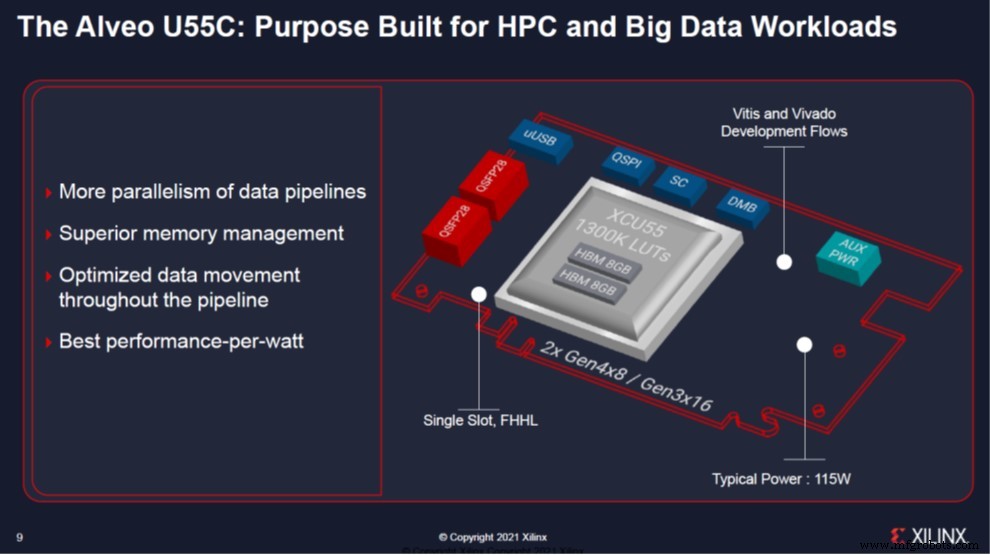
- Highest compute density and 16 GB HBM2—double the capacity of the previous dual‑slot U280.
- Single‑slot full‑height, half‑length (FHHL) form factor with a maximum power of 150 W.
- Superior data‑pipeline parallelism, memory management, and data‑movement optimization for maximum performance‑per‑watt.
- 200 Gbps RoCE v2 networking that competes with InfiniBand in latency and bandwidth.
The API‑driven clustering solution, built on RoCE v2 and Data Center Bridging, lets users construct dense Alveo networks that scale across hundreds of cards—regardless of server platform or network fabric—while sharing workloads and memory. MPI integration from the Xilinx Vitis unified software platform enables developers to scale data pipelines seamlessly.
Software engineers and data scientists can leverage the Vitis platform’s high‑level programmability. Xilinx has invested heavily in Vitis to lower the barrier to entry for adaptive computing. With support for PyTorch, TensorFlow, C, C++ and Python, developers can accelerate critical HPC workloads within their existing data‑center environments.
Who’s Using the U55C?
Chang highlighted several proof‑of‑concept deployments.

CSIRO, Australia
CSIRO’s Square Kilometre Array project uses 420 U55C cards for real‑time signal processing from 131,000 antennas. The cluster—networked through P4‑enabled 100 Gbps switches—delivers 460 Gbps of HBM2 bandwidth and 15 Tb/s of aggregate throughput in a compact, power‑efficient footprint.
Ansys LS‑DYNA
Automotive safety simulations benefit from more than 5× speed‑ups over x86 CPUs when LS‑DYNA runs on clustered U55C cards. By hyper‑parallelizing data pipelines, the solver handles hundreds of millions of degrees of freedom more efficiently, reducing simulation time dramatically.
TigerGraph
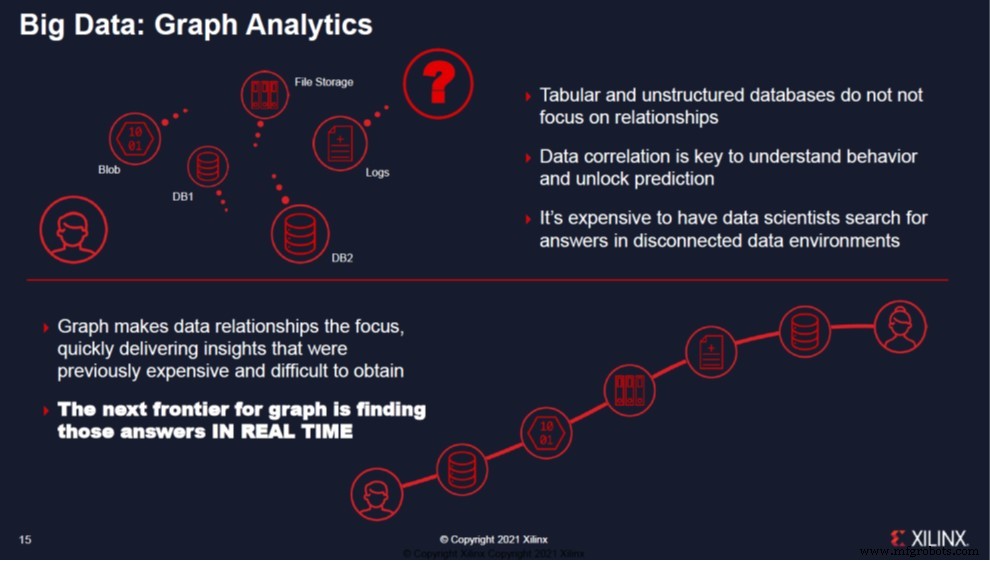
Graph analytics workloads see up to 45× faster query times and 35% higher recommendation accuracy when accelerated by multiple U55C cards, cutting prediction latency from minutes to milliseconds.
The Alveo U55C is now available through Xilinx’s website and authorized distributors. It can also be evaluated via cloud FPGA‑as‑a‑service platforms and select colocation data centers. Clustering is available for private preview, with general availability slated for Q2 next year.
Embedded
- Siemens Boosts Veloce System with Four New Products, Driving Seamless Hardware‑Assisted Verification
- Leveraging Embedded AI to Convert Big Data into Actionable Smart Insights
- MLCommons Unveils MLPerf Inference Benchmark 2024: Edge, Data Center, Mobile, and Notebook Results
- DATA MODUL Launches Hybrid Bonding Technology for High‑Volume Industrial Touch Displays
- Kontron Unveils COM HPC: A New High‑Performance Embedded Computing Standard
- Top 4 Challenges Facing the Industrial Internet of Things (IIoT)
- Can Big Data Revolutionize Health Budgets? Insights from Lux Research
- Big Data Lingo Explained: Essential Terms Every Data Enthusiast Should Know
- Data Lake vs. Big Data: Choosing the Right Approach for Industrial Applications
- Big Data vs AI: Synergy Behind Digital Transformation