



Mastering Ultra‑Wide Frequency Tuning with Software‑Defined Radios
A software‑defined radio (SDR) harnesses a general‑purpose CPU to perform digital signal processing that traditionally would be handled by dedicated analog circuits. The result is a device that is far more flexible, offers a higher dynamic range, and often costs less than its all‑analog counterparts.
While SDRs replace many analog blocks with software equivalents, they still need key front‑end components such as amplifiers that interface with the antenna. A mixer is also essential to shift the signal frequency; SDRs use digital mixers that treat signals as complex numbers, allowing frequency shifts all the way down to DC—something analog mixers can’t do.
Because SDRs typically support wide instantaneous bandwidths around their center frequency, they can monitor and retune across a vast spectrum without frequent hardware adjustments. This capability translates to high instantaneous bandwidths spanning from DC to over 18 GHz, depending on the design.
Frequency tuning can occur at any point in the signal chain—analog, digital, or a hybrid. This article explores the main tuning mechanisms: direct sampling, IQ (in‑phase/quadrature) mixing, and super‑heterodyne mixing.
What Is Frequency Mechanics?
In this context, frequency mechanics refers to the process of shifting a high‑frequency signal down to a range suitable for sampling by an ADC and to the subsequent frequency translations that may occur once the signal is digitized. A specific radio path is chosen based on the signal’s frequency; different paths are optimized for different ranges. Within each chain, the frequency can be mixed by analog converters (shifting up or down) or by digital means in the FPGA.
Direct Sampling
Direct sampling captures the RF signal straight from the antenna with minimal or no intermediate analog components. The entire RF band is digitized and passed to software for processing. While simple, this approach requires high‑speed ADCs and clocks, and is limited by the sampling rate.
Commercial ADCs can sample up to 3 GSPS, enabling the capture of multiple frequency bands—including many commercial cellular bands—in a single pass. On wideband SDRs, the direct‑sampling chain is automatically selected when the operating frequency falls below the range supported by the analog down‑converter.
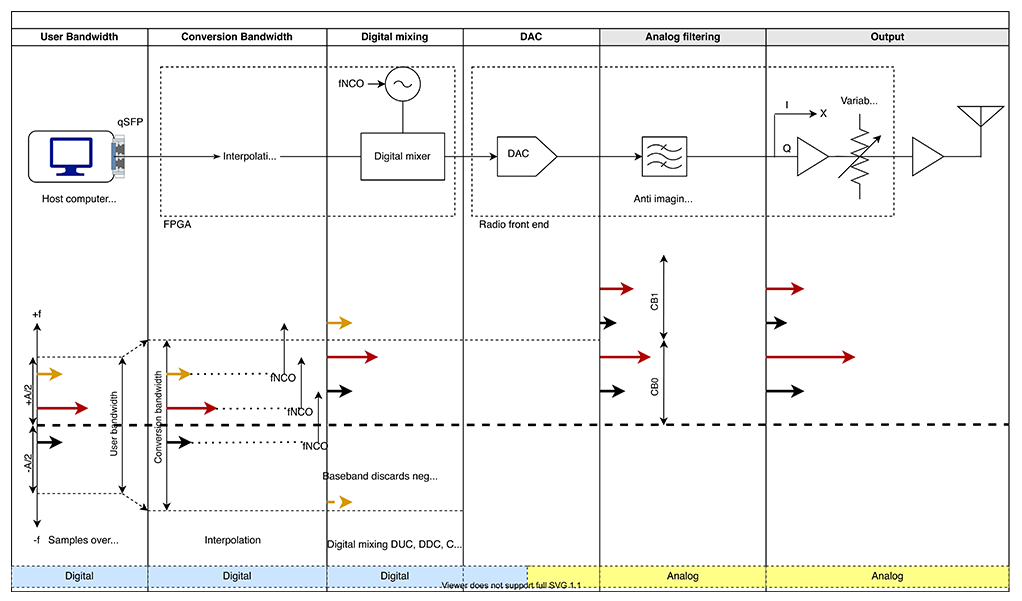
Figure 1: Direct sampling transmits signals directly from the antenna with minimal analog components. Source: Per Vices
Baseband Transmission Mechanics
In a transmit mode, the user application generates samples that the FPGA receives via the qSFP+ ports. The FPGA performs resampling and digital up‑conversion using a numerically‑controlled oscillator (NCO). The digitally shifted samples are sent to a DAC, which converts them to an analog signal. Anti‑image filters then suppress spurious images before the signal is amplified and radiated through the antenna.
Direct IQ
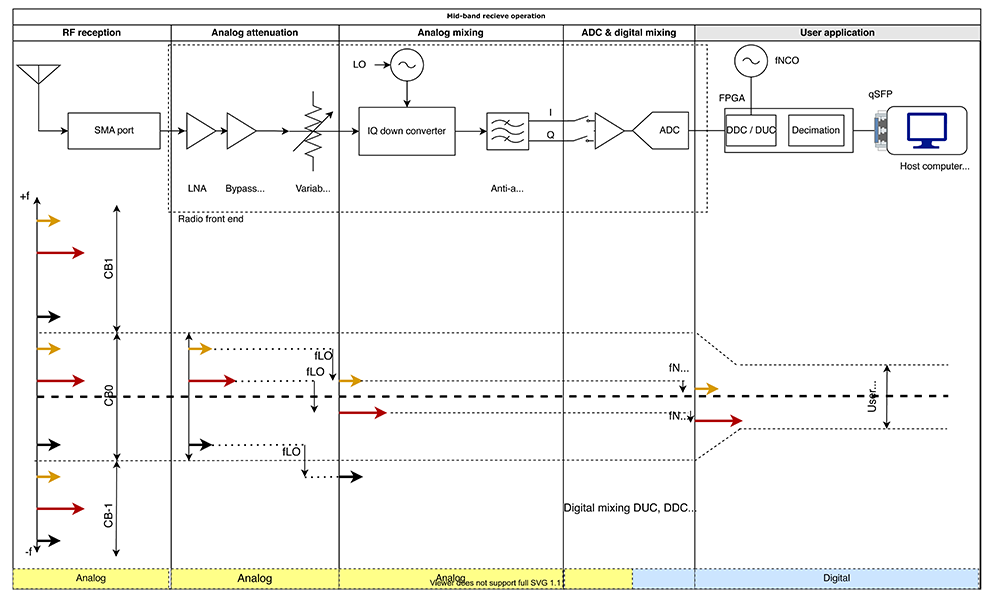
Direct IQ (in‑phase/quadrature) sampling is a variant of direct sampling that splits the incoming RF signal into two phase‑shifted components, sampled by two ADC channels. An analog anti‑aliasing filter limits the bandwidth to the ADC’s Nyquist zone. After digitization, the FPGA digitally down‑converts the signal by mixing with an NCO, followed by decimation to the user‑defined bandwidth.
Figure 2: Direct IQ receiver uses two channels to sample phase‑shifted signals. Source: Per Vices
Super‑Heterodyne
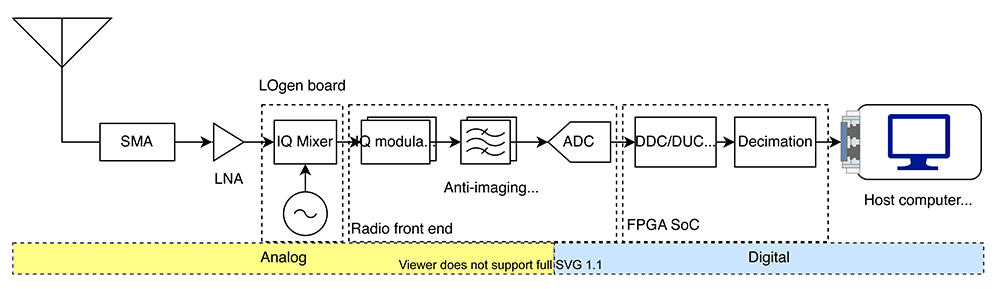
A super‑heterodyne receiver mixes the incoming RF signal with a local oscillator to produce intermediate frequencies (IF) that are easier to process with analog electronics. Typically, the IF is chosen above the audible range to reduce image interference. An analog mixer, followed by an LO generation board, creates the IF. The IF is then digitized and can be further processed digitally.
Figure 3: The super‑heterodyne receiver’s IF is selected to simplify analog processing. Source: Per Vices
Understanding Trade‑Offs
When selecting a tuning method, consider the operating frequency and the required bandwidth. Baseband or direct‑sampling modes avoid analog mixers but are limited by the ADC’s clock speed. Higher frequencies typically require one or more analog mixing stages, such as a super‑heterodyne front‑end, to bring the signal into the ADC’s range. Each approach introduces trade‑offs: analog mixers can generate image artifacts; high‑speed ADCs raise cost and power consumption.
Choosing a vendor with proven experience in wideband SDR design is essential. Evaluate their product specifications, supported applications, and the ability to customize hardware for your project’s specific frequency and bandwidth needs.
>> This article was originally published on our sister site, EDN.
 Victor Wollesen is CEO of Per Vices Corporation.
 Eldrich Rebello is an electrical engineer at the Wind Energy Institute of Canada.
Related Contents:
- Satellite navigation and Software Defined Radio
- Software‑defined automobiles: An efficient platform for essential parallelization
- IoT Security – Software‑defined perimeter and blockchain
- Open‑source SDN project gets Google code
- Why DSPs are suddenly everywhere
For more Embedded, subscribe to Embedded’s weekly email newsletter.
Embedded
- Analog In‑Memory Computing: Power‑Efficient Edge AI Inference
- Avoiding Common Pitfalls: Proper Exception Handling in Python
- Now Hiring? Mastering the Surge of Applicants in a Post‑Pandemic Market
- Adjust Arduino Due Analog Output to Match Input Range
- Step‑by‑Step Guide: Testing a Diode with Digital and Analog Multimeters (4 Proven Methods)
- Accurate Resistance Measurement: Digital vs. Analog Multimeter Guide
- Measure Frequency with a Digital Multimeter – Step-by-Step Guide
- Effective Strategies for Managing Non‑Conformances on Production Lines
- Mastering Analog Electronics: Essential Knowledge for PCB Design
- Step-by-Step Guide to Repairing Your Car Door Handle