



Silicon vs. Advanced Photodiode Materials: Performance, Applications, and Key Trade‑offs
Explore how silicon photodiodes stack up against infrared and ultraviolet semiconductor technologies in modern light‑sensing systems.
In this fourth installment of our photodiode series, we examine the strengths and limitations of common semiconductor materials—primarily silicon, as well as indium antimonide, indium gallium arsenide, germanium, mercury cadmium telluride, and silicon carbide. Understanding these differences will help you select the right detector for visible‑light, near‑IR, or UV applications.
This article is part of a comprehensive guide that covers the fundamentals of light‑diodes, PN junction physics, photoconductive and photovoltaic operation, and equivalent‑circuit modeling. If you haven’t yet read the earlier sections, they provide essential background and can be accessed via the links below.
- Start with the first article to grasp the physics of light and PN junctions.
- Next, the second piece focuses on light‑sensitive PN junctions.
- The third article covers photoconductive and photovoltaic diodes.
- Finally, the fourth article (this one) discusses material trade‑offs.
The Silicon Photodiode
Silicon remains the workhorse of photodiode technology. It offers a mature, cost‑effective solution for visible‑light detection with excellent linearity, low dark current, and high bandwidth. Silicon devices are widely available, and industry leaders like Thorlabs and Hamamatsu provide photodiodes that achieve the lowest dark current and fastest response times in the market.
Silicon’s spectral sensitivity peaks in the 400–700 nm range, making it ideal for ambient‑light sensing, illumination control, and color‑imaging systems. For applications that require enhanced near‑infrared (NIR) response, manufacturers offer silicon photodiodes with anti‑reflection coatings or thin‑film stacks that extend sensitivity up to ~1.2 µm.
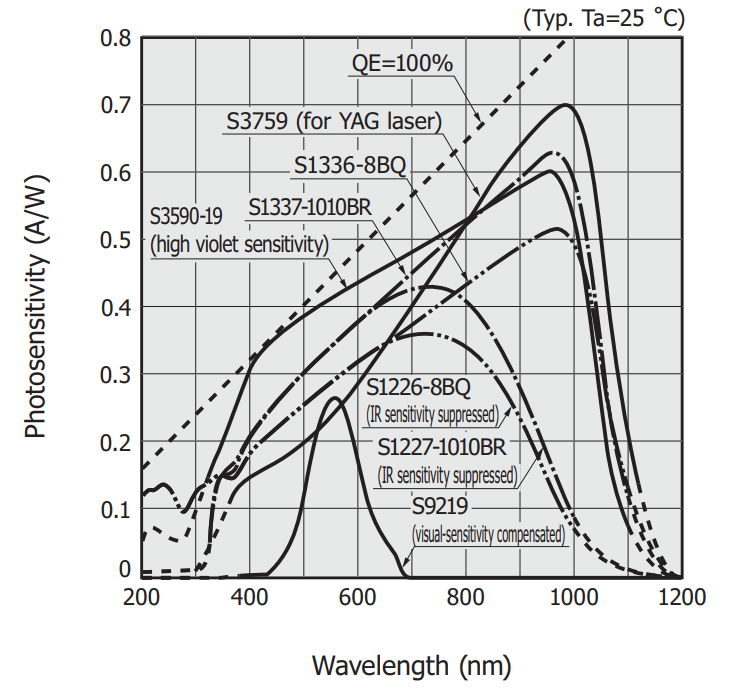
This plot from Hamamatsu’s Silicon Photodiodes Handbook shows the quantum efficiency (QE) of various silicon detectors across the visible and NIR spectrum.
Infrared Detectors
Indium Antimonide (InSb)
InSb photodiodes excel in the short‑wave (SWIR) and mid‑wave (MWIR) infrared bands (0.9–5 µm). Their high responsivity and low noise make them suitable for thermal imaging, missile guidance, and spectroscopy. However, to reach peak performance, InSb detectors must be cryogenically cooled—typically with a liquid‑nitrogen dewar—because their dark current rises sharply at room temperature.
Indium Gallium Arsenide (InGaAs) and Germanium (Ge)
InGaAs is the most common room‑temperature NIR detector, covering 0.7–1.7 µm with high quantum efficiency and a favorable signal‑to‑noise ratio. Germanium also operates at room temperature and shares a similar spectral range, but InGaAs generally delivers superior performance in terms of responsivity and dynamic range.
Mercury Cadmium Telluride (HgCdTe)
HgCdTe photodiodes extend detection capability into the long‑wave IR (LWIR) up to 16 µm, essential for passive thermal imaging and environmental monitoring. Like InSb, HgCdTe requires cryogenic cooling (often liquid nitrogen or closed‑cycle cryocoolers) to suppress dark current and maintain high sensitivity. Although uncooled microbolometers are increasingly popular for LWIR imaging due to their lower cost and power consumption, HgCdTe remains the benchmark for high‑resolution, low‑noise thermal detection.
Ultraviolet Detectors
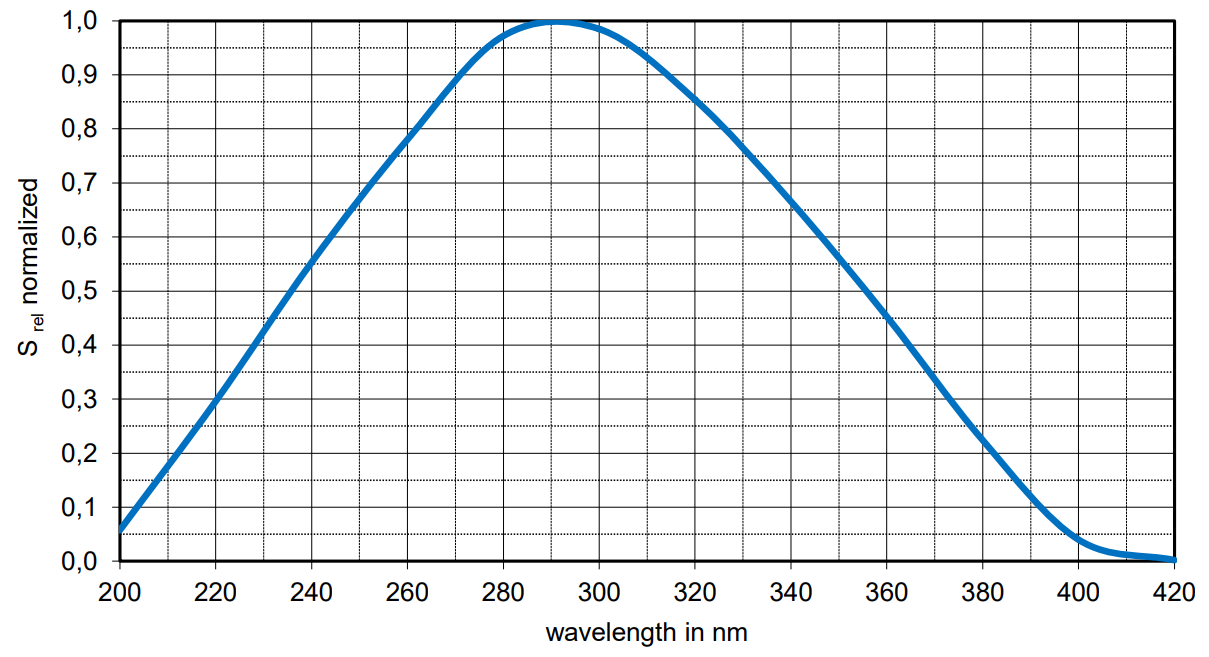
Silicon photodiodes can be engineered for UV sensitivity by adjusting the depletion layer and applying selective filtering. These UV‑enhanced silicon devices still maintain strong visible‑light response but show increased responsivity in the 200–400 nm range, useful for UV sensing in scientific instrumentation and environmental monitoring.
Silicon carbide (SiC) photodiodes offer a rugged alternative that is intrinsically limited to the 200–400 nm band. SiC’s wide bandgap yields low dark current and excellent high‑temperature tolerance, making it ideal for harsh‑environment UV detection without the need for optical filtering to block visible or IR light.
Recap
• Silicon photodiodes are the go‑to choice for visible‑light sensing, offering high linearity, low dark current, and fast response.
• For infrared detection, the standard materials are:
– InSb (SWIR/MWIR, cryogenic)
– InGaAs (0.7–1.7 µm, room temperature)
– Ge (similar to InGaAs, room temperature)
– HgCdTe (LWIR up to 16 µm, cryogenic)
• UV applications can use UV‑enhanced silicon photodiodes for broadband detection or SiC photodiodes for a strictly UV‑only, high‑temperature‑resilient solution.
Next in the series: Understanding the Photodiode Equivalent Circuit.
Sensor
- Silicon: Properties, Production, and Market Outlook
- Proximity Sensors: Comparing Ultrasonic, Photoelectric, Laser, and Inductive Technologies
- Silicon Photomultipliers (SiPMs): Structure, Performance, and Key Applications
- Electroless HF/AgNO3 Etching of n‑Si(100) Wafers: High‑Density Silicon Nanowire Arrays with Low Reflectance and Ohmic Conductance
- How Technology Choices Influence PCB Costs: A Comprehensive Guide
- Precision Machining Technologies: Advancing Accuracy & Efficiency
- Instant Home Health Checks with Smartphone-Linked Silicon Sensors
- NASA's Printable Chemical Nanosensor: 3D-Printed, Graphene-Based Sensor for Rapid Detection
- Flexible, High‑Performance Organic Photodiodes Match or Exceed Silicon Devices
- Understanding the Key Differences Between FDM and SLA 3D Printing Technologies