



Optimizing Photodiode Measurement Circuits for Low‑Light Sensitivity
For accurate low‑light detection, a trans‑impedance (current‑to‑voltage) amplifier is preferred over a conventional op‑amp. This configuration delivers superior sensitivity and bandwidth.
The photodiode is reverse‑biased to minimize its capacitance, which in turn expands the bandwidth and suppresses noise. The feedback resistor defines the gain – typical values range from 1 MΩ to 10 MΩ, with higher resistances providing greater amplification. To maintain stability at high gain, a small compensation capacitor (≈ 1–5 pF) is often added to counteract the diode’s inherent capacitance.
Because the summing node is highly susceptible to parasitic capacitance and external contaminants, the wiring must be as compact and clean as possible. In high‑performance systems, the photodiode and amplifier are frequently integrated into a hybrid micro‑circuit package or a single‑die solution to eliminate trace inductance and reduce noise.
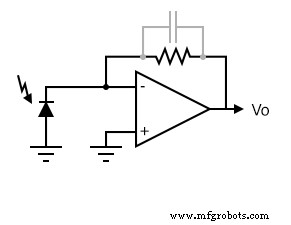
Photodiode amplifier
Industrial Technology
- Foundations of DC Circuits: Understanding Direct Current and Core Electrical Concepts
- Understanding AC Circuits: A Beginner's Guide
- Designing a High‑Gain Multi‑Stage Common‑Emitter Amplifier with Negative Feedback
- Designing a High‑Gain Differential Amplifier with NPN Transistors
- Understanding Amplifier Feedback: Positive vs Negative, and Practical Applications
- Amplifier Input and Output Impedance Analysis
- Complementary NPN/PNP Audio Amplifier Circuit – Direct Coupling for Moderate Power
- Crystal and Transistor Radio Circuits: From Basic Detectors to Integrated AM/FM Receivers
- Control Circuits: Fundamentals, Applications, and Best Practices
- pH Measurement: Fundamentals, Electrodes, and Best Practices