



Exploring Advanced Diode Technologies: Varicaps, PINs, IMPATT, Gunn, and More
Varicap or Varactor Diodes
Varicap diodes, also called varactors, are reverse‑biased junctions whose depletion width—and thus capacitance—varies with applied voltage. The effect is especially pronounced in varicaps, allowing precise tuning of resonant circuits. The schematic below shows a common‑cathode dual‑diode package.
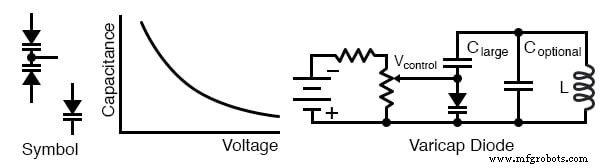
In a resonant network, a varicap’s capacitance changes the circuit’s frequency in response to a control voltage (V_control). A series capacitor with a large value keeps the control voltage from shorting the inductor, preserving the resonant frequency while still allowing fine adjustment. For more on varicap tuning in AM radio receivers, see the “Electronic Varicap Diode Tuning” chapter.
Varicaps come in several types—abrupt, hyperabrupt, and super‑hyperabrupt—each offering a progressively larger capacitance swing. Typical ratios are 4:1 for abrupt, 10:1 for hyperabrupt, and 20:1 for super‑hyperabrupt. These wide‑range variations make them ideal for oscillators and filters that sweep across large frequency spans. Varactors also find use in frequency multiplier circuits; refer to “Practical Analog Semiconductor Circuits” for a detailed example.
Snap Diode (Step‑Recovery Diode)
The snap, or step‑recovery diode, excels in high‑ratio frequency multiplication up to 20 GHz. During forward bias, charge accumulates in the PN junction. Upon reverse bias, the stored charge is released, causing the diode to behave as a low‑impedance current source until the charge is exhausted. At that point, it abruptly “snaps” to a high‑impedance state, generating a sharp voltage impulse rich in harmonics. This makes snap diodes ideal for comb generators and moderate‑power 2× or 4× multipliers.
PIN Diodes
PIN diodes are fast, low‑capacitance switching devices. They differ from PIN photodiodes in that they are designed for high‑power RF switching. The intrinsic region between the P and N layers creates a wide depletion zone, resulting in reduced reverse‑bias capacitance compared to conventional switching diodes.
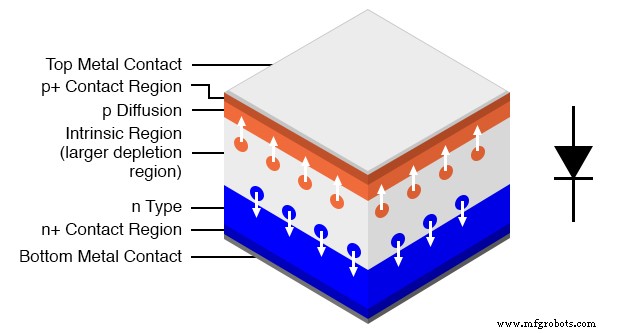
Typical applications include T/R switches in radar systems and antenna switches for direction‑finding receivers. Certain general‑purpose power diodes, such as the 1N4007, can function as PIN switching diodes thanks to their intrinsic layer. PIN diodes also act as voltage‑controlled resistors in variable attenuators, extending flat‑response performance into the microwave band.
IMPATT Diode
The IMPATT (Impact Avalanche Transit‑Time) diode is a high‑power RF generator operating from 3 GHz to 100 GHz. It is fabricated from silicon, gallium arsenide, or silicon carbide. Reverse‑biased above its breakdown voltage, the thin depletion region accelerates carriers, triggering an avalanche that produces a negative resistance effect. When coupled to a resonant circuit, this negative resistance drives oscillations at high power levels.
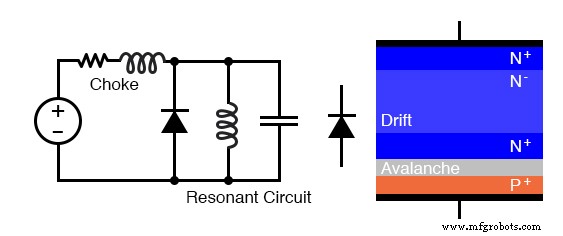
In practical designs, a bias tee provides DC reverse bias while isolating RF signals. Low‑power radar transmitters sometimes use IMPATT diodes, though their high noise makes them unsuitable for receiver front‑ends.
Gunn Diode
A Gunn diode consists solely of N‑type semiconductor material, typically gallium arsenide. When a sufficient voltage is applied, electrons transfer from a low‑energy conduction band to a higher‑energy band, creating a negative differential resistance that supports oscillations. The oscillation frequency depends on the transit time of electrons across the lightly doped N‑layer, which is inversely related to the layer’s thickness.
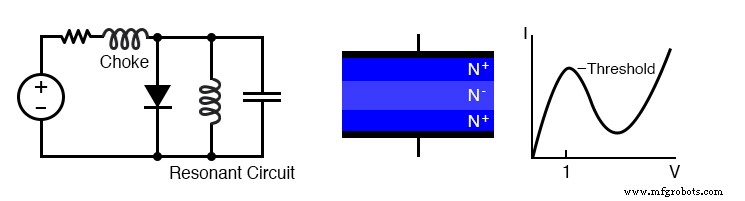
Gunn diodes are available for operation from 10 GHz to 200 GHz, delivering 5 mW to 65 mW of power. When integrated into a resonant circuit, they can also function as compact amplifiers.
Shockley Diode
The Shockley diode is a four‑layer thyristor that triggers larger thyristors when the applied voltage exceeds its breakover voltage (≈ 20 V). It conducts in one direction only. The bidirectional counterpart is the DIAC.
Constant‑Current Diodes
A constant‑current diode (also called a current‑limiting or current‑regulating diode) behaves like a two‑terminal JFET. It maintains a fixed maximum current regardless of voltage variations. If the supply voltage increases, the diode raises its voltage drop to keep the current at its regulation point.
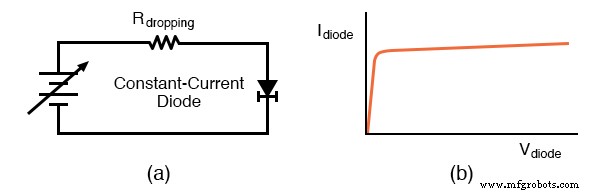
These devices are frequently used to protect LEDs and laser diodes from current surges across a wide range of supply voltages. Proper selection of the regulation point is critical, especially for laser diodes which are less tolerant of forward‑current variations.
SiC Diodes
Silicon carbide (SiC) diodes can operate at temperatures up to 400 °C, making them suitable for harsh environments such as down‑hole oil logging, gas turbine engines, and automotive powertrains. SiC’s radiation hardness—100× greater than silicon—makes it attractive for nuclear and space applications. Additionally, SiC’s superior thermal conductivity allows efficient heat dissipation, while its high breakdown voltage (several kilovolts) enables compact, high‑power designs. Industry forecasts suggest SiC power devices could reduce electrical energy losses in the power grid by up to 100 %.
Polymer Diodes
Organic polymer diodes, fabricated at low temperatures, enable inkjet‑printed electronic components. While most research focuses on organic light‑emitting diodes (OLEDs), progress is underway in printable RFID tags and high‑frequency rectifiers. A pentacene‑based rectifier has achieved operation at 50 MHz, with a target of 800 MHz. Recent developments include a metal‑insulator‑metal (MIM) diode functioning as a back‑to‑back Zener clipper and a tunnel‑diode‑like device, both promising for flexible, low‑cost electronics.
Industrial Technology
- Commutating Diode Experiment: Suppressing Inductive Kickback with a Neon Lamp
- Diodes: Fundamentals, Construction, and Applications
- Understanding Junction Diodes: From Crystal Detectors to Modern Silicon Devices
- Diodes and Rectifiers: Fundamentals, Operation, and Key Parameters
- Zener Diodes Explained: Voltage Regulation, Design Principles, and Practical Applications
- Exploring Advanced Diode Technologies: Varicaps, PINs, IMPATT, Gunn, and More
- Beyond Sine Waves: How Power Electronics Shape Harmonics
- Protecting Solar Panels: How Blocking & Bypass Diodes Guard Against Shade and Faults
- Diodes Explained: Types, Functions, and Applications
- Diode Testing Made Easy: Proven Techniques to Spot Faulty Components