



Diodes: Fundamentals, Construction, and Applications
Diodes: Fundamentals, Construction, and Applications
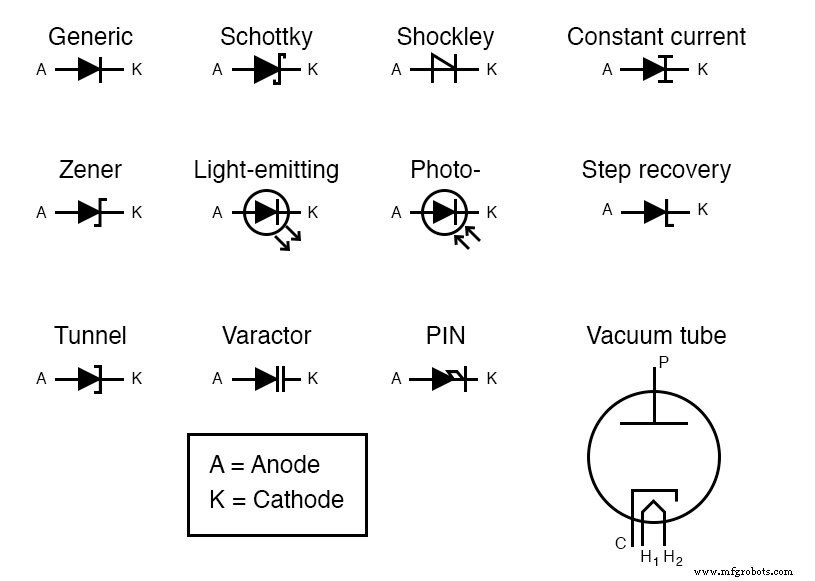
A diode is a semiconductor device comprising a p‑type and an n‑type region joined at a p‑n junction. Two metal leads attach to the junction, enabling straightforward integration into electronic circuits.
The lead attached to the n‑type material is the cathode (negative side), while the lead on the p‑type material is the anode (positive side).
Diodes are essential for rectifying AC signals, protecting circuits, and enabling logic operations in digital electronics. In practical applications, they are used in power supplies, signal detectors, and as part of more complex devices such as zener diodes and thyristors.
RELATED WORKSHEETS:
- Optoelectronic Devices Worksheet
- Thyristors Worksheet
- Zener Diodes Worksheet
- Special Diodes Worksheet
- Rectifying Diodes Worksheet
Understanding Electrical Connectors: Types, Functions, and Best Practices
Bipolar Transistors: Symbols, Types, and Applications
Industrial Technology
- Commutating Diode Experiment: Suppressing Inductive Kickback with a Neon Lamp
- Voltage Regulator Experiment with a 12‑Volt Zener Diode
- Understanding Junction Diodes: From Crystal Detectors to Modern Silicon Devices
- Diodes and Rectifiers: Fundamentals, Operation, and Key Parameters
- Comprehensive Guide to Diode Ratings & Datasheet Parameters
- Understanding Clipper Circuits: Theory, Simulation, and Practical Applications
- Zener Diodes Explained: Voltage Regulation, Design Principles, and Practical Applications
- Special-Purpose Diodes: Schottky, Tunnel, LED, Laser, Photodiode, and Solar Cell Innovations
- Exploring Advanced Diode Technologies: Varicaps, PINs, IMPATT, Gunn, and More
- Protecting Solar Panels: How Blocking & Bypass Diodes Guard Against Shade and Faults