



Mastering Fresh Indigo Leaf Dyeing: A Sustainable Approach
On some days it’s hard to believe how recently we traveled freely worldwide, meeting new people and experiencing new places. Three years ago I attended the natural dye symposium in Madagascar, where I first met Hisako Sumi who started me on my current journey of making and maintaining indigo fermentation vats. As I was harvesting Persicaria tinctoria leaves in the garden, I was reminded of the fresh leaf indigo dyeing that we saw being done in Madagascar.
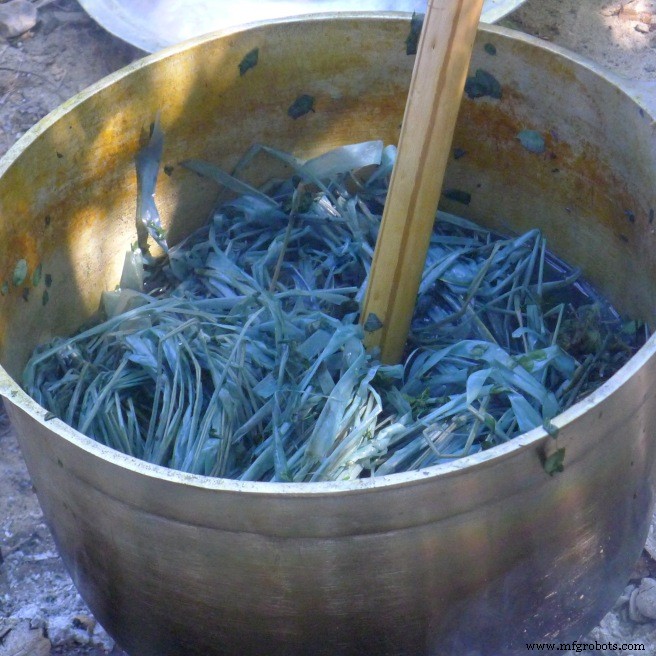
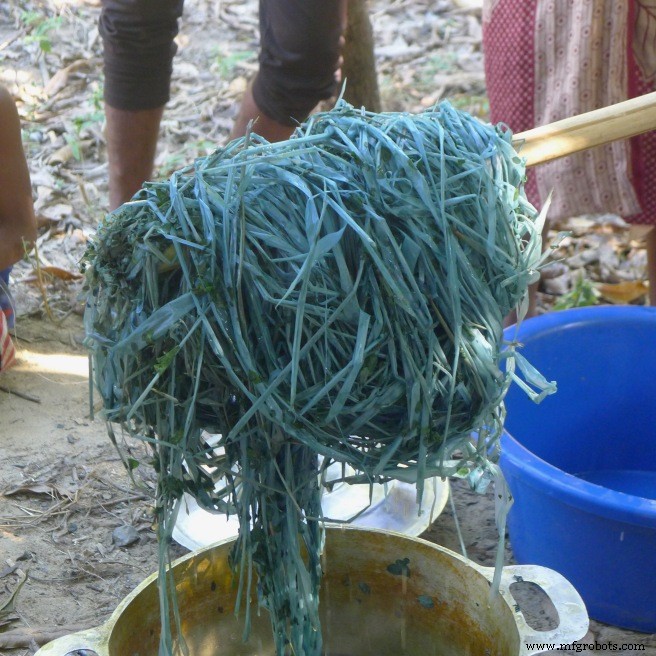
Many of us are growing indigo in our gardens right now and have likely had the pleasure of experimenting with fresh leaf indigo dyeing on silk. It’s like magic to see the lovely turquoise color emerge from the cold leaf bath.
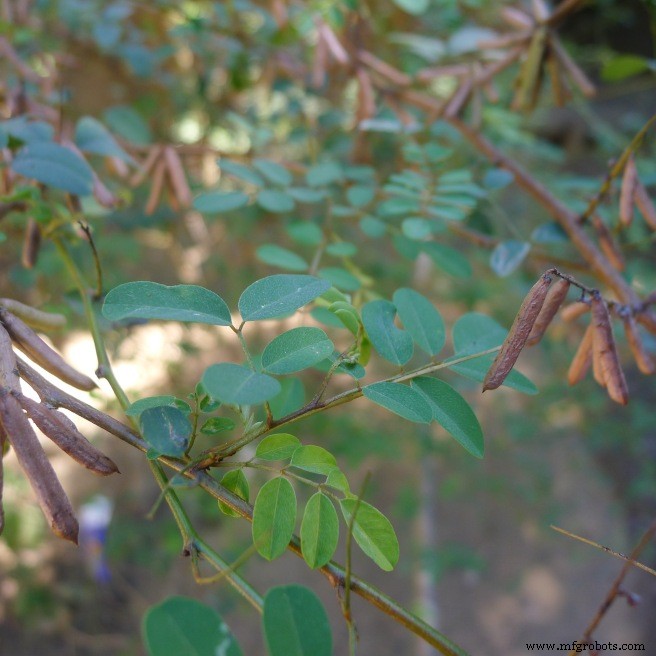
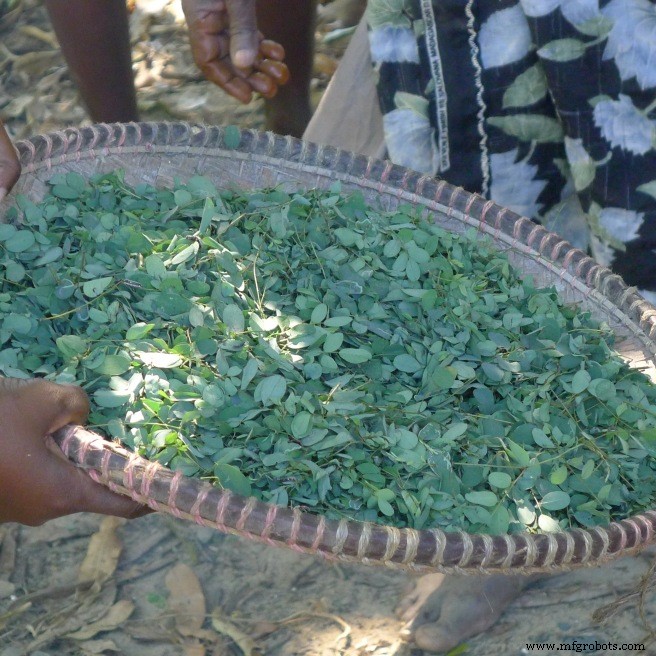
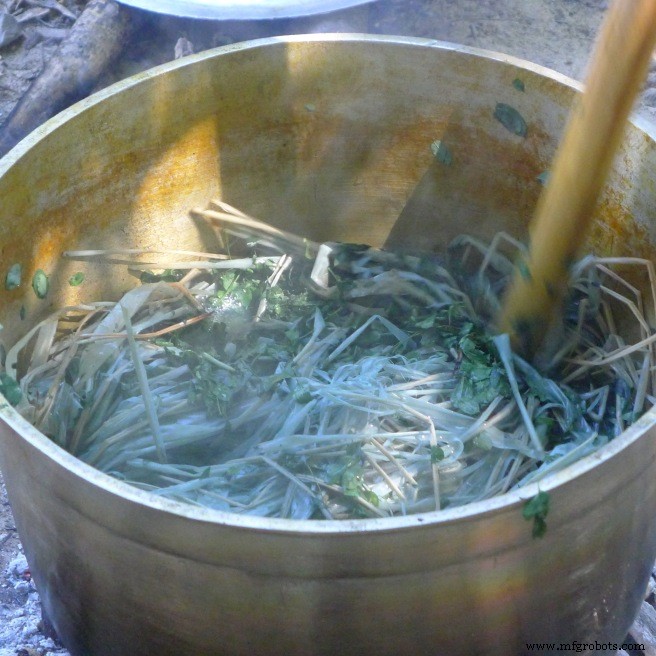
The indigo that grows in Madagascar is Indigofera erecta. It is a perennial in that climate and the leaves are harvested from the bushes as needed. The leaves were used to dye the raffia fibers directly. There was no vat or reduction.
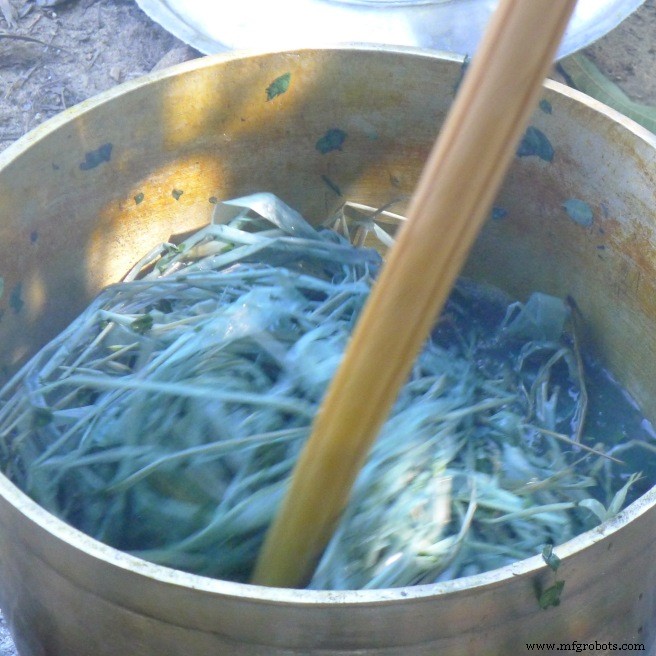
Yet, the dyers took this “cold” process one step further. The ambient temperature dyebath produced a lovely clear turquoise blue color on the raffia. When heat was applied, the color deepened and shifted.
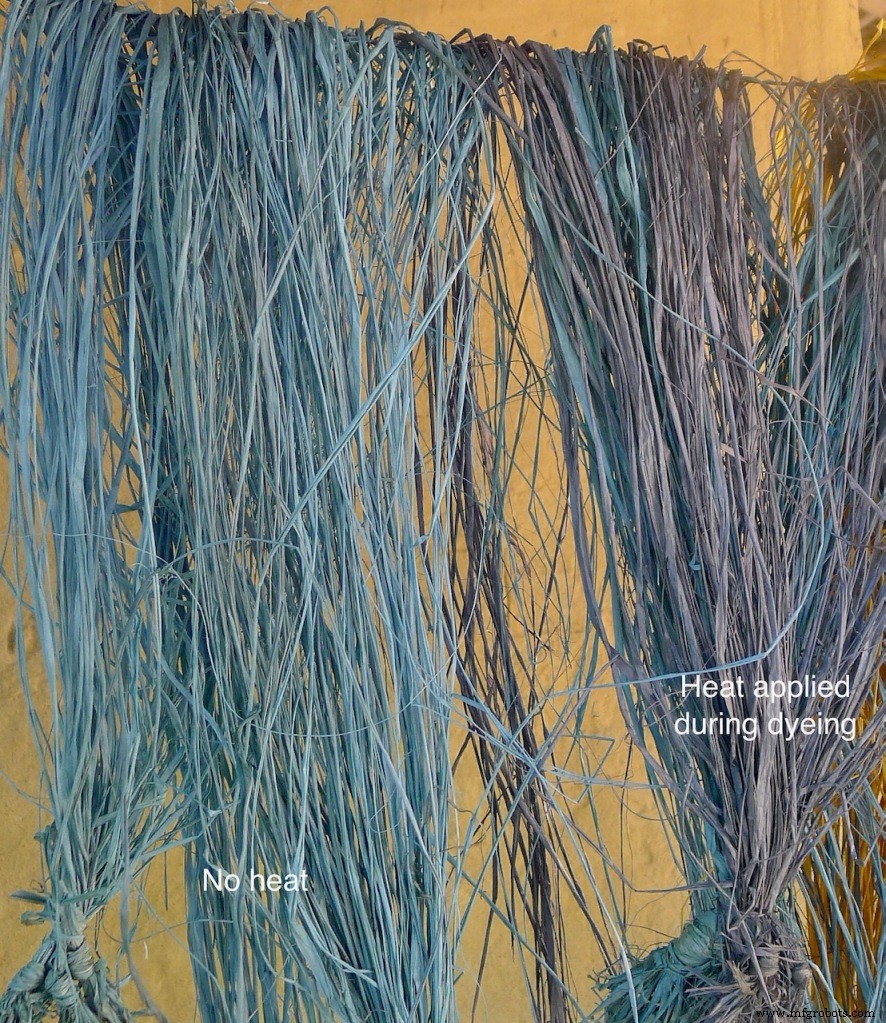
This approach of heat application was new to me. When I inquired about it, both Hisako and Dominique Cardon indicated that they were both familiar with this phenomenon. Hisako sent me an image from a scientific report done by Dr. Kazuya Sasaki that documented the range of color that could be obtained from fresh leaf woad by increasing the temperature. Once armed with that information I was able to reproduce that range of color, nearly exactly, on silk and and on multi-fiber test strips, though the results were not precisely the same as those we saw in Madagascar.
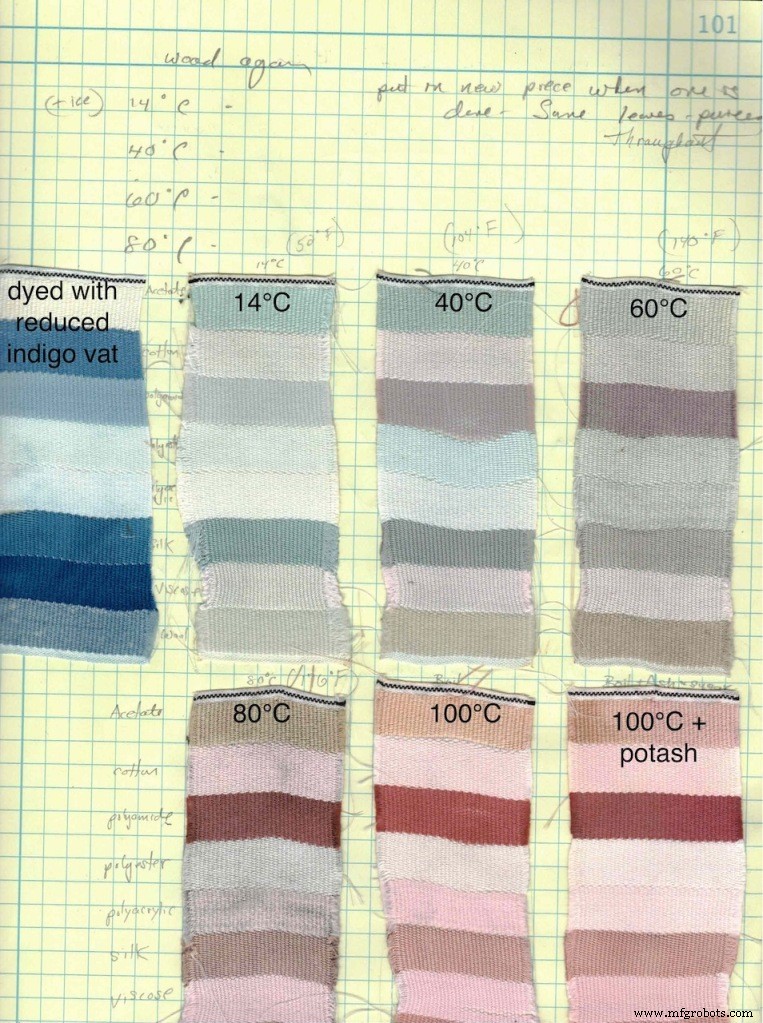
I have always understood that the process of fresh leaf dyeing with indigo is primarily used on silk – a protein. Yet, the dyeing we witnessed in Madagascar was done on raffia. Why did this process work so well on raffia- a cellulose fiber? I posed the question to my colleague, Joy Boutrup. “Raffia is almost pure lignin” she said. Lignin is an organic polymer and has a strong affinity for dye.
This week I repeated the tests with Polygonum tinctorium on silk broadcloth and raffia. I used a greater quantity of leaves this time – a blender full of leaves for a few small samples vs. less than 100 g. I puréed the leaves this time rather than chop them up. The “coldest” blue is a deeper shade but otherwise the results are very similar. I freely admit that I don’t understand, chemically, why the colors change with the temperature:
- Are there other dyes attaching?
- Has the indigo been transformed by the temperature?
Maybe someone else can enlighten.
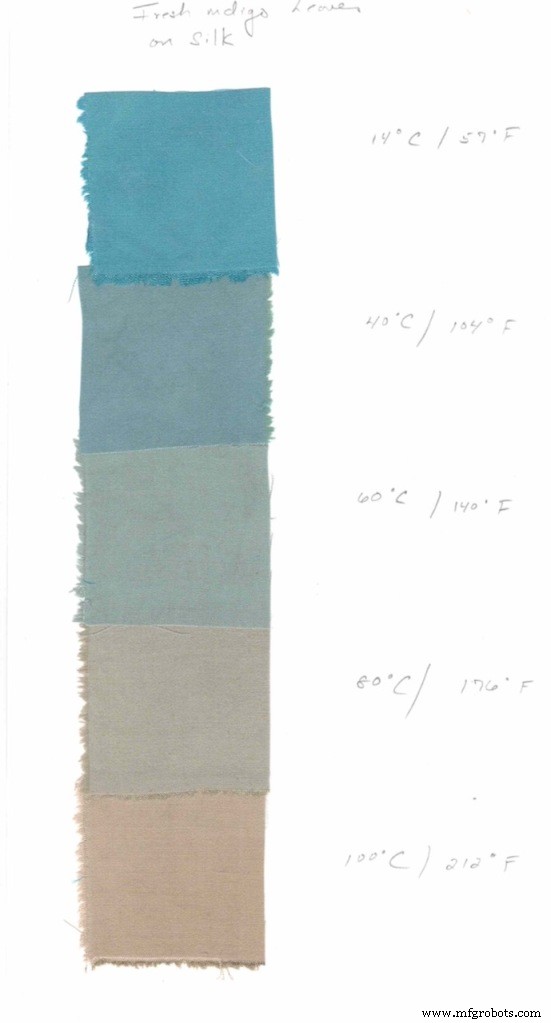
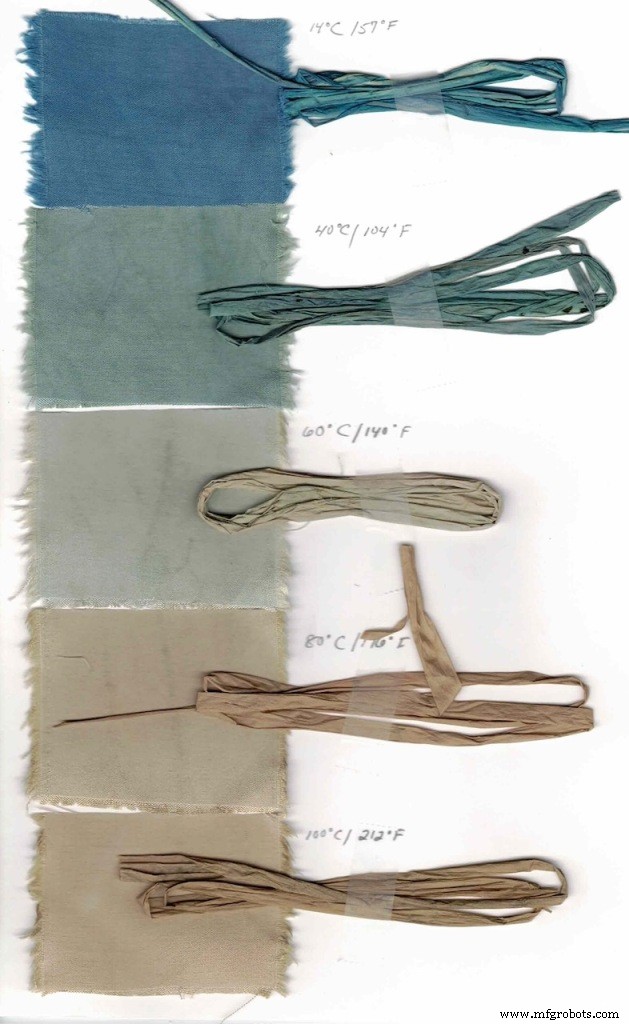
I have always suspected that the lightfastness of the fresh leaf indigo dye is not to the same level as the color obtained from a well reduced indigo vat. I will do lightfast tests on this range of color and report back in a later blog.
Three years ago, the trip to Madagascar taught me about an approach to dyeing that I had never seen before – truly one of the gems of travel. We may not be free to move around for now, BUT other opportunities continue to present themselves on the web. One of the most exciting upcoming events is this year’s Textile Society of America Symposium: Hidden Stories: Human Lives.

Originally planned to be held in Boston this fall, Hidden Stories: Human Lives will now be live and completely online October 15-17. This biennial event brings together scholars, curators, and artists from all over the world who will present their original research in the form of organized panels and talks. Fee structures for the symposium have been completely re-vamped in order to make this event accessible to all – no matter where in the world you might be. Registration has just opened and you can see the full program here. In addition, You can also read about the keynote and plenary speakers. Hope to see you there!
Dye
- From Punched Cards to Hard Drives: The Evolution of Mechanical Storage
- Expert Guide to Overcoming Direct Dyeing Challenges in Textiles
- Achieving High-Precision Temperature Measurements with Advanced Silicon Sensors
- Stratasys Revives MakerBot: The Method Brings Industrial‑Grade Reliability
- Designing Functional 3D‑Printed Bicycle Pannier Adapters with Kevlar CFF
- Markforged 3‑D‑Printed Part Revives Lost Kayak Rudder: A Real‑World Success Story
- Step‑by‑Step Guide to Machining a Steering Wheel with Fusion 360
- Boosting Production Efficiency with Portable Container Tilt Systems
- Enhancing Precision Cup Denester Efficiency with Dual Fanuc Robot Retrofit
- Nitrogen: The Key to Fresh BBQ Food This Summer