



Smithy Secrets: Mastering Modern Forging Techniques
How do modern forging facilities manipulate metal into forged parts?
What is forging?
Forging is a manufacturing process involving the shaping of a metal through hammering, pressing, or rolling. These compressive forces are delivered with a hammer or die. Forging is often categorized according to the temperature at which it is performed—cold, warm, or hot forging.
A wide range of metals can be forged. Typical metals used in forging include carbon steel, alloy steel, and stainless steel. Very soft metals such as aluminum, brass, and copper can also be forged. The forging process can produce parts with superb mechanical properties with minimum waste. The basic concept is that the original metal is plastically deformed to the desired geometric shape—giving it higher fatigue resistance and strength. The process is economically sound with the ability to mass produce parts, and achieve specific mechanical properties in the finished product.
History of forging
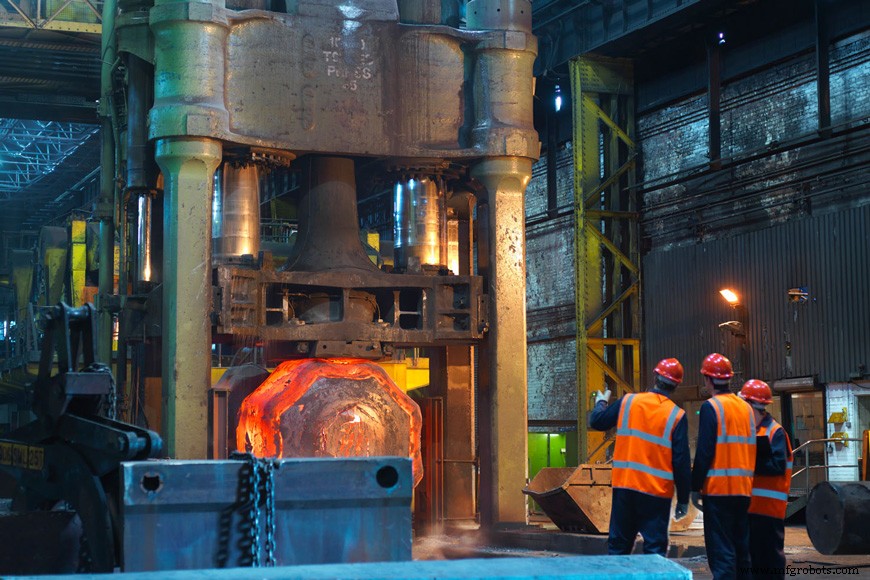
Forging has been practiced by smiths for thousands of years. At first, bronze and copper were the most common forged metals, in the Bronze Age: later, as the ability to control temperature and the process of smelting iron was discovered, iron became the primary forged metal. Traditional products include kitchenware, hardware, hand tools, and edged weapons. The Industrial Revolution allowed forging to become a more efficient, mass-production process. Since then, forging has evolved along with advances in equipment, robotics, electronic controls, and automation. Forging is now a worldwide industry with modern forging facilities producing high-quality metal parts in a vast array of sizes, shapes, materials, and finishes.
Forging methods
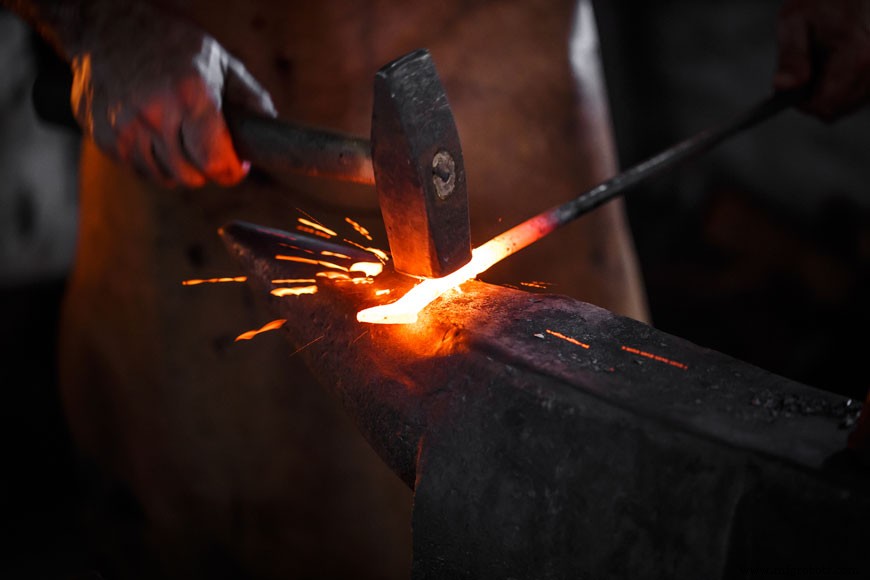
There are several forging methods with different capabilities and benefits. The more commonly used forging methods include the drop forging methods, as well as roll forging.
Drop forging
Drop forging derives its name from the process of dropping a hammer onto the metal to mold it into the shape of the die. The die refers to the surfaces that come into contact with the metal. There are two types of drop forging—open-die and closed-die forging. Dies are typically flat in shape with some having distinctively shaped surfaces for specialized operations.
Open-die forging (smith forging)
Open-die forging is also known as smith forging. A hammer strikes and deforms a metal on a stationary anvil. In this type of forging, the metal is never completely confined in the dies—allowing it to flow except for the areas where it is in contact with the dies. It is the operator's responsibility to orient and position the metal to achieve the desired final shape. Flat dies are used, with some having specially shaped surfaces for specialized operations. Open-die forging is suitable for simple and large parts, as well as customized metal components.
Advantages of open-die forging:
- Better fatigue resistance and strength
- Reduces chance of error and/or holes
- Improves microstructure
- Continuous grain flow
- Finer grain size
Closed-die forging (impression-die)
Closed-die forging is also known as impression-die forging. The metal is placed in a die and attached to an anvil. The hammer is dropped onto the metal, causing it to flow and fill the die cavities. The hammer is timed to come into contact with the metal in quick succession on a scale of milliseconds. Excess metal is pushed out from the die cavities, resulting in flash. The flash cools faster than the rest of the material, making it stronger than the metal in the die. After forging, the flash is removed.
In order for the metal to reach the final stage, it is moved through a series of cavities in a die:
- Edging impression (also known as fullering or bending)
The first impression used to mold the metal into a rough shape.
- Blocking cavities
The metal is worked into a shape that more closely resembles the final product. The metal is shaped with generous bends and fillets.
- Final impression cavity
Final stage of finishing and detailing the metal into the desired shape.
Advantages of closed-die forging:
- Produces parts up to 25 tons
- Produces near net shapes that require only a small amount of finishing
- Economic for heavy production
Roll forging
Roll forging consists of two cylindrical or semi-cylindrical horizontal rolls that deform a round or flat bar stock. This works to reduce its thickness and increase its length. This heated bar is inserted and passed between the two rolls—each containing one or more shaped grooves—and is progressively shaped as it is rolled through the machine. This process continues until the desired shape and size is achieved.
Advantages of automatic roll forging:
- Produces little to no material waste
- Creates a favorable grain structure in the metal
- Reduces the cross-sectional area of the metal
- Produces taper ends
Press forging
Press forging uses a slow, continuous pressure or force, instead of the impact used in drop-hammer forging. The slower ram travel means that the deformation reaches deeper, so that the entire volume of the metal is uniformly affected. Contrastingly, in drop-hammer forging, the deformation is often only at the surface level while the metal's interior stays somewhat undeformed. By controlling the compression rate in press forging, the internal strain can also be controlled.
Advantages of press forging:
- Economic for heavy production
- Greater accuracy in tolerances within 0.01–0.02 inch
- Dies have less draft allowing for better dimensional accuracy
- Speed, pressure, and travel of the die are automatically controlled
- Process automation is possible
- Capacity of presses range from 500–9000 tons
Upset forging
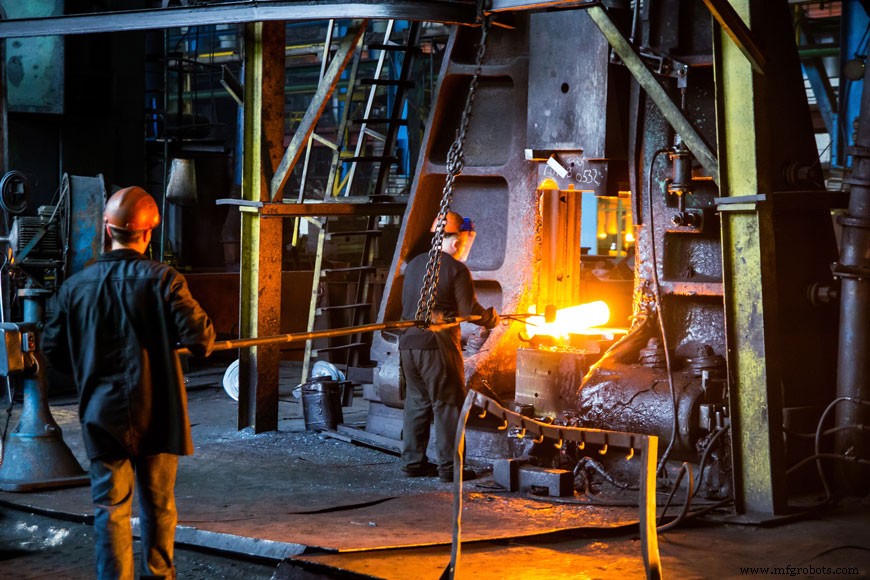
Upset forging is a manufacturing process that increases the diameter of the metal by compressing its length. Crank presses, a special high-speed machine, are used in upset forging processes. Crank presses are typically set on a horizontal plane to improve efficiency and the quick exchange of metal from one station to the next. Vertical crank presses or a hydraulic press are also options.
Advantages of upset forging:
- High production rate of up to 4500 parts per hour
- Full automation is possible
- Elimination of the forging draft and flash
- Produces little to no waste
Automatic hot forging
In automatic hot forging, mill-length steel bars are inserted into one end of the forging machine at room temperature, and hot forged products emerge from the other end. The bar is heated with high-power induction coils to a temperature ranging from 2190–2370°F in under 60 seconds. The bar is descaled with rollers and shared into blanks. At this point, the metal is transferred through several forming stages that can be coupled with high-speed cold-forming operations. Typically, the cold-forming operation is left for the finishing stage. By doing so, the benefits of cold-working can be reaped while also maintaining the high speed of automatic hot forging.
Advantages of automatic hot forging:
- High output rate
- Acceptance of low-cost materials
- Minimal labor required to operate machinery
- Produces little to no material waste (material savings between 20–30% over conventional forging)
Precision forging (net-shape or near-net-shape forging)
Precision forging requires little to no final machining. It is a forging method developed to minimize the cost and waste associated to post-forging operations. Cost savings are achieved from the reduction of material and energy, as well as the reduction of machining.
Isothermal forging
Isothermal forging is a forging process where the metal and die are heated to the same temperature. Adiabatic heating is used—there is no net transfer of mass or thermal exchange between the system and the external environment. The changes are all due to internal changes resulting in highly controlled strain rates. Due to the lower heat loss, smaller machines may be used for this forging process.
Metal
- How Metal Powders Are Made: A Comprehensive Guide to Preparation Methods
- Titanium Rods Manufacturing: Techniques, Benefits, and Industry Applications
- Galvanization Explained: Definition, Methods & Processes for Metal Corrosion Protection
- Heat Treatment Explained: Processes, Methods, and Benefits
- Forging vs Casting: Key Differences in Metal Fabrication
- Cold Working Explained: Techniques, Differences from Hot Working, and Key Benefits
- 11 Proven Metal Casting Techniques for Precision Manufacturing
- Advanced Forging & Pressing Machines for Precision Metal Fabrication
- Top Metal Finishing Techniques: Choose the Best Method for Superior Surfaces
- Exploring Metal Additive Manufacturing: A Beginner’s Guide to Direct Metal Laser Sintering (DMLS)