



Revolutionizing Early Disease Detection with Nano‑Scale Biotech
Envision a future where routine annual check‑ups are complemented by a cost‑effective home diagnostic chip. By analyzing a single urine sample, patients can continuously monitor their baseline health, and any subtle biomarker shift—potential early cancer signals or viral infection—can be detected promptly.
Point‑of‑care tests, such as the home pregnancy test that emerged in the 1970s, have transformed personal health monitoring. These tests detect human chorionic gonadotropin in urine with a simple strip, offering instant results without a clinic visit. The same principle can be extended to detect far more complex conditions, provided we can isolate the relevant nanoscale particles from body fluids.
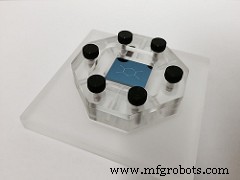
IBM Research’s 2 cm × 2 cm nanoDLD chip mounted in a microfluidic jig
Reinventing Point‑of‑Care Diagnostics
At IBM Research, a cross‑disciplinary team led by Dr. Joshua Smith, a master inventor and research scientist, and Dr. Gustavo Stolovitzky, program director of IBM Translational Systems Biology and Nanobiotechnology, has been reimagining silicon technology for biomedical use. Their goal: to separate nanoscale particles—such as viral components and tumor‑derived vesicles—from easily obtained fluids like urine or saliva.
Current separation methods demand expensive equipment, a full laboratory, and skilled technicians, making frequent screening impractical. A chip‑based nanotech solution could offer a simple, affordable, and rapid alternative that empowers clinicians to detect disease even before symptoms arise.
nanoDLD: The Engine Behind the Innovation
Using nanoscale deterministic lateral displacement (nanoDLD), a liquid sample flows through a silicon chip patterned with an asymmetric pillar array. This design sorts particles by size: smaller particles zig‑zag along the flow, while larger ones are displaced laterally, akin to vehicles forced into the correct lane on a freeway. The result is a continuous, size‑resolved separation down to tens of nanometers.
Smith and Stolovitzky’s team has successfully isolated exosomes as small as 20 nm—roughly 1/5,000th of a human hair—alongside DNA, viruses, and protein complexes. These tiny bioparticles can carry crucial information about early disease onset, viral exposure, or disease progression.
“The societal impact of this research is that it could enable physicians to detect cancer early…when there are more possibilities of being cured,” said Stolovitzky. “We aim to create a small, affordable diagnostic tool capable of detecting minute biomarker quantities that inform clinicians about a patient’s health.”
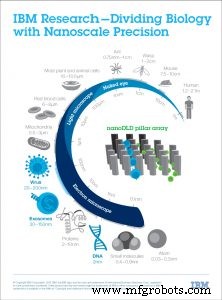
Scale of biology from human to atoms and the new nanoscale ranges that IBM Research’s nanoDLD device can reach [full infographic]
Exosomes: Tiny Messengers, Big Insights
In collaboration with the Mount Sinai Health System, led by Dr. Carlos Cordon‑Cardo, Mount Sinai’s expertise in cancer pathology complements IBM’s bioinformatics and nanofluidic technology. Exosomes—cell‑derived vesicles found in blood and urine—serve as rich reservoirs of proteins, DNA fragments, and RNA, offering a noninvasive snapshot of cellular communication.
“Cells send messages via exosomes, encapsulating proteins, DNA, and RNA. By decoding these envelopes, we can gain early warning signals of disease,” explained Cordon‑Cardo. “Exosomes could become the cornerstone of preventative healthcare, allowing us to identify problems before they manifest clinically.”
With the nanoDLD chip, clinicians can “eavesdrop” on intercellular conversations, monitoring shifts in exosomal content that precede overt pathology. Regular monitoring could transform disease management into a proactive, rather than reactive, endeavor.
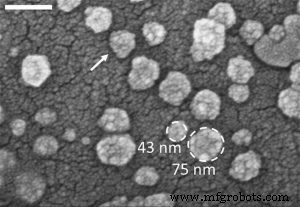
Electron micrograph of exosomes on a surface.
Prostate Cancer: A Case Study in Early Detection
Prostate cancer remains the most common cancer among men in the United States. Current screening relies on prostate‑specific antigen (PSA) tests, which can produce false positives and negatives. By analyzing exosomal biomarkers, the IBM–Mount Sinai partnership hopes to identify disease with higher sensitivity and specificity.
“Exosomes reveal what a cancer cell is processing without needing to touch the tumor,” said Stolovitzky. “By detecting their presence and content, we can gain insights into the tumor’s biology early on.”
From Bench to Bedside
The team’s recent publication in Nature Nanotechnology (DOI: 10.1038/NNANO.2016.134) details the nanoDLD chip’s ability to separate exosomes down to 20 nm. Next steps include increasing throughput, refining the chip to capture particles smaller than 20 nm, and validating biomarkers in clinical samples. Once proven, the platform will evolve into a clinical‑grade, point‑of‑care device that could mirror the impact of the pregnancy test on women's health.
Footnote:
*Nature Nanotechnology: Nanoscale Lateral Displacement Arrays for Separation of Exosomes and Colloids Down to 20 nm, DOI: 10.1038/NNANO.2016.134
Benjamin H. Wunsch (IBM Research), Joshua T. Smith (IBM Research), Stacey M. Gifford (IBM Research), Chao Wang (current affiliation: Arizona State University), Markus Brink (IBM Research), Robert Bruce (IBM Research), Robert H. Austin (Princeton University), Gustavo Stolovitzky (IBM Research), and Yann Astier (current affiliation: Roche Molecular Systems)
Nanomaterials
- Microchip Launches Defense‑Grade PolarFire SoC FPGA with Early Access Program
- Farmaid: Autonomous Robot for Precise Plant Disease Detection & Marking
- BP partners with MIT and Manchester to pioneer materials and corrosion science
- Revolutionizing Early Disease Detection with Nano‑Scale Biotech
- Stability and Natural Convection of TiO₂‑Water Nanofluid in Rotated Enclosures: Experimental Findings
- Smartphone-Enabled Plasmonic ELISA for Ultra‑Sensitive Myoglobin Detection at Point of Care
- Silicon‑Based Photodetectors with Resonant Cavities for Near‑Infrared Polarimetric Sensing
- Speed-Locking of Particles on Graphene under Traveling Surface Waves
- Detect Coughs with TinyML on Arduino Nano for Early Flu Detection
- E‑Health: Affordable Sensors for Early Disease Detection