



Harnessing Twisted 2D Materials to Revolutionize Electronics
Nanotechnology refers to the manipulation of matter at the scale of a few nanometers (nm). For context, a sheet of paper is roughly 100,000 nm thick. By mastering the unique phenomena that emerge at this scale, scientists can develop devices that are smaller, faster, and more energy‑efficient.
At IBM Research, and with support from government partners, researchers are probing the nanoscale to boost power density and energy efficiency across the entire spectrum of electronics—from smartphones and IoT sensors to the massive cloud data centers that power the internet.
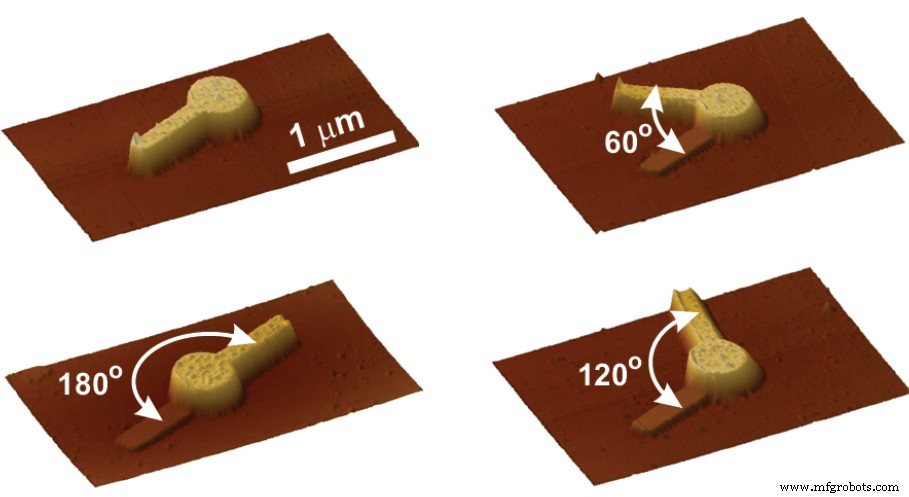
Figure 1: A nano‑sized key‑shaped device that can be rotated 0°–360°, functioning as a switch to control the current in a tunnel field‑effect transistor (TFET).
One pioneering effort is led by Dr. Elad Koren of IBM’s Zurich lab. Funded by the Swiss National Science Foundation’s Ambizione program, the team investigates the fundamental physics of stacking two‑dimensional (2D) materials, with a particular focus on graphene.
Graphene’s exceptional electronic properties make it a frontrunner for future semiconductor and quantum devices. When two identical graphene layers are stacked at precise relative angles, they form periodic superlattices that can open a bandgap—an essential step toward creating next‑generation transistors that are both powerful and energy‑efficient.
In September 2016, Koren and colleagues published their first results in the peer‑reviewed journal Nature Nanotechnology. Using the tip of an atomic force microscope, they achieved sub‑degree control over the rotational alignment of the layers, producing the key‑shaped device shown in Figure 1.
The device can rotate through a full 360°, acting as an ultra‑precise switch for a TFET. This capability is critical for minimizing leakage currents and reducing the overall energy consumption of electronic circuits.
“We have achieved unprecedented accuracy in controlling the rotational configuration with an angular resolution better than 0.1°, enabling both fundamental studies and the realization of practical devices,” said Koren.
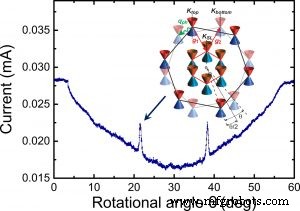
Measured current through the twisted graphite nanostructure at a bias of 50 mV while continuously rotating the lever arm. Inset: momentum‑space representation of bilayer graphene coupling at commensurate twist angles of 21.8° and 38.2°.
Precise control over the stacking angle allows engineers to tailor a wide range of physical properties—electronic, optical, thermoelectric, and electromechanical—opening avenues for innovative materials across science and technology.
When a single crystal cell is twisted, it generates a high magnetic flux that gives rise to the Hofstadter’s butterfly—a theoretical pattern describing electron behavior in strong magnetic fields combined with periodic potentials.
Friction remains a challenge even at the nanoscale, where it can generate heat, wear, and energy loss. However, the rotational mismatch in 2D layered systems suppresses friction dramatically, a phenomenon known as superlubricity.
“There is virtually no friction—once you find the right angle, the layers glide smoothly,” explained Koren.
By sharing these findings with the broader research community, Koren hopes to inspire novel material and device concepts that will shape the future of electronics.
Nanomaterials
- How Live TV Will Transform: The Computing‑Driven Future of Broadcast
- Azure vs. AWS: Which Cloud Certification Paves the Path to Career Success?
- Industry 4.0: Materialise’s Blueprint for the Networked Factory
- Collaboration: The Path to the Factory of the Future
- Smart Cities: Leveraging 5G, IoT, and Fiber for a Net‑Zero Future
- Powering the Future: Innovative Energy Management for Manufacturers
- Hydrogen Fuel: Revolutionizing Logistics for a Sustainable Future
- Robots-as-a-Service vs. SaaS: Which Technology Trend Will Shape Tomorrow's Automation
- Choosing the Best Wind Turbines: Future Trends & Performance Insights
- 4D Printing: Revolutionizing Additive Manufacturing for Adaptive Solutions