



How Engineers Assess Plastic Material Strength: Key Mechanical Properties Explained
When engineers select a plastic for a specific application, the first reference is the material data sheet. These sheets, widely available online for most plastics, compile essential values for physical, mechanical, thermal, and electrical properties. They also disclose the ASTM, ISO, or UL test methods used, the units of measurement, and the raw data. For instance, a density value might be reported as 1.20 g/cm³, determined by ASTM D792.
Below is a concise overview of the most critical mechanical properties that determine a material’s strength and suitability for a given use:
- Ultimate Tensile Strength (UTS) – The maximum stress a plastic can endure while being stretched before failure. It is expressed in MPa or psi and represents the peak of the stress–strain curve. Brittle plastics often exhibit a sharp fracture with no distinct yield point, making UTS a pivotal metric.
- Tensile Stress at Break (Ultimate Tensile Stress) – The stress applied just before the material ruptures. Calculated as force divided by cross‑sectional area (F/A), it is also reported in MPa or psi.
- Flexural Modulus (Bending Modulus) – Measures resistance to bending. It is the ratio of flexural stress to strain, defined in units of force per area. ASTM D790 specifies the test method.
- Flexural Strength – The maximum stress a material can withstand in a flexural test before breaking. ASTM D790 also governs this measurement.
- Young’s Modulus (Tensile Modulus) – Also known as the Modulus of Elasticity, it quantifies a material’s stiffness. A higher value indicates a more rigid polymer.
- Shear Strength – The force per unit area required to cause shear failure, adjusted for material density. It reflects how well a plastic resists internal sliding forces.
- Rockwell Hardness – A widely accepted hardness test that measures a polymer’s resistance to indentation. The Rockwell scale is one of the most recognized hardness metrics in the industry.
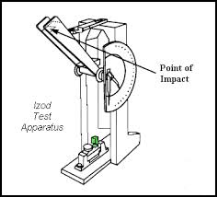
- Izod Impact Strength (Notched) – An ASTM standard test that assesses a material’s ability to absorb energy under impact. The specimen, a vertical cantilever beam, is struck by a swinging pendulum; the absorbed energy is measured in joules per unit thickness.
- Elongation at Break – The ratio of the final length to the original length after fracture. It indicates how much a material can deform plastically before cracking.
Why ASTM matters – The American Society for Testing and Materials (ASTM) develops voluntary technical standards that are globally recognized. Using ASTM‑approved test methods ensures that the reported values are reliable and comparable across suppliers.
Questions? Let me know in the comments below.
Looking for more information on material properties? Download our free Plastic Manufacturing Glossary.


Resin
- Plastic Wear: Causes, Mechanisms, and How to Design for Durability
- How Plastic Materials Are Driving Advances in Space Exploration
- Acetal, Delrin AF, and PTFE: Premium Plastic Bearing Materials
- DSM Introduces Trosar UHMWPE: Enhanced Strength & Durability for High-Performance Applications
- How Waste Costs Impact Materials, Time, and Profitability
- Kraibon Elastomers: Enhancing Adhesion & Composite Performance Across Industries
- 14 Key Mechanical Properties of Materials: A Practical Guide
- Delrin (POM) Plastic: Properties, Grades, and Uses in CNC Machining
- The Role of Friction Materials in Vehicle Brakes and Industrial Applications
- Hardness, Strength & Toughness: Key Metal Properties Explained