



Additive Manufacturing Landscape 2019: 171 Companies Powering Industrial 3D Printing Growth (Updated)
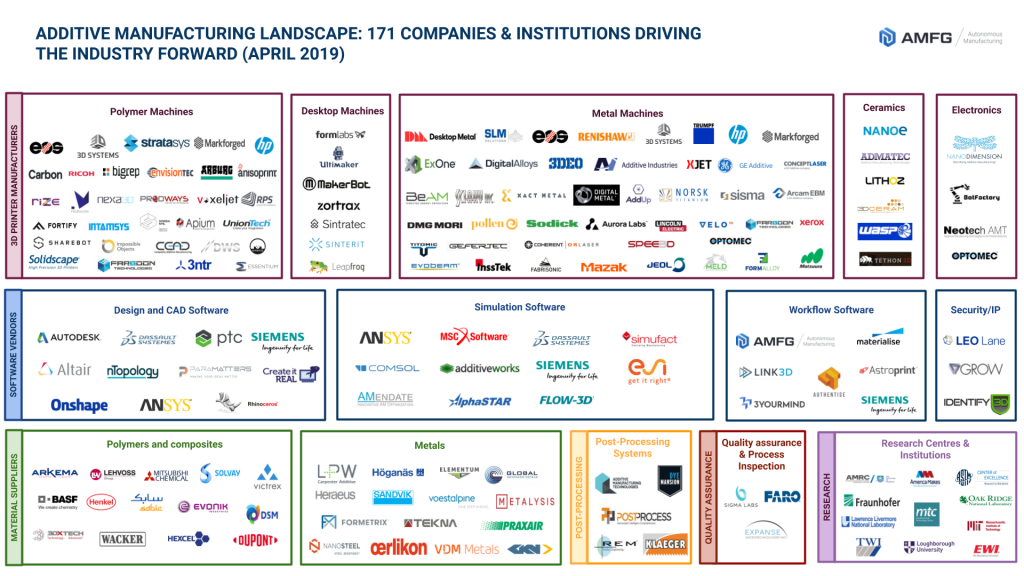
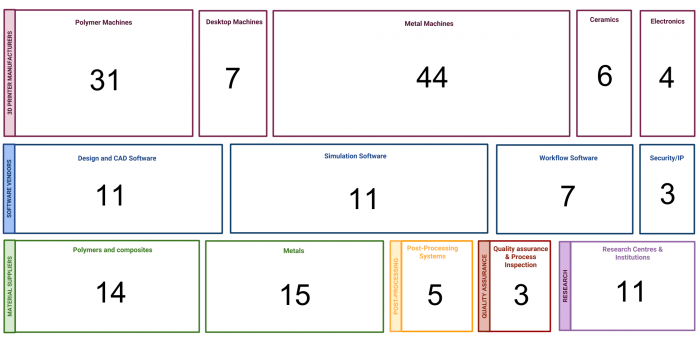
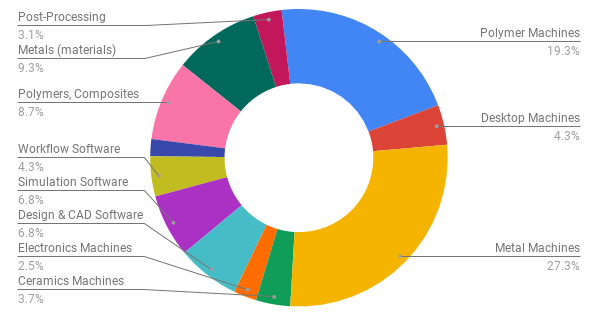
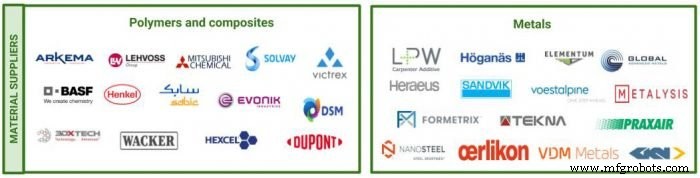
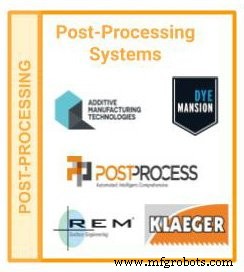
Update 26/05/2020: We’ve released our Additive Manufacturing Landscape 2020 report and infographic, covering 231 organisations driving digital manufacturing. Explore the full article. Over the past decade, additive manufacturing (AM) has evolved from a niche prototyping tool into a cornerstone of industrial production. By 2019, the AM market was valued at over $9 billion—an impressive stride within the broader $12 trillion manufacturing economy—and its rapid expansion is reshaping how products are designed, prototyped, and produced. New entrants and technological breakthroughs are accelerating this shift, creating unprecedented opportunities for manufacturers, investors, and technology providers alike. Keeping pace with this dynamic landscape can be challenging. In February 2019, AMFG introduced the first Additive Manufacturing Landscape—a visual map of the sector’s leading players. The goal was to give stakeholders a clear snapshot of the market and a benchmark for future growth. The infographic’s popularity exceeded expectations, prompting us to expand the dataset and publish a detailed whitepaper outlining key insights. Below is the updated landscape and a concise summary of the sector’s most important trends. The AM ecosystem is vast and fast‑moving. Our Landscape visualizes 171 companies that are actively driving industrial 3D printing forward. The firms are grouped into six categories: To maintain focus on industrial 3D printing, we included only B2B companies that offer core AM products and services. Consumer‑focused printers and pure service bureaus were excluded, with plans to cover those segments in future iterations. Highlights from the Landscape: Hardware leads the Landscape, with firms delivering faster, more precise, and production‑ready systems. Many manufacturers now cross‑sell materials and software, creating integrated ecosystems. From Stratasys and EOS to newer entrants like Carbon and Nexa3D, polymer AM is moving from prototyping to end‑use parts. Carbon’s CLIP and DLS technologies, coupled with partnerships with Adidas, Ford, and Lamborghini, exemplify the maturity of this segment. Desktop 3D printers have pivoted from consumer hobbyist tools to enterprise‑grade devices. Formlabs and Ultimaker dominate the market, offering affordable yet industrial‑grade solutions—Formlabs’ Form 2 SLA starts at $3,350 and its new Fusion 1 SLS is priced around $10,000. Metal printing has surged, with an 80% increase in sales reported in 2018. Established players like EOS, 3D Systems, and SLM Solutions coexist with newcomers such as Desktop Metal, HP’s Metal Jet, and Digital Alloys’ Joule technology, which uses metal wire to address cost and speed challenges. Design & CAD, simulation, workflow, and security software are essential for a production‑ready AM workflow. Major vendors—Autodesk, Dassault Systèmes, ANSYS, and PTC—continue to acquire specialized firms to deepen their AM capabilities. These categories remain dominated by industry giants integrating generative design and topology optimisation into their platforms. Recent acquisitions, such as ANSYS’ purchase of 3DSIM and Granta Design, reinforce this trend. Workflow SaaS solutions manage end‑to‑end AM production. As 3D printing becomes mainstream, the demand for such tools is expected to grow sharply. Protecting IP and data is critical. Leading vendors—LEO Lane, GROW, and Identify 3D—offer encryption, secure distributed manufacturing, and file‑level protection, a niche poised for expansion. While most suppliers are established materials companies, the push into 3D‑printable offerings has spurred competition and price reductions. Polymers remain the largest segment, with high‑performance materials like PEEK and ULTEM driving industrial adoption. Metal powders, particularly titanium alloys, are also expanding rapidly—Titanium shipments grew 32% in 2018, with forecasts of 24% growth in alloy revenues for 2019. Automated post‑processing solutions are emerging to tackle a traditionally labor‑intensive step. Additive Manufacturing Technologies’ PostPro3D, PostProcess Technologies, and DyeMansion offer surface finishing, support removal, and high‑volume finishing systems, respectively. The AM Landscape demonstrates a clear trajectory toward industrial maturity. With continued innovation, new entrants, and strategic partnerships, the sector is set to disrupt the $12 trillion manufacturing market. Investors and companies that engage early stand to benefit from the rapid evolution of hardware, software, materials, and services. Click here to download the full Additive Manufacturing Landscape whitepaper.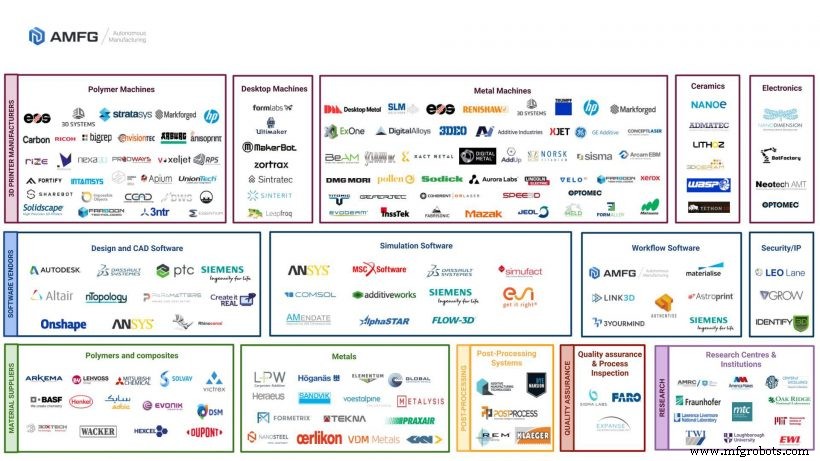
What Is the Additive Manufacturing Landscape?
Who Is Included?
Key Takeaways
Segment Deep‑Dive
Hardware

Polymer Systems
Desktop Machines
Metal AM Growth
Software

Design & CAD, Simulation
Workflow Software
Security
Materials
Post‑Processing
Future Outlook
3D printing
- How 3D Printing Drives Innovation, Efficiency, and Customization in the Automotive Industry
- Seven Key Trends That Shaped 3D Printing in 2018
- 25 Pivotal Milestones Shaping Additive Manufacturing in 2019
- 2020 Additive Manufacturing Landscape: 240 Companies Shaping Digital Manufacturing
- Manufacturing Today and Tomorrow: Insights, Trends, and Future Outlook
- Additive Manufacturing Explained: From Design to Finished Part
- Revolutionizing Aerospace: How Additive Manufacturing Enhances Performance and Efficiency
- Assessing Manufacturing Companies' Progress in Industry 4.0 Implementation
- Revolutionizing Auto Production: The Role of Additive Manufacturing
- Metal Additive Manufacturing: Transforming Production for Aerospace and Beyond