



Customer Spotlight: 3D‑Printed Sailboat Components Propel Olin’s Autonomous Sailing Team
Olin College’s Robotics Lab continues to showcase cutting‑edge technology. While the Mark One printer recently helped design impact‑resistant quadcopter landing gear, its real‑world versatility shines in another arena: autonomous sailing.
For nearly five years, the Olin Robotic Sailing Team (ORS) has been crafting fully autonomous sailboats for the International Robotic Sailing Regatta (IRSR). Their ambition is clear: build the first robotic vessel capable of crossing the Atlantic. This year, the team upgraded from 1‑2 m prototypes to a 4 m Sunfish‑class boat, christened Enterprise.
Scaling a boat presents significant mechanical challenges. Larger sails and a heavier hull demand stronger wind‑tolerance, especially during the IRSR in Kingston, Ontario. To actuate a robotic sailboat, you need reliable systems for rudder control, sail retraction, and real‑time wind sensing. While smaller prototypes use a simple winch, Enterprise required a sophisticated sheet‑tensioning and gust‑release mechanism to keep the sail taut yet release during sudden gusts.
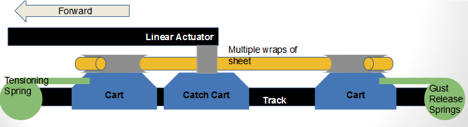
During winter and spring 2016, ORS undertook an intensive fabrication schedule to ready Enterprise for early‑June competition. The team anticipated forces of several hundred pounds on the sails under Lake Ontario’s strong winds. Although the winch system distributed load via pulleys, the actuator mount still had to withstand sudden gusts.
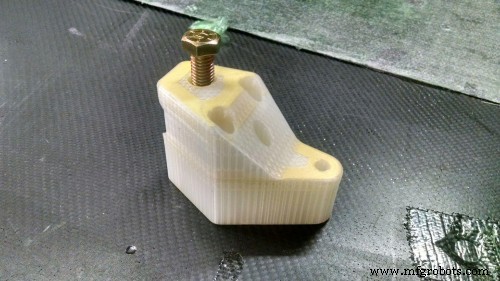
The actuator and critical electronics were housed in a waterproof forecastle at the bow, leaving limited space. With tight deadlines and competing priorities, the team turned to Olin’s Mark One to print a custom linear‑actuator mount that met both strength and size constraints.
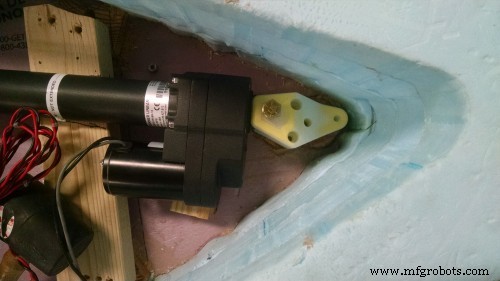
Initially, the viability of a 3D‑printed bracket seemed doubtful. The mount had to be exceptionally robust to absorb impact and resist wind‑induced shocks. Using the desktop Markforged printer, ORS reinforced the bracket with Kevlar fibers, achieving the required durability without sacrificing weight.
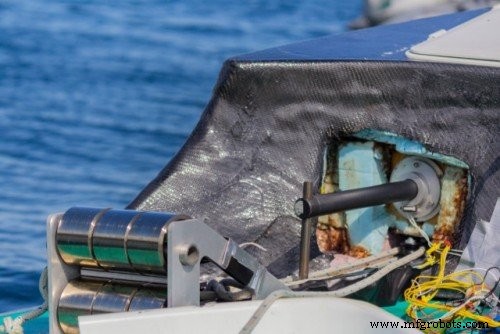
Thanks to rapid prototyping, the team delivered a seaworthy design on schedule. At the IRSR, Enterprise not only stood as the largest vessel on the water but also demonstrated the feasibility of large‑scale 3D printing for maritime robotics. Sailors in the Boston area should keep an eye out for Enterprise in the near future.
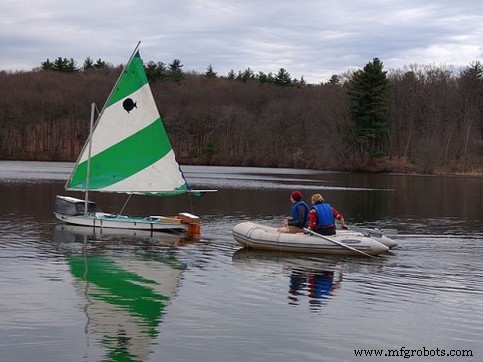
Photos and images courtesy of William Lu and the Olin Robotic Sailing Team.
Not sure how you can use the Mark Two? Request a demo today and find out for yourself!
3D printing
- 3D Printing for Turbine Parts: Accelerating Development, Performance, and Sustainability
- Revolutionizing Robotic Grippers with 3D Printing: Insights and Industry Successes
- Award‑Winning 3D‑Printed Miniature Satellite Triumphs at India’s First CanSat Challenge
- In‑Process Inspection: Elevating 3‑D‑Printed Part Quality
- 3D‑Printed Drone Enables Rapid, Cost‑Effective Data Collection in Antarctica
- Customer Part of the Month: Showcase Your 3D‑Printed Innovation
- Customer Spotlight: Custom CVT Impellers Power Olin Baja MiniBaja Racing Team
- Wärtsilä's First CE‑Certified 3D‑Printed Lifting Tool: A Game‑Changing Innovation
- Guaranteeing Dimensional Accuracy in 3D Printed Parts
- Are 3D Printed Parts Really Strong?