



Auburn University Advances Assistive Technology: 3D‑Printed Prosthetics Revolutionize Care
Both 3D printing and advanced composite materials—particularly carbon fiber—are reshaping prosthetics. At Auburn University, students use the Mark One 3D printer to design and prototype innovative assistive devices that address real‑world needs.
Associate Professor Jerrod Windham of Auburn’s School of Industrial and Graphic Design leads a semester‑long project that has been evolving for nine years. Each term, rehabilitation and industrial design students partner with users who have physical disabilities, working from initial concept to a functional prototype that meets the user’s specific goals. “By the end of the semester we hand off a piece of technology that actually works for them,” Windham explains.
Recent projects focused on enhancing the lives of prosthetic users. Tasks ranged from creating a sleeve that lets someone with a leg prosthetic comfortably pull on pants, to developing a shoulder‑attachment system that enables a woman with a shoulder disarticulation to play the cello. The breadth of challenges required students to explore a wide array of materials and design solutions.
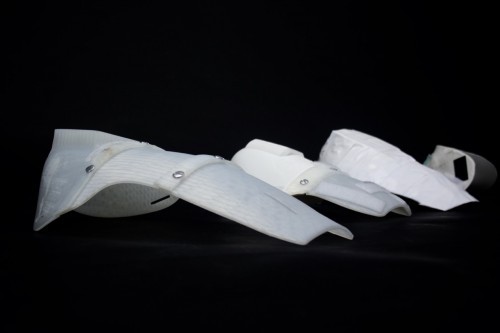
The Mark One stands out in the lab for its ability to print fiber‑reinforced plastics with an exceptional strength‑to‑weight ratio. While many 3D‑printed prosthetic parts are used for hands, achieving the durability needed for leg or foot devices is more demanding. “We needed a structure that could support the weight of a human body, so the strength‑to‑weight ratio was critical,” Windham notes.
Carbon fiber 3D printing with the Mark One provides an ideal blend of lightweight strength. For the cello‑playing project, the team scanned the user’s shoulder and chest, then used CAD software to design a shell that fit snugly over the shoulder blade. Printing in Markforged nylon gave the prototype the flexibility to conform comfortably to the body—an advantage over brittle PLA or ABS.
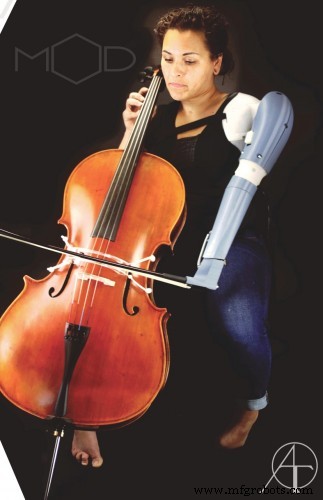
“The device we created lets her hold a bow and articulate the arm to play the cello again—a passion she hadn’t pursued since childhood,” Windham says. Each student’s project is tailored to the individual, whether it’s a father missing three fingers who wants to shake hands and play baseball with his son, or an amateur fisherman needing a water‑resistant fairing for his prosthesis.
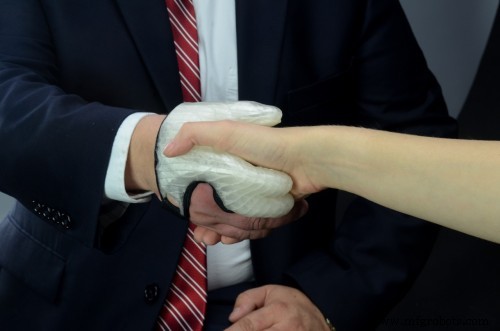
These projects are more than prototypes; they are durable, functional solutions that bring meaning back into users’ lives.
See more of the students’ design process here.
Photos courtesy of Jerrod Windham
Interested in the Mark Two? Request a demo and experience the printer’s performance for yourself!
3D printing
- Revolutionizing Injection Molding with Stratasys PolyJet Technology
- 3D‑Printed Prosthetics: Transforming Access and Affordability for Amputees
- Revolutionizing Sand Casting with Stratasys FDM Technology
- Crafting a Custom 3D‑Printed Steering Wheel for a Go‑Kart: Lighter, Comfortable, and Modifiable
- MarkForged Mechanical Features #1: Mastering 3D Printed Living Hinges
- How 3D‑Printed Assistive Devices Are Improving Lives for Children with Disabilities
- Boy Machines: Advancing Small-Scale Production with Cutting-Edge Technology
- Students Build Advanced B&R-Powered Robotic Garbage‑Sorting System
- Calculating SLS 3D Printing Costs: A Step-by-Step Guide for Sinterit Lisa & Lisa Pro
- PPprint: Expert FDM 3D Printing of Polypropylene Parts