



Combinational Logic Functions: Fundamentals & Practical Applications
The term "combinational" originates from mathematics, where a combination is an unordered set. In this context, the order of input changes does not affect the circuit’s output. Consequently, a combinational logic circuit delivers the same result regardless of the sequence in which its inputs are applied.
In contrast, circuits that depend on the timing of input transitions are known as sequential logic. Although the term "sequential logic" does not appear in the chapter titles, upcoming sections will cover these concepts in depth.
Real‑world digital designs combine both types of logic: sequential elements ensure proper ordering and synchronization, while combinational blocks perform arithmetic, logical operations, and data conversion.
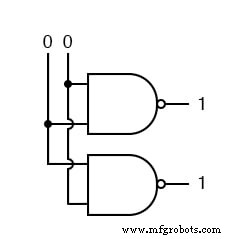
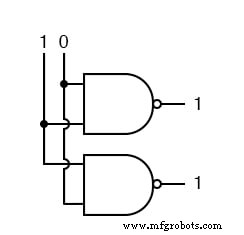
Every logic gate we’ve discussed so far—AND, OR, XOR, NOR, XNOR, and NOT—is inherently a combinational function. To illustrate, let’s examine a pair of NAND gates and observe their behavior when the inputs are applied in different orders.
We start with both inputs low:
Next, we raise the first input:
Finally, we raise the second input:
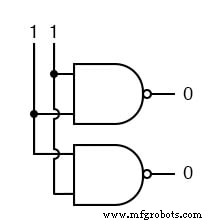
These results confirm that NAND gates—and, by extension, all other gates mentioned—are truly combinational: the output depends solely on the present input values, not on the order in which those values arrive.
RELATED WORKSHEET:
- Boolean Algebra Worksheet
Industrial Technology
- Foundations of DC Circuits: Understanding Direct Current and Core Electrical Concepts
- Understanding AC Circuits: A Beginner's Guide
- Getting Started with SPICE: A Text‑Based Circuit Simulation Tool
- Understanding Digital Logic Functions: OR, AND, NOT, and Beyond
- Understanding Boolean Algebra: From Logic Foundations to Digital Circuits
- Foundations and Advancements of AC Motor Technology
- Exploring FPGAs: Applications, Benefits, and Getting Started with VHDL
- Designing Combinational Logic in Verilog Using Continuous Assign Statements
- Implementing Combinational Logic Using Verilog's always Block
- Understanding Electrical Harmonics: Part 1 – Fundamentals & Impact