



Fundamentals of Radio: How Electromagnetic Waves Are Generated and Transmitted
One of the most intriguing applications of electricity is the creation of invisible ripples of energy known as radio waves. While this lesson focuses on alternating current, we’ll outline the core principles that underpin radio technology.
Oersted’s accidental discovery of electromagnetism revealed a profound link between electricity and magnetism. When an electric current flows through a conductor, it generates a magnetic field perpendicular to the direction of current. Conversely, exposing a conductor to a changing magnetic flux induces a voltage along its length.
Scientists had long observed this perpendicular interaction, but the deeper connection—unveiled by James Clerk Maxwell—was transformative for modern science.
Relationship of Electric and Magnetic Fields
Maxwell’s breakthrough unified electricity and magnetism into four elegant equations, showing that electric and magnetic fields are intrinsically linked even without a conducting path. In concise terms:
- A changing electric field produces a perpendicular magnetic field.
- A changing magnetic field produces a perpendicular electric field.
These mutually reinforcing fields can propagate through empty space at the speed of light, forming what we call an electromagnetic wave. Light, X‑rays, and gamma rays are all electromagnetic radiation; the only distinction lies in their oscillation frequency.
By applying an AC voltage to a specially designed device called an antenna, we can generate low‑frequency electromagnetic waves that serve as the foundation of radio communication.
Types of Antenna
An antenna is a device engineered to radiate or capture electromagnetic fields. Two fundamental antenna designs are the dipole and the loop, illustrated below:
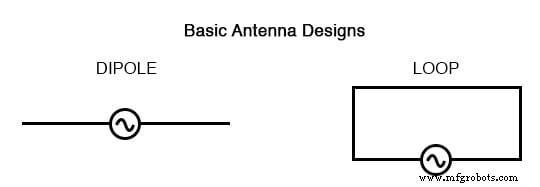
Dipole and loop antennas.
The dipole resembles an open circuit, while the loop functions like a short circuit. When driven by an AC source at the appropriate frequency, both configurations become effective radiators.
The dipole’s two separated wires act as a capacitor, allowing the electric field to radiate outward. The loop’s closed path behaves as an inductor with a large air core, enabling the magnetic field to disperse. In both cases, the alternating field produces a complementary field at right angles, sustaining the electromagnetic wave as it travels.
Functions of an Antenna
When coupled to a high‑frequency AC source, an antenna serves as a transmitter, converting electrical energy into electromagnetic waves. Conversely, when placed in an electromagnetic field, it can function as a receiver, converting incoming waves back into electrical signals:
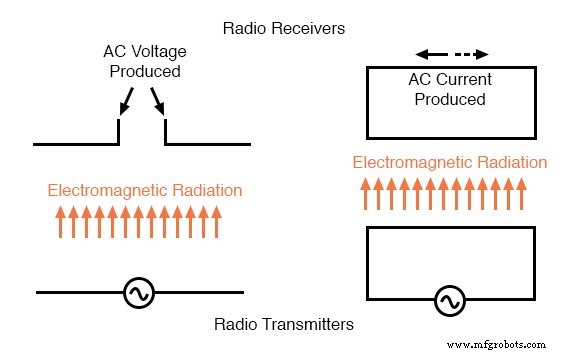
Basic radio transmitter and receiver.
While antenna technology is vast, this overview provides the essential concepts and may inspire hands‑on experimentation.
REVIEW:
- James Maxwell showed that changing electric fields generate perpendicular magnetic fields—and vice versa—even in free space.
- Electromagnetic waves consist of twin electric and magnetic fields oscillating at right angles and traveling at light speed.
- An antenna radiates a changing electric or magnetic field when powered by high‑frequency AC, or captures such fields and converts them to electrical signals.
- The dipole antenna, made of two non‑touching wires, primarily emits an electric field when energized.
- The loop antenna, a closed wire loop, primarily emits a magnetic field when energized.
RELATED WORKSHEETS:
- Basic Electromagnetism and Electromagnetic Induction Worksheet
Industrial Technology
- Detecting AC Electric Fields: A Hands‑On Guide to Electrostatic Coupling and Shielding
- Build a High‑Performance Class B Push‑Pull Audio Amplifier with TL082 Op‑Amp
- Crystal and Transistor Radio Circuits: From Basic Detectors to Integrated AM/FM Receivers
- Electric Fields and Capacitors: Fundamentals, Functionality, and Design
- Electromagnetism: From Oersted’s Discovery to Modern Applications
- The Electric Guitar: History, Design, and Modern Innovations
- The Evolution and Engineering of Radio Technology
- Electric‑Field‑Induced Band‑Gap Transition in Monolayer InSe: From Indirect to Direct and Back
- Build a Reliable FM Radio with SparkFun & Arduino Components
- Mastering Centerless Grinding: 8 Key Principles for Precision Machining