



Key Testing Parameters for Electric Vehicle Batteries
This article outlines the critical safety tests and standards that electric vehicle battery systems must meet.
The rapid rise in electric vehicle (EV) adoption is driving manufacturers to deliver more affordable models. At the core of every EV battery and battery management system (BMS) design is safety. Industry safety is achieved through rigorous regulation, certification, and, most importantly, comprehensive testing.
In the sections that follow, we’ll examine the main testing domains that battery standards cover and why they matter for real‑world deployment.
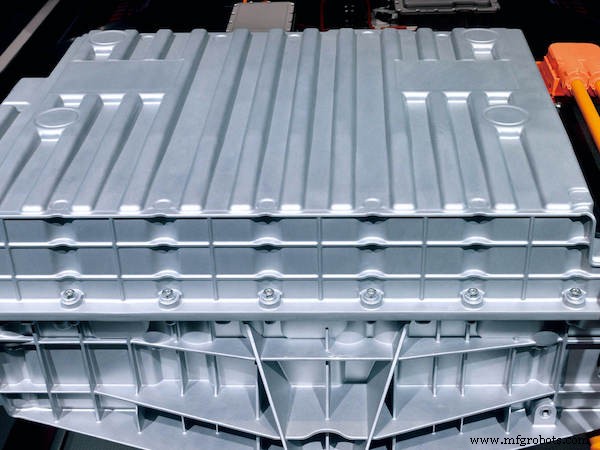
EV batteries must undergo exhaustive testing to prove they’re safe for commercial use. Image courtesy of UL (Underwriter Laboratories).
Why EV Battery Testing Matters
EVs rely on high‑power, high‑capacity lithium‑based cells that store more energy per kilogram than conventional fuel. This advantage comes with increased risk: a single failure can release flammable gases and generate intense heat, potentially igniting a fire or even a flame‑thrower‑like effect. Vehicles also face everyday mechanical stresses and collisions, so batteries must contain layered safety mechanisms that prevent ignition under all circumstances.
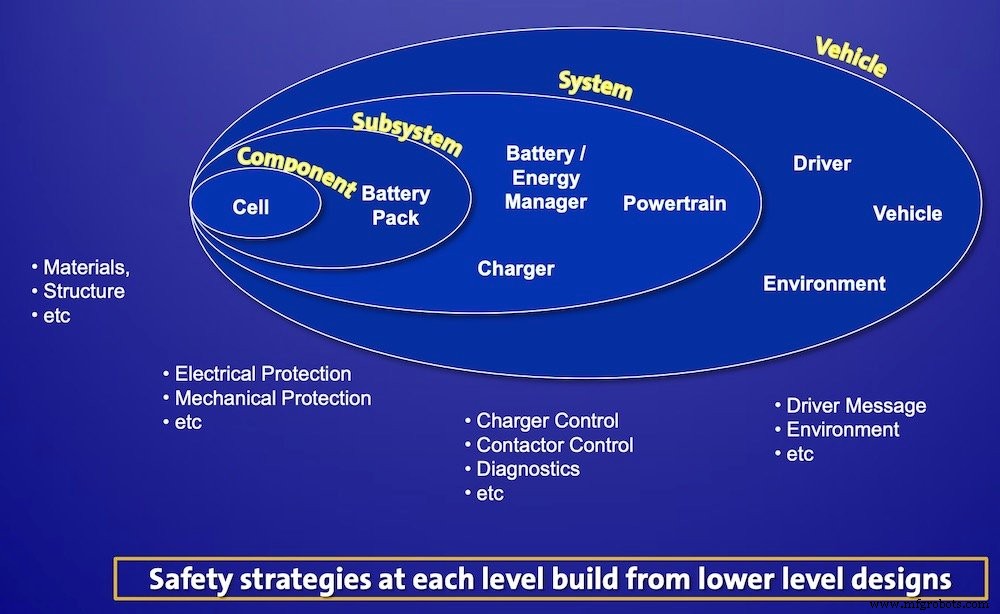
“Safety strategies” for each EV system level, as presented by GM for the United Nations Economic Commission for Europe, 2013.
EV Testing Parameters
As with any engineering effort, the first step is to understand the operating environment. For automotive batteries, the key stressors include:
- Mechanical: Vibrations from wheel motion, uneven roads, and potential collision impacts. Batteries must survive prolonged vibration and high‑energy impacts without igniting or leaking hazardous gases.
- Temperature: High currents raise internal temperatures, while extreme ambient conditions demand low‑temperature performance. Thermal cycling, hot sun exposure, and cold nights all impose daily thermal stress that designs must accommodate.
- Electrical: Voltage ramps during charge and discharge, mains supply spikes, and over‑charge scenarios can cause overheating or internal short circuits. Proper cable sizing, fuse settings, and protection circuitry are essential.
Types of Testing for Compliance
Regulatory bodies like ISO (over 40 standards covering everything from component safety to V2X protocols) and UL (Underwriter Laboratories) define the testing matrix. UL 2580, for example, specifies how EV batteries should tolerate abuse across a broad spectrum of conditions. The tests are designed to confirm that batteries can endure:
- Standard thermal tests: Storage at various temperatures.
- Thermal abuse: Sudden exposure to high temperatures.
- Loss of cooling: Operation without active thermal management.
- Mechanical vibration: Long‑term vehicle vibrations.
- Mechanical shock: Sudden impacts.
- Impact and crush: Collision‑induced compression.
- Penetration: Resistance to cell shorting or puncture.
- Electrical short circuit: Ability to handle internal shorts.
- Electrical overcharge: Over‑charge resilience.
- Forced discharge: Rapid discharge and gas buildup.
- EMC susceptibility: Resistance to electromagnetic interference.
- High‑voltage protection: Safeguarding against sudden voltage spikes.
- Shutdown integrity: Correct operation of emergency shutdown separators.
- Imbalanced charging: Safety during uneven charge states.
- Environmental: Altitude, moisture, humidity, and fire exposure.
- Water immersion: Safety when submerged.
Conclusion
Standards exist not only to harmonize hardware and software across the industry but also to enforce a minimum safety baseline. Compared to internal‑combustion vehicles, EV batteries are more susceptible to shock, vibration, temperature swings, and penetration. Strict adherence to the comprehensive testing regime outlined above is therefore essential to guarantee safety—even under the most hostile operating conditions.
Industrial Technology
- Optimizing Battery Performance: Parallel & Series‑Parallel Configurations for High‑Load Lamps
- Practical Battery Bank Design: Series vs Parallel, Protection, and Charging Best Practices
- Graphene Batteries Explained: The Future of Long-Lasting Energy
- Self‑Powered Sensors: Eliminating the Battery Barrier for Ubiquitous IoT
- Advancing EVs: Lightweight Composites for Structural Batteries
- Electric Vehicle Battery Systems: Design, Development, and Emerging Trends
- Essential Guide to Battery Types for Electronics Projects
- How to Test Your Alternator: Expert Methods for Reliable Results
- Battery Types Explained: Key Definitions & Insights
- Inside the Making of Car Batteries: From Cells to Power Packs