



Fabric Softener: From Early Innovations to Modern Formulations
History
A fabric softener is a liquid formulation applied during the rinse cycle that imparts softness, reduces static cling, and adds fragrance to laundry. The first commercial products emerged in the early twentieth century when the textile industry sought to improve the harsh feel of dyed cotton fibers. Early cotton softeners typically mixed seven parts water, three parts soap, and one part olive, corn, or tallow oil, providing a simple yet effective conditioning layer.
Advances in organic chemistry soon yielded more sophisticated compounds, allowing manufacturers to offer stronger, longer‑lasting softness. By the 1960s, leading companies such as Procter & Gamble began selling liquid softeners for home use, and popularity surged in the 1970s as formulations incorporated improved fragrances and softness profiles.
Initially, softeners could not be added alongside detergents because their cationic conditioning agents would react with anionic surfactants. Consumers therefore had to perform an extra rinse cycle to soften garments. In the late 1970s, manufacturers introduced dryer sheets—a convenient sheet format that delivers many softening benefits directly in the dryer, though liquid softeners remain preferred for their superior performance.
In the 1990s, environmentally conscious brands launched ultra‑concentrated formulations that used only a quarter of the product volume, enabling smaller packaging. While cost‑effective, these concentrates often carried a higher price point and uncertain consumer appeal.
By the end of the decade, U.S. sales of liquid fabric softeners had reached approximately $700 million annually across supermarkets, drug stores, and mass merchandisers, compared to $400 million in dryer sheet sales. Procter & Gamble (Downy) and Lever Brothers (Snuggle) dominated roughly 90 % of the market, with private label brands accounting for the remaining 10 %.
Design
Product chemists craft fabric softeners to meet a spectrum of consumer‑desired attributes: superior softness, enhanced iron glide, reduced wrinkle formation, improved color retention, and robust stain protection. Formulations must also be safe, environmentally friendly, aesthetically pleasing, and cost‑effective. Through technical evaluation and consumer testing, chemists balance efficacy with affordability.
Raw Materials
Conditioning agents
Early softeners were simple fatty dispersions; the most common ingredient was dihydrogenated tallow dimethyl ammonium chloride (DHTDMAC), a quaternary ammonium compound. The positively charged head group binds to negatively charged fabric fibers, neutralizing static, while the fatty tail provides slip and lubricity.
Modern formulas combine quats with silicone‑based conditioners such as polydimethylsiloxane (PDMS) or amine‑functional silicones. These additives deliver deeper penetration into fibers and improved ironing ease while minimizing the reduction in absorbency that pure quats can cause.
Emulsifiers
Because conditioning agents are largely oil‑soluble, emulsifiers are essential to create a stable aqueous dispersion. Three emulsification strategies are used: macro‑emulsions (creamy oil‑in‑water), micro‑emulsions (clear, sub‑micron droplets that penetrate fibers), and emulsion polymers (solid polymer nets that suspend droplets). A balanced blend of non‑ionic and cationic emulsifiers typically achieves optimal deposition, while anionic surfactants are rarely used due to incompatibility with cationic conditioning agents.
Other ingredients
Fragrance, color, emulsion stabilizers, and preservatives round out the formulation, ensuring consumer appeal and shelf stability.
The Manufacturing Process
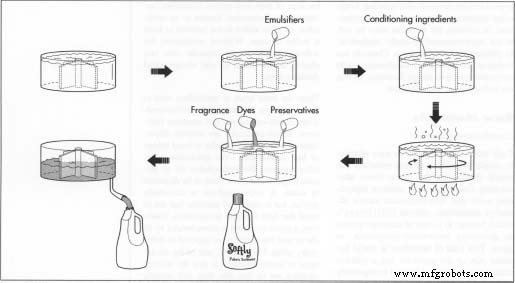
- Fabric softeners are manufactured in a single, jacketed stainless‑steel mixing vessel equipped with a propeller‑type high‑shear mixer. Deionized water (80‑90 % of the batch) is added first to serve as a carrier.
- Once the water reaches the target temperature, emulsifiers are introduced at 70‑80 °C. Emulsifier levels typically range from 1‑10 % of the batch.
- Conditioning agents follow, usually at 5‑10 % of the batch, with silicone additives added at 0.5‑1.5 %.
- Pre‑emulsified silicones are added later at lower temperatures; non‑pre‑emulsified silicones require high temperature and vigorous agitation.
- After homogenization, the batch is cooled and final additives—preservatives, dyes, fragrance—are incorporated at sub‑percent levels. The finished product is then sampled for pH, viscosity, and solids content before filling.
- Automated filling lines dispense the formulation into plastic bottles, cap them, and pack them into cartons for distribution.
Quality Control
Finished softeners undergo a battery of tests: basic lab checks for pH, viscosity, and solids; advanced functional assays such as the Drayes Wetting Test (measuring water absorption time), anti‑wrinkle scoring, and ease‑of‑ironing evaluations. Swatches of identical fabric are treated with either softener or detergent alone, then assessed in controlled conditions (22 °C, 65 % RH) after 24 hours of drying.
The Future
Key trends shaping the next generation of fabric softeners include the potential market acceptance of ultra‑concentrates and the rise of multifunctional formulas that simultaneously soften, reduce wrinkling, improve ironing, and protect against stains. Companies like Lever Brothers and Procter & Gamble have already introduced such multi‑benefit products.
Innovative delivery systems are also emerging. In the late 1990s, Procter & Gamble introduced the “Downy Ball,” a reusable plastic sphere that releases softener during the rinse cycle, eliminating the need for separate dispensers. Similar devices may gain traction as brands seek product differentiation.
Where to Learn More
Periodicals
Henault, Benoit. “A Fresh Look at Fabric Softeners.” Soap & Cosmetics (June 2001).
Turcsik, Richard. “The Soft Sell: Supermarkets are Hoping New Fabric Softener Formulations and Advertising Will Help Stem Market Share Erosion.” Supermarket News (21 August 1995).
Randy Schueller
Manufacturing process
- From Macintosh to Microfiber: The Evolution and Craft of Modern Raincoats
- Softening Tissues: How Lotion Enhances Comfort & Performance
- Bicycle Shorts Explained: Design, Materials, and Production Process
- Fabric, Fragrances & Flavors: The Science Behind Textiles and Aromatics
- Expert Classification of Fiberglass Fabric for Advanced Applications
- Broad Applications of Glass Fiber Fabric in Advanced Composite Materials
- 10 Key Applications of Glass Fiber Products Across Industries
- Fiberglass Fabric: Properties, Uses, and Handling Tips
- Intelligent Automated Industrial Fabric Cutting Machine
- Proven Strategies to Resolve Production Challenges in Fabric Manufacturing