



Softening Tissues: How Lotion Enhances Comfort & Performance
Background
Facial tissues are a staple in personal hygiene, prized for their absorbency, softness, and flexibility. To deliver an exceptionally gentle touch, manufacturers incorporate softening agents—or lotions—into the paper surface. These additives reduce friction and chafing, making tissues more pleasant against delicate skin.
Tissue production begins with a nonwoven fabric formed from a cellulose‑fiber slurry. The slurry is sheeted, coated with softening agents, and then cut, folded, and packaged. The challenge is to soften the sheet without compromising strength, absorbency, or environmental performance.
Softness is a tactile property influenced by flexibility, texture, and friction. Traditional softening methods—such as debonding agents or oily coatings—often weaken the paper or reduce moisture uptake. Modern formulations balance these factors by using carefully engineered blends of polyhydroxy compounds and low‑level oils, reinforced with surfactants that maintain water permeability and fiber integrity.
Raw Materials
Nonwoven Tissue Paper
Nonwoven tissue is made from cellulosic pulp sourced from wood, rayon, bagasse, or recycled paper. The fibers are macerated in a hydropulper and blended with a cooking liquor containing calcium, magnesium, ammonia, or sodium bisulfite. The result is a viscous slurry with ~0.5 % solids. Bleaching agents—chlorine, peroxides, or hydrosulfites—whiten the pulp, after which the mixture is thoroughly washed and filtered. This “furnish” is then ready for papermaking.
Lotion (Softening Additives)
Softening agents are oily or waxy substances that are applied as an emulsion. Because oils are hydrophobic, they must be dispersed in water with surfactants (e.g., cetyl alcohol) to create a stable mixture. Common lotion ingredients include vegetable and mineral oils, plant or animal waxes, and silicone‑based oils. Polyhydroxy compounds—glycerine, propylene glycol, polyoxyethylene glycol, and polyoxypropylene glycol—are added at 0.1–1 % of dry weight. These compounds interact with water, softening the surface without blocking moisture transport. The careful balance of oils and surfactants ensures the tissue remains absorbent while feeling silky to the touch.
The Manufacturing Process
Preparation of the Nonwoven
The pulp slurry is introduced into a headbox and spread onto a Fourdrinier wire mesh. As fibers travel down the 15 m belt, water drains through the mesh, and the wet sheet is compressed by a series of woolen felts and rolls. The resulting semi‑dry web is transferred to a Yankee dryer—an 10–12 ft steam‑heated roller—where successive passes remove residual moisture. Optional imprinting can be applied during dewatering, creating subtle patterned “pillows” that add bulk and texture. After drying, the web is stored on calendar stacks for further processing.
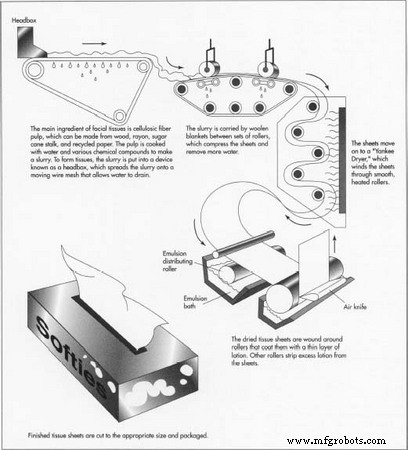
Lotion Preparation and Application
- The lotion is heated in batch tanks with high‑speed mixers, forming a fine emulsion of oils, water, and surfactants. The emulsion is pumped to a holding vessel connected to the coating system.
- As the nonwoven web moves over coating rollers, the emulsion is distributed in a thin film—typically 0.3 % or less—to avoid over‑coating. Surfactants act as wetting agents, allowing the hydrophobic layer to remain permeable. Excess lotion is stripped by downstream rollers, and belt‑cleaning showers keep the system free of residue.
Forming Operations and Packaging
- The coated web is cut to width by rotating knives, then sliced into tissue‑sized intervals. The strips are folded and boxed or wrapped in cellophane, ready for retail distribution.
Byproducts and Waste
While the process generates waste, many materials are recoverable. Fiber scraps from pulping can be re‑washed and reused, and water from slurry and coating stages can be recycled. Chemical recovery is more challenging, and spent solutions require careful disposal to protect the environment.
Quality Control
Quality assurance focuses on both chemical and sensory metrics. Analytical methods—such as Webul solvent extraction followed by spectrophotometry or chromatography—measure polyhydroxy and surfactant concentrations. However, softness cannot be quantified analytically; it is evaluated by trained panelists using ASTM paired‑comparison tests. Panels assess softness, flexibility, and smoothness after conditioning samples at 22–44 °C and 10–35 % RH, followed by 24 h at 50 % RH.
Absorbency is measured by wetting time: a crumpled tissue ball is placed in a 3‑qt beaker of water, and the time to full saturation is recorded. Tests are performed on fresh samples and after a minimum two‑week aging period to capture coating cure effects. Additional metrics—thickness, density, linting, and colorimetric analysis—ensure product consistency.
The Future
Environmental concerns are driving research into biodegradable or recyclable lotion formulations. Advances in fiber chemistry aim to strengthen nonwoven fabrics without sacrificing softness. Industry efforts also focus on energy‑efficient processes and reduced chemical footprints.
Manufacturing process
- Circuit With a Switch: A Practical Guide to Basic Electrical Circuits
- Fabric Softener: From Early Innovations to Modern Formulations
- From Macintosh to Microfiber: The Evolution and Craft of Modern Raincoats
- Artificial Skin: Advanced Tissue Engineering for Burns, Wounds, and Future Regenerative Therapies
- Bicycle Shorts Explained: Design, Materials, and Production Process
- Accurate Temperature Monitoring in a Server Closet with Raspberry Pi
- Arduino‑Powered HID UPS: Upgrade Your Dummy Power Supply to USB‑Compatible Backup
- Build an IR Sensor Project with Arduino UNO – Simple Guide
- Efficient 3‑Pin Wireless Sensor Transmission with nRF24L01+ and ATtiny85
- MIT Researchers Turn Shirts into High‑Performance Microphones with Functional Fibers