



Tennis Rackets: Evolution, Materials, and Manufacturing Excellence
Background
The official codification of tennis dates to 1873, when Major Walter Clopton Wingfield of North Wales published the first rulebook. However, the sport evolved from earlier hand‑ball games played across Europe before the Renaissance, transitioning from bare hands to gloves, rope‑wrapped hands, and eventually wooden bats. By the 15th century, the first rackets appeared—smaller than today’s models and strung in diverse patterns. While Wingfield and his contemporaries standardized court dimensions and ball specifications, early rules did not constrain racket size, shape, or material.
Until 1965 every professional racket was crafted from wood. The French player René Lacoste patented the first steel racket in 1965, followed by Spalding’s aluminum models in 1968. Metal frames enabled broader heads, allowing higher string tension without compromising playability. Howard Head’s oversized aluminum racket in the mid‑1970s doubled the sweet spot and, despite initial skepticism from pros, quickly became the norm for amateurs. By the early 1980s, larger heads dominated all levels of play.
In 1981 the International Tennis Federation (ITF) formalized racket regulations. A 1977 "spaghetti string" racket—whose innovative stringing technique produced massive upset victories—was banned after only five months of play. Early ITF rules permitted any material, size, weight, or shape, with string holes spaced 0.64–1.30 cm apart. Subsequent limits capped racket length at 32 in (81 cm) and later reduced it to 29 in (74 cm) in 1997. Today, the average racket measures 28 in (71 cm) and weighs 10–14 oz (284–397 g).
Recent innovations have tested the boundaries of racket design. One manufacturer introduced a hexagonal frame; others explored ultra‑wide bodies. A graphite fiber‑reinforced thermoplastic viscoelastic polymer offers variable flexibility based on impact force. A design incorporating lead bearings within plastic chambers aims to reduce vibration‑induced tennis elbow. The prevailing choice remains aluminum or composites of graphite, fiberglass, and other advanced materials.
Raw Materials
Aluminum rackets are produced from alloys such as 2% silicon (plus trace magnesium, copper, and chromium) or 10% zinc (with magnesium, copper, and chromium). The silicon alloy is easier to work with, while the zinc variant offers greater hardness at the expense of brittleness. Composite frames layer fiberglass, graphite, boron, or Kevlar over a hollow core or polyurethane foam. Ceramic fibers may be added for extra strength.
Strings are typically nylon, though some professionals still favor natural gut (twisted cow or sheep intestine) or synthetic gut (twisted nylon). Handles are now made from vinyl or other leather‑like materials, replacing the leather grips of older wooden rackets. Plastic components—such as the yoke at the head’s base and the butt cap—complete the construction.
The Manufacturing Process
Most U.S. rackets are mass‑produced in Japan or other Asian factories. High‑end models are often shipped unstrung, allowing players to have strings installed to their preference at a pro shop.
Aluminum Racket
- 1 Forming the frame. Aluminum may be forged through a die or extruded into a tube and then shaped into the frame.
- 2 Drilling and sanding. Holes for the yoke, string channels, and handle base are drilled simultaneously, then the frame is sanded to smooth edges.
- 3 Tempering. The frame is heat‑treated (O‑tempering) to harden the metal, then may be anodized for a glossy finish.
- 4 Stringing. A grommet strip and yoke are fitted, after which a technician strings the racket using a machine that applies tension precisely.
- 5 Finishing. The handle is capped, wrapped in double‑stick tape and vinyl grip, logos are applied, and the racket undergoes final inspection, cleaning, and packaging.
Composite Racket
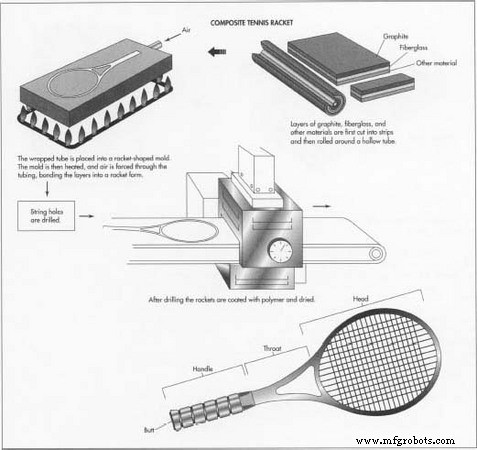
- 6 Forming the frame. Layers of graphite, fiberglass, and optional boron or Kevlar are assembled into a flat sandwich, cut into strips, and wound around a flexible tube before being molded into shape. Heat and air pressure bond the layers, or polyurethane foam expands to consolidate the structure.
- 7 Drilling and sealing. After removal from the mold, string holes are drilled. The frame is coated with polymer, dried, and sanded, then the brand decal is applied.
- 8 Stringing and finishing. Identical to the aluminum process: grommets, yoke, stringing, logo printing, butt cap insertion, tape winding, inspection, cleaning, and packaging.
Quality Control
Inspectors evaluate rackets at multiple stages: visual checks upon mold release, stress tests for hardness and stiffness 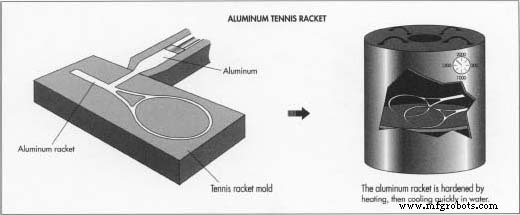 , weight verification before and after stringing, and balance assessment to ensure a midpoint center of gravity (unless a head‑heavy design is intentional)
  . Grommet holes are inspected for smoothness, and finishing details—cap fit, logo clarity, and grip integrity—are scrutinized. New designs may also undergo play‑testing.
The Future
Modern racket design is increasingly data‑driven, leveraging physics, CAD, and CAM to model string and frame vibrations, weight distribution, and center‑of‑gravity. As regulations remain broad, researchers and manufacturers continue to explore lighter, larger frames made possible by advanced composites. These innovations promise enhanced performance and new gameplay possibilities.
Manufacturing process
- What is VMC Machining? An Expert Overview of Vertical Machining Centers
- Expert Guide to Aluminum Laser Marking: Precision, Durability, and Industry Applications
- MIG vs. TIG Welding: Selecting the Right Arc Welding Technique for Your Project
- Comprehensive Guide to Laser Marking: Types, Benefits, and Applications
- Key Considerations for High‑Volume Swiss Machining
- CNC Prototyping Guide: Precision, Speed, and Cost‑Effective Production
- Expert Shaft Manufacturing: Precision Processes & Custom Solutions
- Tungsten Alloy Weight Blocks: Enhancing Tennis Racket Performance and Safety
- Tennis Rackets: Evolution, Materials, and Manufacturing Excellence
- Arduino Tennis Game – Build a Virtual Racquet Experience with NeoPixel, Sensors, and Bluetooth