



Television: From Mechanical Origins to Smart Future
Background
Television has become an integral part of modern life. In the United States, over 98 % of households own at least one TV set, and 61 % receive cable. The average U.S. household spends about seven hours a day watching television, making it a valuable platform for news, sports, education, and advertising.
The television we use today is a sophisticated receiver that receives signals from a complex broadcast network—including cameras, transmitters, ground‑based towers, cables, and satellites—before rendering the image on a screen. A standard U.S. picture, whether black‑and‑white or color, is composed of 525 horizontal lines displayed in a 4:3 aspect ratio at 30 frames per second.
History
The journey from mechanical scanners to electronic displays spanned several decades and involved scientists from many fields—electricity, mechanics, electromagnetism, acoustics, and chemistry. No single inventor holds the patent for the modern television; instead, it is the cumulative result of competitive innovation.
Early electrical conductors such as selenium, isolated by Baron Ångström in 1817 and characterized by Louis May in 1873, laid the groundwork for later photoelectric devices. Sir William Crookes’ 1878 cathode‑ray tube and the 1884 mechanical system of Paul Nipkow—using a spinning disk with perforations to sample an image—were the first steps toward a coherent broadcast system.
In 1888, W. Hallwachs introduced photoelectric cells into cameras, while Boris Rosing in Russia and A. A. Campbell‑Swinton in Britain independently demonstrated cathode‑ray image reconstruction in 1907. Thomas Edison and other radio pioneers explored television signal transmission, leading to the first crude mechanical broadcasts.
By the 1920s, John Logie Baird in Scotland and C. Francis Jenkins in the United States produced the first functional television sets that combined Nipkow’s disk with vacuum‑tube amplifiers and photoelectric cells. The 1920s also saw major corporations—General Electric, RCA, Westinghouse, and AT&T—invest heavily in research. Mechanical systems were replaced by fully electronic cameras and receivers by 1935, thanks to inventions like Vladimir K. Zworykin’s cathode‑ray tube and Philo T. Farnsworth’s pickup tube, which entered the market by 1939.
The transition to color began in the 1940s. CBS and RCA collaborated to refine mechanical color methods before developing an all‑electronic system. The first color broadcast on CBS aired on 25 June 1951, and commercial color programming became widespread by 1954.
Raw Materials
A modern television consists of five main subsystems: the housing, the audio circuitry and speakers, the picture tube (or display panel), the electronics assembly, and the remote control. Each component relies on specialized materials:
- The housing is typically injection‑molded plastic, though premium models still use wood.
- The audio system incorporates metal and plastic components for speakers and wiring.
- The picture tube—originally a cathode‑ray tube—requires precision glass, phosphor coatings, and a thin aluminum reflective layer.
- Electronics include silicon chips, solder, metal connectors, and integrated circuits.
- The remote control, often referred to as a “clicker,” is a separate module that communicates via infrared or radio frequency.
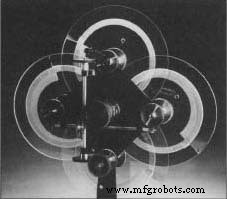 Prismatic scanning disc mount made by C. Francis Jenkins in 1923 (Henry Ford Museum & Greenfield Village).
Surprisingly, television transmission began almost a quarter century before World War II. Baird in the United Kingdom and Jenkins in the United States publicly demonstrated mechanical television in 1925. These early systems used rotating disks and light‑sensitive selenium tubes to transmit still images; moving‑picture broadcasts appeared the following year.
Jenkins’ 1922–23 prismatic disc scanners focused light through a series of glass prisms. The resulting light spot scanned across a photo‑sensitive surface, converting optical data into electrical signals for transmission. By 1925 he broadcast the silhouette of a windmill for ten minutes. Experimental stations operated in New York and Washington, D.C., by 1931, and he sold receiver kits to enthusiasts.
By 1933, the limitations of mechanical scanning—chiefly image quality—prompted manufacturers to pursue electronic solutions, effectively ending the mechanical era.
Design
Television design is a multidisciplinary effort involving audio, video, plastics, optics, fiber optics, and electronics engineers. A new model may simply be a scaled version of an existing design, or it may introduce breakthrough features such as a high‑definition flat panel, advanced sound systems, or smart‑remote integration.
Design teams iterate concept sketches, prototype assemblies, and rigorous testing before final approval. The prototype validates form, function, and manufacturability, guiding production engineers in selecting tooling, machining processes, and automation strategies.
The Manufacturing Process
Housing
- Most housings are created by injection‑molding high‑quality plastic into precision molds. After curing, parts are trimmed, cleaned, and assembled with internal brackets for component support.
Picture Tube
- The classic cathode‑ray tube is crafted from curved glass with a dark‑tinted face plate to enhance contrast. Phosphor powder is deposited inside the plate, then coated with a thin aluminum layer that reflects electrons toward the screen.
- Large‑screen tubes are scarce; the rise of plasma‑addressed liquid‑crystal (PALC) displays and later LCD technologies replaced them for their lower weight and energy consumption.
- Shadow masks made from Invar alloy align the three electron beams, while rare‑earth phosphors increase brightness. The tube is evacuated to a near‑vacuum, and a deflection yoke steers the beams precisely.
Audio System
- Speakers and audio circuitry are integrated into the housing. Manufacturers partner with specialized speaker producers to meet acoustic specifications, assembling them as sub‑assemblies on the production line.
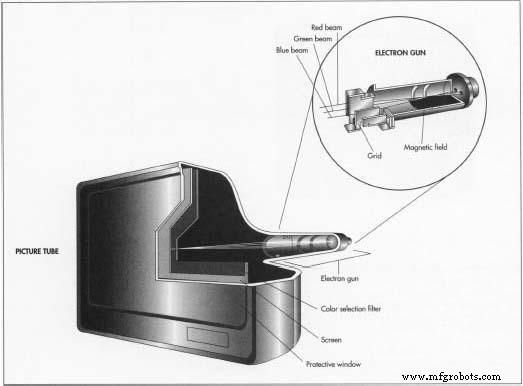 The electron guns in the tube’s neck are sealed in a near‑vacuum. A 200,000‑hole Invar shadow mask aligns the color channels.
Electronic Parts
- After the core subsystems are assembled, additional components—antennas, cable jacks, remote‑control receivers, and other input/output devices—are mounted before the housing is sealed.
Quality Control
Television manufacturing follows stringent quality assurance protocols. Each prototype undergoes laboratory testing, field trials, and safety inspections to ensure reliable performance and compliance with regulatory standards.
Byproducts and Waste
Television production generates limited waste, primarily recyclable metals, plastics, and glass. Chemicals used in phosphor coatings and other processes are monitored, purified, and recycled where possible. Hazardous waste management plans are enforced at every stage to protect workers and the environment.
The Future
High‑Definition Television (HDTV) emerged in the early 1980s, offering a 1,125‑line image on a 16:9 aspect ratio. Modern flat‑panel displays now employ synthetic diamond films, gold‑plated connectors, and Invar shadow masks to deliver superior brightness and color accuracy.
LCD technology continues to advance, with newer panels supporting features like touch input, dynamic channel‑labeling, time‑display, parental controls, and screen‑splitting. Digital television will soon enable interactive experiences—users can adjust camera angles, interact with commentators, or edit clips in real time.
Manufacturing is increasingly global; for instance, 30 % of televisions produced by Japanese companies are assembled in Mexico. Future trends point toward hybrid devices that combine TV, monitor, and communication functions, facilitated by seamless analog‑to‑digital bridges.
Manufacturing process
- Resistor Color Codes – A Comprehensive Guide to Decoding Value, Tolerance, and E-Series Standards
- Cathode‑Ray Tube: Technology, Design, and Future Trends
- Color Masterbatch Market: Growth Drivers and Industry Applications
- Arduino RGB LED Color Mixer – Beginner‑Friendly DIY Project
- Build an Arduino RGB Color Mixer – Step‑by‑Step Tutorial
- Energize Your New Year with Dynamic Musical LED Lights
- Advanced Color Sorting Machine with Arduino and RGB Sensor
- Detecting Object Colors with Arduino Nano and TCS3200 Sensor
- Create Your Own LED Color Sequencer with Arduino – Easy DIY Tutorial
- Build an Arduino Color Sorter: Simple Guide with TCS3200 & Servos