



The Timeless Legacy of the Teddy Bear: History, Craftsmanship, and Cultural Impact
Background
Since the turn of the 20th century, teddy bears have become a ubiquitous comfort object for children and collectors alike. The inspiration comes from real bears—ancient Neanderthal hunters revered extinct brown bears, and modern folklore celebrates the animal’s strength and nurturing nature. This deep-rooted symbolism translates into the teddy bear’s role as a “transitional object” that helps children move toward independence while remaining a steadfast confidant.
Iconic bear characters such as Winnie‑the‑Pooh, Paddington, Yogi, and Fozzie have cemented the teddy bear in popular culture. Psychologists note that the tactile nature of a stuffed bear fosters emotional regulation and social development.
History
In 1903, German designer Margarete Steiff crafted the first teddy bear from felt and mohair, featuring articulated limbs and a gentle face. A demonstration at a Leipzig toy show drew the attention of an American buyer who ordered 3,000 bears, launching the Steiff brand to global recognition.
Concurrently, in the United States, President Theodore “Teddy” Roosevelt’s refusal to shoot a captured bear cub sparked a national conversation. Cartoonist Clifford Berryman’s illustration of the incident appeared on November 16, 1902, inspiring Brooklyn candy shop owner Morris Michtom to produce “Teddy’s Bears.” Michtom’s bears, similar in construction to Steiff’s, received the President’s endorsement and helped cement the name “teddy bear” in the public imagination. By 1907, nearly one million teddy bears had sold worldwide, and the industry has routinely shipped roughly 250,000 units annually since the 1950s.
Raw Materials
Early teddy bears used mohair, Angora, sheep’s wool, rayon, or silk for the “fur,” with black leather shoe‑button eyes and wood shavings (excelsior) for stuffing. In the 1920s glass eyes were introduced, later replaced by nylon screw‑in eyes in 1948 and secure plastic “safety eyes” in the 1950s.
Modern production favors plush fabrics—wool, silk, rayon, nylon, and synthetic blends—along with velvet, velveteen, and faux fur. These materials offer softness, durability, and a realistic texture. Additional fabrics such as corduroy, denim, calico, terry cloth, and velour provide functional and aesthetic variety. Leather or suede, real or synthetic, is often used for paws and feet. Polyester fiber has largely supplanted wood shavings for stuffing, offering a more durable, huggable core. Thread, embroidery floss, glue, Velcro®, and metal or plastic eye assemblies complete the construction.
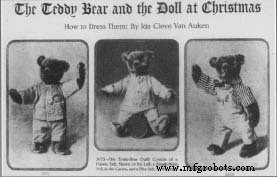 Teddy bear photos from a 1907 Ladies’ Home Journal article on how to dress them for Christmas.
Design
Each new bear model begins with an artist’s sketch that translates into detailed patterns. Prototypes undergo rigorous testing—checking for sit‑ability, cuddly texture, and visual appeal. Iterations continue until the design meets market expectations and production feasibility.
Manufacturing Process
- Patterns are cut from layered plush fabrics and stitched by skilled seamstresses on industrial sewing machines. A typical worker assembles 35–45 baby bears or 8–9 larger ones per day.
- The sewn bear is stuffed with high‑density polyester fiber. An automated picker fluffs the material, which is then blown into the toy through a pressure‑controlled nozzle. Operators perform a “hug test” to ensure optimal softness.
- A dedicated “bear surgeon” closes the back seam, grooms the fur with a powered brush, and removes excess fluff. Final touches—costumes, ribbons, accessories—are added before packaging.
Quality Control
Every stage—from cutting to final grooming—is supervised by experienced artisans who take pride in producing a bear that will offer comfort for years. Hand‑inspection prevents defects from reaching the shelf.
Byproducts and Waste
Production generates minimal by‑products, mainly fabric scraps and excess stuffing that are not recyclable. Strict safety protocols protect workers from airborne fibers and machinery hazards.
The Future
Today’s teddy bears evolve with media trends, from cinematic characters to compact, collectible editions. Notably, a teddy bear flew aboard the Space Shuttle in 1995, illustrating the toy’s enduring cultural relevance. Whether as a child’s first friend or a collector’s prized piece, the teddy bear remains a timeless emblem of comfort and imagination.
Manufacturing process
- What is VMC Machining? An Expert Overview of Vertical Machining Centers
- Expert Guide to Aluminum Laser Marking: Precision, Durability, and Industry Applications
- MIG vs. TIG Welding: Selecting the Right Arc Welding Technique for Your Project
- Comprehensive Guide to Laser Marking: Types, Benefits, and Applications
- Key Considerations for High‑Volume Swiss Machining
- CNC Prototyping Guide: Precision, Speed, and Cost‑Effective Production
- Expert Shaft Manufacturing: Precision Processes & Custom Solutions
- Fiber Laser Marking: Precision, Speed, and Versatility for Modern Industries
- The Timeless Legacy of the Teddy Bear: History, Craftsmanship, and Cultural Impact
- John Deere Secures $250M for Bear Flag Robotics, Advancing Autonomous Farm Technology