



The Modern Hair Dryer: Design, Safety, and Future Innovations
Background
A hair dryer, commonly called a blow dryer, is an electric appliance that uses a fan to push air over a heating element. The heated air evaporates moisture from wet hair, allowing styling tools such as brushes and combs to shape the hair more quickly and efficiently.
History
The first handheld hair dryer appeared in 1925, delivering only 100 W of heat and weighing over 2 lb (≈1 kg) because of heavy steel and zinc construction. Within two decades, engineers tripled the output to 300 W. By the 1960s, advances in electrical technology enabled 500 W models. In the late 1970s, safety became a priority: manufacturers adopted Consumer Products Safety Commission (CPSC) guidelines to prevent accidental electrocution when dryers entered water. The 1990s saw the introduction of 1,500 W portable units, and today most hair dryers produce up to 2,000 W while remaining lightweight and user‑friendly.
Design
Effective hair dryers balance power, airflow, and safety. The heating element must reach temperatures that maximize moisture absorption without damaging skin or hair. Engineers calculate specific heat capacity and set a maximum output of roughly 2,000 W, which translates to an outlet temperature around 140 °F (60 °C). Concurrently, the fan must move sufficient air volume to carry the heat away and dry the hair swiftly.
Safety mechanisms are integral to modern design. A temperature‑cutoff switch interrupts the heating coil if the internal temperature exceeds 140 °F, while a thermal fuse melts at critical temperatures to halt power immediately. A Ground‑Fault Circuit Interrupter (GFCI) monitors for leakage currents and disconnects the device to prevent electrocution.
Weight and ergonomics are also critical: contemporary dryers typically weigh ~1 lb (≈500 g) and feature an easy‑grip handle with intuitive controls.
Raw Materials
Key components include a compact electric motor, fan blades, nichrome heating elements, copper wiring, and a durable yet lightweight plastic housing. The outer shell is usually molded from polypropylene, a material that resists heat and impact while remaining lightweight.
Manufacturing Process
- The pre‑assembled motor and fan blades arrive at the plant.
- The heating element, made from nichrome wire wound around a mica insulating board, is fabricated. Nichrome’s high resistance and corrosion resistance allow it to reach 2,000 W without rusting.
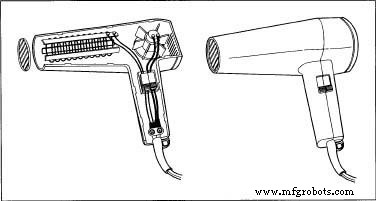
- The gun‑shaped plastic shell is injection‑molded in two halves, each fitted with aligning pins and holes for precise assembly.
- Safety components—temperature‑cutoff, thermal fuse, and GFCI—are installed, along with mesh screens to protect the fan and heating element.
- Electrical parts are mounted in the lower shell, the upper half is sealed, and the device is powered on for a final safety check.
- Fasteners are secured; modern designs use only a few screws to reduce cost and assembly time.
- Warning labels indicating “Keep away from water” are affixed to the cord, followed by packaging with user instructions and safety notices.
Quality Control
Safety regulations have tightened since the 1980s. Warning labels and polarized plugs were mandated to prevent accidental shock. In 1991, designs were required to preclude short‑circuits even when the device was off. Today, GFCI technology has lowered electrocution fatalities to fewer than four per year, a figure that continues to decline as older models are phased out.
The Future
While core design principles remain, future improvements focus on quieter operation, enhanced ergonomics, and aesthetic appeal—designer colors, clear plastics, and minimalistic shapes. Technological breakthroughs, such as ionic hair dryers that use charged particles to reduce drying time and hair damage, are under development but yet to prove market viability. Manufacturers may also explore specialty uses, from removing gum residue to drying nail polish, expanding the hair dryer’s role beyond styling.
Where to Learn More
Books
Dalton, John W. The Professional Cosmetologist. New York: West Publishing Company, 1985.
Randy Schueller
Manufacturing process
- Comprehensive Guide to Modern Epilation Devices: Design, History, and Future
- The Science and Manufacturing of Hairspray: From Chemistry to Consumer Use
- Professional Hair Removal: Depilatories, Epilatories, and Manufacturing Insights
- Hair Dye: From Ancient Roots to Modern Manufacturing
- The Art and History of Wigs: From Ancient Ritual to Modern Fashion
- Can Organic Amla Powder Truly Revert Gray Hair? Evidence & Practical Tips
- Custom Industrial Dryers Built for Precision and Performance
- Heat of Compression Dryers Explained: Ensuring Dry, High-Quality Compressed Air
- Atlas Copco Launches MDG Rotary Drum Dryer – Ultra‑Efficient, Low‑Energy Air Drying Technology
- How to Choose the Ideal Compressed Air Dryer for Your System