



The Science and Manufacturing of Hairspray: From Chemistry to Consumer Use
The Science and Manufacturing of Hairspray: From Chemistry to Consumer Use
Hairspray is a sophisticated personal‑care product that gives hair its shape and hold. By combining polymers, solvents, and propellants, manufacturers create a fine mist that forms invisible film bonds on the hair shaft. Below is a detailed look at the chemistry, production, and future trends that shape today’s hairspray market.
Background
Hairsprays are aerosols or pump‑dispensed liquids that coat hair with film‑forming polymers. When the mist dries, the polymers create tiny glue‑like bridges that lock strands together, delivering lasting hold.
History
While ancient women used natural clays and gums to control their hair, the modern hairspray emerged in the late 1940s, coinciding with the Army’s development of aerosol spray technology during World War II. Early commercial formulas relied on shellac resin; over the past five decades, advancements in polymers and aerosol technology have dramatically improved performance and safety.
Raw Materials
Holding Agents (Polymers)
Polymers are long‑chain molecules that form transparent, flexible films upon drying. Common choices include:
- Polyvinylpyrrolidone (PVP) – offers moderate hold but absorbs moisture.
- PVP‑Vinyl Acetate (PVPVA) – a copolymer that resists humidity and maintains curls.
- Vinyl Acetate‑Crotonic Acid copolymer – balances hardness, solubility, and moisture resistance.
Solvents
Solvents carry active ingredients and determine drying time. Water is inexpensive but can slow drying and promote corrosion. Ethanol is more volatile but is subject to VOC restrictions. Currently, no fully approved alternative solvents exist.
Additives
Additives modify film properties and protect packaging. Examples include:
- Plasticizers (isopropyl myristate, diethyl phthalate, silicones) – improve film flexibility.
- Neutralizers and anti‑corrosion agents (aminomethyl propanol, ammonium hydroxide, morpholine, cyclohexylamine, borate esters) – prevent rust and maintain resin solubility.
Propellants
Propellants provide the pressurized gas that ejects the product. The industry transitioned from CFCs to hydrocarbons (butane/propane mixtures) and now to hydrofluorocarbons (HFCs) such as 1,1‑difluoroethane (Propellant 152A) and 1,1,1,2‑tetrafluoromethane (Propellant 134A). HFCs offer lower ozone impact and faster drying times, though they are more costly.
Packaging
Traditional aerosol cans are tin‑plated steel or aluminum, fitted with a complex valve system that mixes propellant and liquid, creates a fine mist, and seals the can. Non‑aerosol pump dispensers use spring‑powered mechanisms or bag‑in‑can bladders to reduce VOC emissions.
Design Considerations
Formulators balance efficacy, safety, cost, consumer appeal, and regulatory compliance. Desired polymer traits include:
- Film formation that is both strong and easy to wash out.
- Flexibility to allow hair movement without film breakage.
- Transparency to preserve natural gloss.
- Resistance to flaking and moisture absorption.
- Non‑irritating and non‑sensitizing for skin contact.
Consumer appeal is enhanced through pleasant fragrances, ergonomic valves, and convenient can sizes (typically 8 oz/237 ml). Cans are engineered for 40–80 lb/in² (18–36 kg/cm²) pressure and have a minimum shelf life of three years, often exceeding five years.
Manufacturing Process
Batching
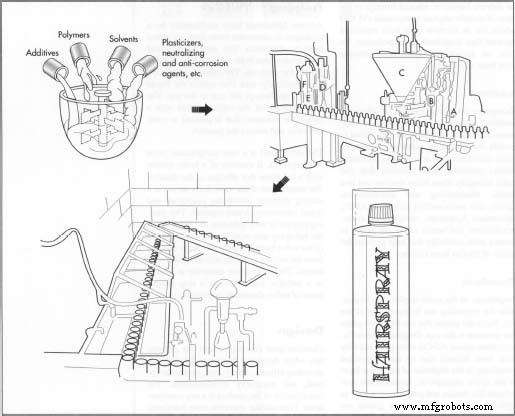
- Formulas are prepared as liquid concentrates in stainless‑steel or fiber‑reinforced tanks up to 2,000 gal (7,570 L).
- Large‑diameter turbine mixers blend solvents (≥80 % by weight) with polymers, fragrances, and additives.
- Batch quality is verified before transfer to holding tanks.
Filling
- Empty cans are cleaned by compressed‑air jets.
- Filling heads inject precise liquid volumes via piston mechanisms.
- Propellant is injected and the valve cup is crimped to seal the can.
- Water‑bath checks for bubble leaks; leaking cans are removed.
- Cans are air‑dried, capped, and boxed for shipment.
Byproducts and Waste
VOC emissions from aerosol hairsprays contribute to air pollution and can facilitate inhalant abuse. While pump sprays and bag‑in‑can systems reduce VOC release, many consumers still prefer aerosol cans for their convenience and spray pattern.
Quality Control
Continuous sampling on the conveyor line monitors fill weight, active‑ingredient concentration, and can pressure. Spray rate, pattern, and long‑term stability are tested to ensure consistent performance and prevent corrosion.
The Future
Regulatory pressures and consumer demand for greener products drive innovation. Researchers are developing water‑based polymers, non‑VOC propellants, and alternative delivery systems such as bag‑in‑can and pump sprays to reduce environmental impact while maintaining hold and ease of use.
Where to Learn More
Books
Dallal, Joseph, and Colleen Rocafort. Hair Styling/Fixative Products, in Hair and Hair Care. Marcel Dekker, 1997.
Schueller, Randy, and Perry Romanowski. Beginning Cosmetic Chemistry. Allured Publishing, 1999.
Randy Schueller
Manufacturing process
- What is VMC Machining? An Expert Overview of Vertical Machining Centers
- Expert Guide to Aluminum Laser Marking: Precision, Durability, and Industry Applications
- MIG vs. TIG Welding: Selecting the Right Arc Welding Technique for Your Project
- Comprehensive Guide to Modern Epilation Devices: Design, History, and Future
- The Modern Hair Dryer: Design, Safety, and Future Innovations
- Professional Hair Removal: Depilatories, Epilatories, and Manufacturing Insights
- Hair Dye: From Ancient Roots to Modern Manufacturing
- The Art and History of Wigs: From Ancient Ritual to Modern Fashion
- Can Organic Amla Powder Truly Revert Gray Hair? Evidence & Practical Tips
- Hair Drug Testing: The Emerging Standard for Driver Safety and Compliance