



Comprehensive Guide to Modern Epilation Devices: Design, History, and Future
Background
Epilation refers to the removal of hairs below the skin’s surface. Common devices include tweezers, wax, electrolysis, and laser hair removal. Modern epilation tools aim to minimize skin irritation, enhance user comfort, extend intervals between treatments, and reduce pain while targeting the hair root.
The original and most popular epilation device is the Epilady. Through innovative marketing, Epilady quickly became a market leader. Despite legal challenges around its patent, the brand has remained a benchmark for electronic epilators and has become a generic term for the category.
Two common designs exist. The tweezing head uses a series of small plucking mechanisms to extract individual hairs. The disc‑based head employs rotating metal discs that grip and pull hair and its root. Neither method destroys the follicle, so regrowth occurs, but results can last several weeks.
History
Humans have experimented with hair removal for centuries, from social status to hygiene. Early techniques—waxing, shaving, depilatory creams—evolved into advanced methods like electronic epilators, electrolysis, and laser removal as technology progressed.
The first manufactured razor appeared in the late 1700s, but safety razors emerged in the 18th century. In 1762, French barber Jean‑Jacques Perret invented the safety razor with a metal guard. In 1895, King Gillette introduced disposable blades, leading to the 1903 market launch of his razor. By 1915, Gillette offered a razor designed for women.
In 1931, Jacob Schick introduced the electric shaver, challenging Gillette’s blade. Remington followed with a dual‑headed shaver and, in 1940, the first electric shaver for women.
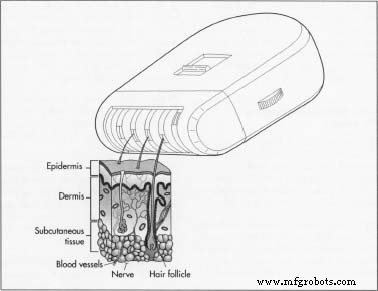
In 1986, Israeli company Mepro launched Epilady, the first electronic hair removal device that extracted hairs by the root, offering longer intervals between treatments. Despite pain reports, it achieved international success and reshaped the market.
1996 saw the release of the first disc‑operated Epilady, “Discrette,” which provided a virtually pain‑free experience thanks to high‑velocity rotating discs.
Since then, Epilady has released variants targeting specific areas such as the face, underarms, and bikini line. Competitors like Philips, Braun, and Emjoi have followed the original design, incorporating pain reduction, larger coverage, and longer lasting results, making electronic epilation a popular choice again.
Raw Materials
The housing can be made from insulative materials such as plastic or nylon, with a rubber‑like grip to prevent slippage. Metal and electrical components—wires, insulating parts—are integrated into the device.
Design
Electric epilators come in two primary designs: rotating disc and rotating tweezing barrel.
The earliest models used rotary cylinders with pivoting axes, allowing adjustment to skin contours. Small plucking elements attach to these cylinders.
Disc‑operated epilators are newer and generally cause less pain. High‑velocity rotating discs grasp shorter hairs quickly, covering larger areas in less time.
In both designs, hairs are trapped between projecting portions of the blades or discs. They are then pinched and ejected by centrifugal force as the device completes its cycle.
The Manufacturing Process
- Motor‑powered epilators are built around a hollow cylinder housing that serves as a handgrip. A molding press shapes the plastic housing from a pellet of encapsulating material.
- The material is heated until molten, then cooled and solidified. The press is opened, and the molded parts are removed.
- Exterior surfaces receive a heat‑shrunk rubberized coating for a comfortable grip.
- The epilator head and frame form the top of the device. The head frame is molded similarly and attaches to the housing via interlocking components or screws.
- The roller‑type head consists of alternating fixed and movable metal blades. Blades are cast from non‑corrosive metal, cooled, and sharpened. Polygonal openings accommodate the rotary shaft and bar components.
- The rotary shaft sits between two end plates with bearings. A thin metal bar connects the shaft to the electric motor.
- The motor, powered by a dry‑cell battery, drives the shaft’s rotation.
- Two flat metal strips hold the blades; two sliding bars move parallel to the shaft, engaging the blades through transverse grooves.
- Once assembled, the plastic housing is attached, sealing the unit.
- The finished device undergoes inspection and packaging before shipping to retailers.
Quality Control
Motor‑driven devices pose an electrical shock risk if insulation fails. Manufacturers rigorously test insulating materials and monitor heat buildup during operation. Compliance with FDA guidelines ensures safety, especially for laser hair removal devices, which require professional supervision.
Manufacturers must also address infection risks by ensuring devices are sanitized properly at home. The U.S. Food and Drug Administration can enforce action against unsafe products. The Epilady line, produced by Mepro, adheres to ISO 9002 standards, guaranteeing consistent quality control across all stages.
Byproducts/Waste
Plastic and moldable components are recycled by melting and re‑molding. Electrical parts undergo testing; those that pass are reused, while defective components are dismantled or reassembled as needed.
The Future
Manufacturers continue to refine epilation devices to improve efficacy, reduce pain, and extend treatment intervals. Innovations include 24‑karat gold plating on tweezing components for better sanitation and hypo‑allergenic properties, increased tweezing speed, and higher component counts for faster coverage.
Permanent depilatory technologies are gaining traction. High‑frequency electrical devices target the hair papilla, but often require salon visits. A cost‑effective alternative involves a compressible coil‑spring tweezer that grasps multiple hairs simultaneously.
Laser hair removal, a long‑standing medical cosmetic procedure, offers non‑invasive removal of unwanted hair without damaging surrounding tissue. Hand‑held units emit pulsed optical energy that ablates hair roots until the bulb is fully vaporized.
Where to Learn More
Periodicals
Segal, Marian. “Hair Today, Gone Tomorrow.” FDA Consumer Magazine (September 1996).
Other
“Electrolysis Manufacturers.” Hairfacts.com Web Page. December 2001. https://www.hairfacts.com/makers/epltrmfr.html.
“Epilady Story.” Epilady Web Page. December 2001. https://www.epilady.com/profile.html.
“The Shaving Historical Timeline.” The Quik Shave Body Razor Web Page. December 2001. https://www.quikshave.com/timeline.htm.
United States Patent and Trade Office. December 2001. https://patft.uspto.gov.
Stacey L. Blachford
Bonny P. McClain
Manufacturing process
- Thyristor Technology: From SCR to TRIAC, GTO, and UJT
- The Modern Hair Dryer: Design, Safety, and Future Innovations
- The Science and Manufacturing of Hairspray: From Chemistry to Consumer Use
- Professional Hair Removal: Depilatories, Epilatories, and Manufacturing Insights
- Hair Dye: From Ancient Roots to Modern Manufacturing
- The Art and History of Wigs: From Ancient Ritual to Modern Fashion
- Reducing Standby Power in Smart Home Devices with Power Integrations’ LinkSwitch‑TNZ
- Building an Outdoor Weather Station with Raspberry Pi 2 and ADS‑WS1
- Automated Gaming Assistant: A Smart Task‑Automation Device for Gamers
- Smart UV‑C & Heat Face Mask Disinfection Device – Arduino Controlled