



The Evolution and Production of Action Figures
Background
Action figures are high‑quality collectible dolls designed to replicate iconic characters from film, literature, and pop culture. They feature articulated joints, accessories, and customizable outfits that allow collectors to pose them in a variety of dynamic stances.
History
The term “action figure” first appeared in 1964 when Don Levine of Hasbro coined it to describe the new G.I. Joe toy. Levine chose the name to appeal to boys, distinguishing it from the traditional “doll” and highlighting its superior articulation and extensive accessories—an approach that paid off as G.I. Joe became a perennial best‑seller for almost four decades.
In 1966, Hasbro introduced Captain Action, a single figure that could transform into multiple iconic characters such as the Phantom, Captain America, Batman, Superman, and Spider‑Man. This was the first instance of combining superhero personas with the action‑figure format, setting a trend that endures today.
In 1977, Twentieth Century Fox licensed the newly released film Star Wars to Kenner, who produced 3.75‑inch figures that became the new industry standard, superseding the larger 8‑12‑inch models. The success of Star Wars spurred a wave of licensed figures based on Star Trek, Battle Star Galactica, and Buck Rogers, cementing the role of media tie‑ins.
When federal regulations prohibiting toy‑based programming were lifted in 1983, Mattel launched “He‑Man and the Masters of the Universe”, a cartoon series built around its 1981 action‑figure line. The franchise sold 55 million units in its first year and generated over $1 billion in revenue by 1990, proving the power of synergistic media and toy cross‑promotion.
In 1984, the Transformers line introduced robots that could transform into vehicles and other objects, adding a new level of interactivity and complexity. Since 1984, Transformers has released multiple generations of toys that continue to dominate the market.
In 1994, Todd McFarlane's Spawn comics inspired a line of highly detailed action figures. By involving the comic’s creator directly in toy design, McFarlane elevated the level of detail beyond what had previously been achieved, a standard that still defines modern collectible figures.
Design
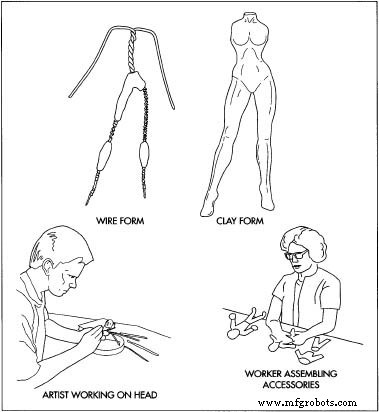
The design process begins with detailed sketches, followed by a clay prototype built on an aluminum‑wire armature. Sculptors refine the form, adding intricate details—especially facial features—before the model is baked to harden the clay.
During sculpting, the head and body are often worked separately, allowing for finer control over expressions and proportions. Reference materials, including photographs and live models, guide the sculptor to achieve realistic anatomy and dynamic poses.
Once the prototype is complete, it is sent for manufacturer approval. The mold‑making phase then creates durable plastic molds from the finished clay, a process that typically takes two weeks per part and may require multiple revisions over several months.
Raw Materials
Prototypes are crafted from aluminum wire, modeling clay, and sculpting tools. The final figures are molded from ABS plastic for the main body, with softer polymers such as polypropylene and polyethylene used for accessories and costume details. Fabrics—rayon, nylon—produce realistic uniforms, capes, and masks, while acrylic paints finish the exterior. Some premium figures incorporate electronic components for sound and light.
The Manufacturing Process
Creating the mold
- 1 A master mold—or series of molds—is created from the clay prototype. This stage consumes roughly two‑thirds of the total production time. Molds are typically manufactured overseas, often in Asia.
- 2 Designers translate the three‑dimensional figure into a set of plastic parts. Single‑piece molds provide limited articulation, while multi‑piece designs incorporate swivel joints and hidden gears that enable a wide range of motion.
Molding the parts
- 3 While rotational molding was initially considered for smooth finishes, it proved unsuitable for detailed pieces due to size constraints and higher cost. Injection molding became the industry standard, allowing precise control over part geometry and rapid cycle times.
Assembly
- 4 After molding, components are assembled into the finished figure. Ultrasonic sealing—high‑frequency vibration fusion—provides virtually invisible seams and superior structural integrity, while selective gluing attaches accessories such as chest plates and boots.
Finishing details
- 5 Clothing and accessories are fabricated separately—often from real fabrics—and attached after the figure’s body is completed, ensuring authenticity and durability.
Packaging and shipping
- 6 Packaging design runs in parallel with figure production. High‑quality graphics and clear windows protect the toy while enticing collectors. Finished units are sealed, boxed, and shipped by sea to U.S. distributors.
Quality Control
Throughout manufacturing, rigorous quality‑control protocols ensure safety and durability. Molds and finished parts undergo mechanical testing, while figures are subjected to articulation stress tests, drop tests, and packaging resilience evaluations to mimic real‑world handling. Only products that meet stringent standards reach the shelf.
The Future
Action figures continue to evolve, driven by new media franchises, technological innovations, and collector preferences. Recent trends include hyper‑realistic female figures from comic books and the resurgence of wrestling‑based toys. Emerging digital features—sound chips, LEDs, and app‑controlled interactivity—promise even more engaging play experiences.
Manufacturing process
- Industry 4.0 in Action: 7 Real‑World Digital Manufacturing Success Stories
- 3D Systems Figure 4 Production – High‑Volume Resin 3D Printing Solution
- 3D Systems Figure 4 Modular: Scalable, Semi‑Automated 3D Production for Low to Mid‑Volume Manufacturing
- 3D Systems Figure 4 Standalone: High‑Accuracy, Industrial‑Grade 3D Printing for Low‑Volume Production
- Manufacturing Analytics in Action: Driving Production Excellence at Bosch
- Understanding Battery Management Systems (BMS): Core Concepts and Key Components
- Implementing Total Productive Maintenance: A Hands‑On Cleaning Case Study
- Fiber‑Reinforced Plastic (FRP): A Game‑Changing Alternative to Steel
- Boosting Production Efficiency: How Halter’s Adaptive Automation Transformed Kilgore Manufacturing
- How NIST Traceable Standards Drive Precision & Quality