



Yarn Production: From Ancient Threads to Modern Innovation
Background
Yarn is formed by twisting multiple strands of fibers together. Each strand is itself composed of shorter fibers spun into longer filaments. Long, continuous strands may simply be twisted further or processed through texturing to alter their properties.
The amount of twist applied during spinning determines a yarn’s character: a high twist yields strength; a moderate twist offers softness and luster; an extremely tight twist produces crepe yarn. Yarns are also classified by their construction—single yarns, ply yarns (two or more single yarns twisted together), and cord yarns (twisting two or more ply yarns).
In 1995 the United States produced nearly 8 billion pounds (3.6 billion kg) of spun yarn, 40 % of which came from North Carolina. Over half of that output was cotton, with textured, crimped, or bulked yarns accounting for roughly half of the total. Textured yarns expand in volume through physical, chemical, or heat treatments; crimped yarns use thermoplastic fibers with a deformed shape; bulked yarns are made from inherently bulky fibers that cannot be tightly packed.
Yarn is essential to textile manufacturing, feeding weaving, knitting, and felting processes. In 1995 the U.S. produced 4 billion pounds (1.8 billion kg) of weaving yarn, 3 billion pounds (1.4 billion kg) of machine‑knitting yarn, and 1 billion pounds (450 million kg) of carpet and rug yarn. The textile sector employs over 600,000 workers, consumes about 16 billion pounds (7 billion kg) of mill fiber annually, and generated $2.1 billion in profit in 1996. Exports represent more than 11 % of sales—approaching $7 billion—while the apparel industry adds another million jobs.
History
Natural fibers such as cotton, flax, silk, and wool have been staples of early textile production. The oldest known yarn and fabric fragments—bundles of flax fibers and plain‑weave linen—date back roughly 7,000 years and were found near Robenhausen, Switzerland.
Cotton cultivation and textile use span at least 7,000 years. Evidence of cotton fabrics appears in Egypt as early as 12,000 B.C., and similar finds exist in Mexico (3,500 B.C.), India (3,000 B.C.), Peru (2,500 B.C.), and the southwestern U.S. (500 B.C.). Cotton only gained commercial prominence in Europe after the New World was colonized. Silk, a specialty of China from 2,600 B.C., remained largely confined until the 6th century when the Byzantine Empire began silkworm breeding.
Synthetic fibers emerged much later: rayon, derived from cotton or wood fibers, was developed in 1891 and commercially produced in 1911; nylon followed, then various polyesters, reducing global demand for natural fibers and expanding applications.
Before the 14th century, yarn was spun by hand on a spindle and whorl—a tapered stick with a weight to maintain rotation. The fibers were pulled from a carded bundle tied to a distaff. In the 12th‑13th centuries, the spinning wheel appeared in India (500–1000 A.D.) and later Europe, featuring a hand‑driven wheel, a flyer to twist the thread, and a bobbin that wound the yarn. The Saxon wheel, introduced about 150 years later, used a foot pedal, freeing both hands for fiber work.
The 18th century saw mechanization breakthroughs: John Kay’s flying shuttle (1733), Richard Arkwright’s spinning jenny (1766), and Samuel Crompton’s mule machine (1776). In 1828, John Thorp invented the ring frame, still widely used, involving hundreds of spindles inside a metal ring. The open‑end system now spins many natural fibers, drawing them by air into a rapidly rotating cup before extrusion.
Raw Materials
Yarn is produced from roughly 15 fiber types, grouped into natural and synthetic. Natural fibers—obtained from plants or animals—are predominant in weaving. Cotton, harvested from mature seed pods, remains the best‑selling fiber in America, surpassing all synthetics combined. Plant fibers like acetate (wood pulp or cotton linters) and linen (flax) are also used. Animal fibers include wool (sheep), mohair (Angora goats), and silk, which is extruded by silkworms in continuous strands.
Synthetic fibers are created by extruding a polymer solution through spinneret nozzles and hardening the filament chemically. Examples include acrylic, nylon, polyester, polyolefin, rayon, spandex, and triacetate. Many synthetics emulate natural fibers’ properties while avoiding shrinkage, and others offer specialized features—spandex can stretch over 500 % without breaking.
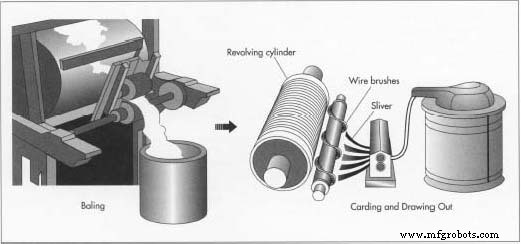
Fibers arrive in bales, opened manually or by machine. The picker separates and cleans the fibers, then carding aligns them into a slightly parallel web. A funnel‑shaped device transforms this web into a ropelike strand. Rollers elongate the strand—now called a sliver—into a uniform thread that receives a light twist and is fed into large cans.
The Manufacturing Process
Three primary spinning methods exist: cotton, worsted (long‑staple), and wool. Synthetic staple fibers can be spun using any of these. Because the cotton method yields the greatest volume, it is described in detail below.
Preparing the Fibers
- Fibers are shipped in bales and opened by hand or machine. Natural fibers may require cleaning; synthetic fibers only need separation. The picker loosens, separates, and cleans the fibers. Blending different staple fibers may be necessary for specific applications, performed during lap formation, carding, or drawing. Quantities are carefully measured to maintain consistent proportions.
Carding
- The carding machine, equipped with fine wires, separates fibers and aligns them into a loose, parallel web. The web passes through a funnel‑shaped device to form a ropelike strand. Blending can occur by joining laps of different fibers.
Combing
- For a smoother, finer yarn, fibers undergo further paralleling. A comb‑like device arranges fibers in parallel, letting short fibers fall out of the strand.
Drawing Out
- After carding or combing, the fiber mass is a sliver. Several slivers may be combined before this step. Rollers at varying speeds elongate the sliver into a more uniform strand, adding a small twist before feeding into large cans. Carded slivers are drawn twice post‑carding; combed slivers are drawn once pre‑combing and twice post‑combing.
Twisting
- The sliver enters a roving frame, where strands are further elongated and twisted, producing roving.
Spinning
- Commercial yarn production mainly uses ring spinning and open‑end spinning. In ring spinning, roving is fed through rollers, elongated, and passed through an eyelet and traveler. The traveler moves around a stationary ring at 4,000–12,000 rpm while the spindle turns the bobbin, twisting and winding the yarn in one operation. Open‑end spinning skips the roving step: a sliver is fed into a spinner by an air stream, delivered to a rotary beater that separates fibers into a thin stream, which is carried by air into the rotor’s V‑shaped groove. Twist is produced as the rotor turns, and new fibers continuously enter while the finished yarn exits at the groove’s end.
Quality Control
Automation streamlines quality assurance: electronic systems monitor temperatures, speeds, twists, and efficiencies. The American Society for Testing and Materials (ASTM) provides standardized methods for measuring properties such as drawforce, bulk, and shrinkage.
The Future
Spinning systems will become increasingly automated and integrated, merging carding and drawing functions into single units. Production rates are expected to surge as machines accommodate more spindles, and robot‑controlled equipment will become commonplace.
Domestic producers face stiff competition from Asian manufacturers acquiring the latest technology. Raw material costs—potentially up to 73 % of total yarn production cost—remain a challenge. U.S. producers will likely strengthen alliances with customers and their clients, while industry collaborations such as the American Textile Partnership—a joint research program among industry, government, and academia—aim to enhance competitiveness.
Environmental regulations will tighten, prompting the industry to adopt recycling and pollution‑prevention measures. Developing yarn from scrap materials, including denim, is already underway. Equipment manufacturers will continue to innovate to meet air and water quality standards.
Genetic engineering promises fibers with unique properties. Researchers have created cotton plants with fibers that retain warmth more effectively, incorporating small amounts of the natural plastic polyhydroxybutyrate. Future fibers may exhibit superior dye‑binding and stability.
New synthetic fibers that combine the best qualities of two polymers are under development. Some will result from chemical processes; others may be biologically produced using yeast, bacteria, or fungi.
Manufacturing process
- Felt Fabric: History, Production, and Modern Uses
- Carbon Fiber: Composition, Manufacturing, and Future Applications
- Spandex: The Science, History, and Manufacturing of the Elastic Fiber
- Fiberglass: Production, Materials, and Industry Outlook
- Rope: From Ancient Water‑Reed to Modern Synthetic Mastery
- Carbon Fiber Manufacturing: From Precursors to Premium Composites
- Key Parameters of Fiberglass Yarn: Density, Twist, and More – Expert Guide
- AeroLas Accelerates Carbon Fiber Yarn Production for Advanced Manufacturing
- Thermoplastic Additives: Boosting Strength, Flexibility & Durability
- Carbon Fiber Varieties & Production Processes