



Spandex: The Science, History, and Manufacturing of the Elastic Fiber
Spandex—also known as elastane—is a lightweight, high‑performance synthetic fiber prized for its exceptional stretchability. Its core polymer, polyurethane, is formed by reacting a polyester macroglycol with a diisocyanate. The resulting long‑chain polymer is then spun into fibers using a dry‑spinning technique.
Background
Spandex is a polymeric elastomer that can be stretched up to 500 % of its original length and return almost precisely to its pre‑stretched shape. This remarkable elasticity stems from its dual‑segment structure: long, amorphous chains provide softness and stretch, while short, rigid segments impart strength and resilience. When tension is applied, the rigid segments separate, allowing the amorphous chains to align and extend. Upon release, the rigid segments re‑associate, locking the extended chains in place and restoring the fiber’s original form.
Beyond stretch, spandex fibers are lightweight, soft, and smooth. They resist abrasion, body oils, sweat, and detergents, and can be dyed easily. Their compatibility with other fibers—such as nylon, polyester, and cotton—enables the creation of hybrid fabrics that combine elasticity with durability, breathability, or moisture‑wicking properties.
Typical applications include athletic wear, swimwear, cycling apparel, and supportive undergarments. The fabric’s form‑fitting nature makes it ideal for waistbands, support hose, bras, and briefs.
History
Spandex’s development began during World War II when chemists sought synthetic alternatives to scarce rubber. In 1940, the first polyurethane elastomers were produced, paving the way for more flexible materials. By 1952, German chemist Heinrich Rosenbaum of Farbenfabriken Bayer secured the first patent for a spandex‑type polymer. Independently, Du Pont and the U.S. Rubber Company refined the process, and Du Pont launched the commercial brand Lycra in 1962, establishing itself as the global leader in spandex production.
Raw Materials
Spandex production starts with two prepolymers:
- Macroglycol: A long, flexible chain (polyester, polyether, or polycarbonate) with terminal hydroxyl groups. This segment imparts stretch.
- Diisocyanate: A shorter, rigid chain with terminal isocyanate groups. This segment confers strength.
The macroglycol and diisocyanate react to form a prepolymer, which is further extended with a diamine. Stabilizers—such as antioxidants, UV blockers, and anti‑mildew agents—protect the fiber from heat, light, chlorine, and atmospheric pollutants. Colorants (acid and dispersed dyes) give the fibers their final appearance.
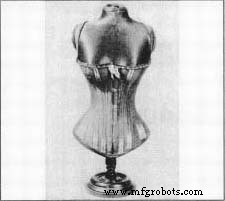 Corset designed by Jacob Kindliman of New York City in 1890. (From the collections of Henry Ford Museum & Greenfield Village, Dearborn, Michigan.)
Manufacturing Process
Spandex fibers are produced via four main methods: melt extrusion, reaction spinning, solution dry spinning, and solution wet spinning. Over 90 % of global production uses solution dry spinning, which we outline below.
Polymer Reactions
- Mix macroglycol and diisocyanate to form the prepolymer. The glycol:diisocyanate ratio is tightly controlled (typical 1:2) to tailor fiber properties.
- Chain‑extend the prepolymer with a diamine, then dilute with a solvent to create the spinning solution.
Fiber Production
- The spinning solution is pumped into a cylindrical spinning cell. A spinneret forces the solution through microscopic holes, aligning polymer strands.
- Inside the cell, the strands are cured under nitrogen and solvent vapor, solidifying into fibers.
- Fibers exit the cell, where a compressed‑air twist bundles them into the desired thickness. Each macroscopic fiber actually consists of thousands of micro‑fibers.
Final Processing
- Fibers receive a finishing agent (e.g., magnesium stearate or poly(dimethyl‑siloxane)) to prevent clumping and aid textile handling. They are then wound onto spools at speeds of 300–500 mi/min (482–805 km/h).
- Spools are packaged and shipped to textile manufacturers, where they may be blended with cotton, nylon, or polyester and dyed to produce finished fabrics.
Quality Control
Manufacturers monitor every stage: raw material checks (pH, specific gravity, viscosity, appearance), reaction parameters, and final fiber attributes (elasticity, resilience, absorbency). Consistent quality ensures reliable performance in end products.
The Future
Ongoing research focuses on optimizing prepolymer chemistry, catalyst selection, and filler integration to enhance stretch, durability, and sustainability. Hybrid fabrics—such as nylon/spandex blends—are expanding, and next‑generation manufacturing aims to increase speed and reduce environmental impact.
Manufacturing process
- Felt Fabric: History, Production, and Modern Uses
- Carbon Fiber: Composition, Manufacturing, and Future Applications
- Yarn Production: From Ancient Threads to Modern Innovation
- Fiberglass: Production, Materials, and Industry Outlook
- Rope: From Ancient Water‑Reed to Modern Synthetic Mastery
- Carbon Fiber Manufacturing: From Precursors to Premium Composites
- Woven Fabrics: Fundamentals for Composite Manufacturing
- Lanxess Introduces Lighter, Fossil‑Free Flax‑PLA Biocomposite for Scalable Production
- Thermoplastic Additives: Boosting Strength, Flexibility & Durability
- Carbon Fiber Varieties & Production Processes