



Rope: From Ancient Water‑Reed to Modern Synthetic Mastery
Background
A rope is a bundle of flexible fibers twisted or braided to enhance length and tensile strength. From prehistoric hunting to contemporary marine operations, ropes have been essential for lifting, carrying, and climbing. Early ropes were hand‑crafted from natural fibers; modern production relies on machines and a variety of synthetic materials that offer superior strength, lighter weight, and resistance to rot. Today, more than half of all rope manufactured worldwide serves the fishing and maritime industries.
Although the exact origins of rope are uncertain, the ancient Egyptians were the first to develop specialized tools for rope production, dating back to 4000‑3500 B.C. Their ropes, primarily made from water‑reed fibers, were also crafted from date‑palm, flax, grass, papyrus, leather, and camel‑hair. Thousands of laborers hauled these ropes to move the massive stones used in pyramid construction. By around 2800 B.C., hemp‑fiber rope emerged in China, and the craft spread throughout Asia, India, and Europe over the next millennia.
By the fourth century, Indian rope makers had specialized enough to produce ropes specifically for elephants. Leonardo da Vinci (1452‑1519) sketched a concept for a ropemaking machine, and by the late 1700s several functional machines were patented. Rope remained a natural‑fiber craft until the 1950s when synthetic materials such as nylon gained popularity. Despite material changes, the core process of rope making has remained largely unchanged since the time of the ancient Egyptians.
Rope is often referred to as cordage and is categorized by diameter. Cordage under 0.1875 inches (0.5 cm) includes twine, clothesline, sash cord, and marline—a tar‑covered hemp line. Cordage 0.1875‑0.5 inches (0.5‑1.3 cm) is light‑duty rope, sometimes called “small stuff.” Cordage 0.5‑1.5 inches (1.3‑3.8 cm) constitutes true rope, while cords over 1.5 inches (3.8 cm) are hawser, used for mooring large vessels.
Construction Methods
Rope construction begins by twisting fibers into yarn. For twisted rope, the yarn is then twisted into strands, and the strands into the final rope—typically using a three‑strand configuration. Braided rope is created by weaving the yarn directly into a braid, with double‑braided rope featuring a braided core and a braided cover. Plaited rope, such as eight‑plaited rope, interlocks twisted strands. Complex constructions combine twisting, braiding, and plaiting to achieve specific performance characteristics.
Raw Materials
Ropes may be made from natural fibers processed for easy yarn formation or from synthetic fibers spun into long filaments.
Natural fibers include hemp, sisal, cotton, flax, and jute. Manila hemp—derived from a banana plant—was widely used until synthetic alternatives supplanted it. While sisal remains common for twine, manila rope can rot internally, compromising strength without outward signs.
Common synthetic fibers are nylon, polyester, polypropylene, and aramid. Polypropylene is inexpensive, buoyant, and minimally stretchable—ideal for water‑ski tow ropes. Nylon offers moderate cost, good strength, and slight elasticity, making it suitable for mooring and docking lines. Aramid is the strongest but also the most costly. Nylon and polyester can be spun into fibers 4‑10 inches (10‑25 cm) long; ropes made from continuous filaments typically exhibit higher strength and smoother surfaces than those made from spun fibers. Hybrid ropes that combine two synthetic materials can balance high strength, low cost, and a smooth finish.
Wire rope—commonly called cable—is fabricated from iron or steel wires and is used in bridges, elevators, and cranes. Its manufacturing process differs fundamentally from fiber‑based ropes.
The Manufacturing Process
Fibers and filaments are first formed into yarn. The yarn is then twisted, braided, or plaited according to the desired rope type. The final diameter depends on yarn diameter, the number of yarns per strand, and the number of strands or braids.
Processing Fibers and Filaments
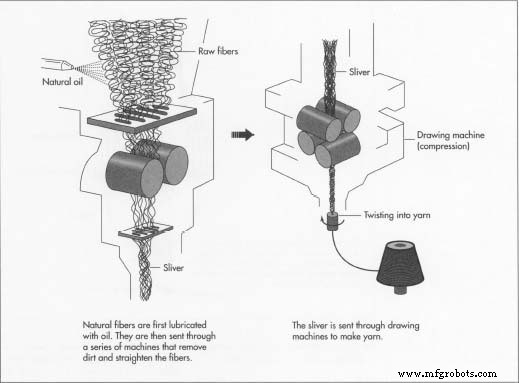
- Raw natural fibers are lubricated with a natural oil and fed through machines that clean, straighten, and comb them into a continuous ribbon called a sliver. Synthetic fibers undergo a similar process but align more readily. If using long synthetic filaments, multiple filaments are grouped in a process called doubling or throwing, producing a multi‑ply sliver.
- The sliver passes through rollers of a drawing machine, compressing it before it is twisted into yarn. A right‑hand twist (Z‑twist) or left‑hand twist (S‑twist) is applied. The finished yarn is wound onto bobbins; it may be dyed at this stage to aid identification in complex rigging.
Forming Twisted Rope
- Bobbins of yarn are arranged on a creel. For a three‑strand, right‑hand twist rope, Z‑twist yarns form each strand. The yarn ends pass through a register plate to maintain proper alignment, then enter a compression tube that twists them in the opposite S‑direction, tightening each strand.
- The strands are fed to a closing machine, where a tube‑like clamp (laying top) holds them. Each strand end passes through a rotating die that twists the strands in the Z‑direction, locking them together—a process known as closing the rope.
- The finished rope is wound onto a reel. When the strand ends are reached, the coil is removed, banded, and the ends are sealed—either by taping or by heat‑melted sealing for synthetic ropes—to prevent unraveling.
Forming Braided Rope
- Braided ropes are usually made from synthetic yarns. Bobbins are mounted on moving pendants that oscillate, weaving the yarn into a tight braid. Rollers pull the braid through a guide that locks it and maintains tension. Some machines braid by feeding yarns through counter‑rotating register plates, weaving each yarn in alternating directions to create an interlocked braid.
- In double‑braided ropes, the first braid becomes the core, and the second braid is woven over it to form the outer coat.
- The finished braid emerges onto a reel; the coil is then banded and the ends sealed.
Forming Plaited Rope
- Eight‑plaited rope consists of four S‑twist strands and four Z‑twist strands, paired and braided together. The manufacturing sequence follows the twisted‑rope process to create strands, then the braided‑rope process to assemble the final rope.
Quality Control
The rigor of quality control depends on the rope’s intended application. General‑purpose ropes are rated by diameter and tensile strength—determined by breaking a sample under load—and undergo basic material specification checks and visual inspection. High‑risk ropes—used for rappelling, rescue, or lifting above people—undergo extensive testing and inspection, possess finite service lives, and may include color codes or other identifiers indicating manufacture date. Some ropes incorporate wear tracers: a contrasting‑color yarn placed just beneath the outer wrap. When abrasion or overextension exposes the tracer, it signals an unsafe condition and prompts replacement.
The Future
Advancements in materials science directly drive the evolution of rope manufacturing. Each new generation of fibers—stronger, lighter, and more weather‑resistant—enables manufacturers to reduce rope diameter while maintaining or improving tensile strength and abrasion resistance. Emerging fabrication techniques promise further improvements, positioning ropes for even greater performance in marine, industrial, and adventure contexts.
Manufacturing process
- Felt Fabric: History, Production, and Modern Uses
- Carbon Fiber: Composition, Manufacturing, and Future Applications
- Spandex: The Science, History, and Manufacturing of the Elastic Fiber
- Yarn Production: From Ancient Threads to Modern Innovation
- Fiberglass: Production, Materials, and Industry Outlook
- Carbon Fiber Manufacturing: From Precursors to Premium Composites
- Woven Fabrics: Fundamentals for Composite Manufacturing
- Thermoplastic Additives: Boosting Strength, Flexibility & Durability
- Understanding Sheaves: Types, Functions, and Applications in Lifting Systems
- Carbon Fiber Varieties & Production Processes