



Elevators: Design, History, and Future Innovations
Background
An elevator—a platform that can be open or enclosed—transports people and freight between floors. Modern high‑rise commercial and residential structures routinely incorporate elevators. The Americans with Disabilities Act (ADA) has mandated that many two‑ and three‑story buildings retrofit elevators to ensure accessibility.
Manual freight elevators appeared in warehouses and factories as early as the 1600s. The breakthrough came with Elisha Otis’s 1853 demonstration at the New York World’s Fair, where a safety device instantly engaged the elevator if the hoisting cables failed. Early models ran on steam, and in 1871 hydraulic elevators using water pressure were introduced. The initial hydraulic rams were single‑piece, requiring deep shafts; later telescoping rams reduced the required depth. Electrical power soon replaced steam and hydraulics, with the first commercially successful electric elevator installed in 1889. Electricity offered universal availability and virtually unlimited vertical reach, unlike the height‑restricted hydraulic systems.
Electric‑powered elevators have evolved from simple DC motors to modern AC gear and direct‑drive systems. Gear motors typically handle speeds up to 500 ft min⁻¹ (153 m min⁻¹), while direct‑drive units enable high‑speed travel up to 2 000 ft min⁻¹ (610 m min⁻¹).
Control technology shifted from manual operation to automatic push‑button systems in the 1950s, and from electromechanical relays to solid‑state electronics in the 1970s. Today, microprocessor‑based controllers deliver precise speed regulation and diagnostic feedback.
Elevators are designed with robust safety systems: a governor limits speed by adjusting the drive pulley, an emergency brake engages when cables fail, and door interlocks prevent operation unless the doors are fully closed. Many units also include an emergency telephone and a ceiling trapdoor for passenger escape.
Design
While the lifting mechanism remains largely unchanged, control logic has become increasingly sophisticated to enhance safety and passenger throughput. Each elevator is tailored to its building’s height, expected traffic, and peak usage periods.
Counterweights balance the car plus 40 % of its maximum load, reducing motor effort and preventing uncontrolled descent. In a traction‑driven system, the hoist cable runs from the car, around a drive drum, and back to the counterweight. A second governor cable connects the car to a governor pulley, which triggers the emergency brake if the car accelerates beyond safe limits.
A ramped guide bar inside the shaft activates floor‑level switches that decelerate and stop the car at the correct floor. When the car aligns with the door opening, a limit switch signals the controller to halt the car and open both the inner and outer doors.
Large commercial towers often host multiple elevators managed by a unified control system that minimizes passenger wait times. The simplest systems employ single up/down buttons on each floor; the controller dispatches the nearest car traveling in the desired direction, signaled by illuminated arrows above the doors.
Advanced configurations form “banks” of elevators, partitioned into sectors covering adjacent floors. After completing a trip, a car returns to a designated home floor or is dispatched to the sector farthest from other available cars. Time‑of‑day programming tailors the dispatch strategy—morning peaks may prioritize ground‑floor service, while evening traffic distributes cars more evenly.
Firefighters can override normal operation with a key to route an elevator directly to a specified floor without intermediate stops.
Raw Materials
The car’s skeleton is a steel framework providing strength and rigidity. A crosshead of steel beams spans the shaft, supporting the hoist pulley. A sling extends from the crosshead to cradle the platform. Passenger car walls are usually steel panels finished with decorative trim; the floor may be tiled or carpeted, and handrails are often stainless steel for durability. A suspended ceiling with fluorescent lighting is installed below the car’s roof. Controls, alarm buttons, and the emergency telephone are housed behind panels near the doors.
Guide rollers or shoes sit on the sling’s ends, sliding along steel guide rails that run the shaft’s interior. The emergency brake consists of two clamping faces that grip the guide rails when a wedge—activated by a drum—closes the jaws.
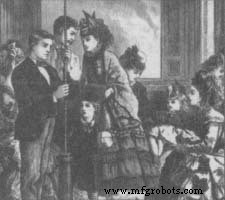 The elevator in the new Lord and Taylor department store in New York City looked like this on opening day in 1873.
(From the collections of Henry Ford Museum & Greenfield Village.)
The elevator in the new Lord and Taylor department store in New York City looked like this on opening day in 1873.
(From the collections of Henry Ford Museum & Greenfield Village.)
The elevator’s ripple effect reshaped modern cities. Without elevators, any building taller than eight or ten stories would be impractical. Combined with steel framing and reinforced concrete, elevators enabled the skyscraper and, by extension, the modern urban landscape.
In the 1880s, as cities expanded and property values surged, apartment living emerged as a high‑tech lifestyle. Developers marketed amenities—hot and cold running water, telephone lines, central gas, fully equipped bathrooms, and elevators—to attract middle‑class tenants who could no longer afford detached homes.
These buildings often featured centralized heating, ventilation, plumbing, and even vacuum systems that served all apartments. Elevator access democratized living: every floor was equally reachable, unlike in Europe where wealthier families occupied middle floors and the poor were relegated to basements or top levels.
William S. Pretzer
The hoisting cable is a braided assembly of multiple strands, each comprising several steel wires twisted around a hemp core that cushions and lubricates the cable.
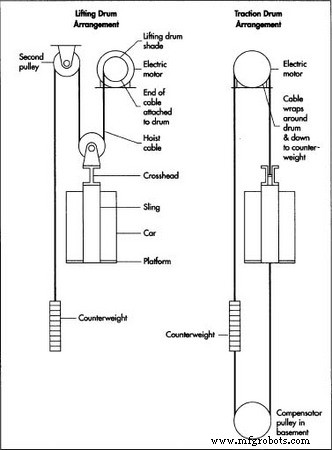 In a lifting‑drum installation, the hoist cable runs from a drive drum, around a top pulley, and back to the counterweight. In a traction‑drum system, the cable loops once around the drive drum before returning to the counterweight.
Electric hoisting motors are specifically engineered for elevator service and may include a gearbox, both of which are commercial components.
The Manufacturing Process
- The manufacturer fabricates elevator cars on a dedicated plant using standard metal cutting, welding, and forming techniques. Interior trim may be installed after the building’s exterior is completed.
- On site, the elevator shaft is integrated into the building design from the outset. As the structure rises, concrete walls are poured and the shaft’s straightness and dimensions are meticulously monitored.
- After the shaft walls are finished but before the roof is closed, guide rails, switch ramps, service ladders, and related equipment are bolted into place.
- A crane lifts the counterweight to the top of the shaft and lowers it onto the rails.
- The same crane lifts the elevator car and seats it partially into the shaft; guide wheels engage the rails, and the car is lowered to the shaft’s base.
- The shaft is roofed, creating a machine room above it. Here, the hoist motor, governor, controller, and ancillary equipment are mounted, with the motor positioned directly over the car’s pulley.
- Final assembly connects the elevator and governor cables, completes electrical wiring, and programs the controller.
Quality Control
Every elevator installed in the United States must meet the safety standards set by the American National Standards Institute (ANSI) and the American Society of Mechanical Engineers (ASME). Local building codes may adopt these standards or establish equivalent requirements. State authorities inspect, rate, and certify each passenger elevator before it enters service, and conduct regular reinspections thereafter.
The Future
Elevator technology will continue to evolve, albeit gradually. Emerging control systems learn from historical traffic patterns to forecast demand, reducing wait times. Laser‑based sensors are being introduced to monitor car speed and detect occupants, while floor‑level scanners anticipate passenger arrivals. These innovations promise smarter, safer, and more efficient vertical transportation.
Manufacturing process
- What is VMC Machining? An Expert Overview of Vertical Machining Centers
- Expert Guide to Aluminum Laser Marking: Precision, Durability, and Industry Applications
- Elevator Bolts Explained: Design, Uses, and How to Choose the Right One
- Elevators: Design, History, and Future Innovations
- Compact 5-Story Arduino-Driven Mini Elevator
- Smart Arduino-Driven Service Elevator for 4-Floor Operation
- World Bank Analysts Say Automated Transport Can Drive Global Development
- Bucket Elevators: Key Benefits & Industrial Applications
- Standard Elevator Load Capacity: How Much Weight Can It Support?
- Efficient Vertical Bulk Material Handling with Bucket Conveyors & Elevators