



Simplesse®: The Protein‑Based Fat Substitute Transforming Low‑Fat Foods
Background
High‑fat diets have long been linked to obesity, cardiovascular disease, and other health concerns, prompting a multibillion‑dollar market for low‑fat, fat‑free, and calorie‑restricted products. Fat substitutes such as Simplesse® provide a means to enjoy the mouthfeel and creaminess of traditional fats while cutting calories and cholesterol.
History
Simplesse® is a branded fat substitute developed by NutraSweet Company of Deerfield, Illinois. It is not the first “fake fat”; in the early 1970s, Procter & Gamble created Olestra®—a sucrose polyester that mimics fat’s texture but passes through the body without calories. Olestra was marketed in ice cream, cooking oils, salad dressings, baked goods, deep‑fried foods, and snack chips, though its safety has been questioned by the Center for Science in the Public Interest. While Olestra’s patent expired in 1994, Procter & Gamble continues to pursue FDA approval and has introduced Caprenin®, a reduced‑calorie fat that resembles cocoa butter.
In 1984, inventors Norman S. Singer, Shoji Yamamoto, and Joseph Latella filed a U.S. patent (No. 4,734,287) for Simplesse®. The patent describes a microparticulation process that turns a blend of egg white and whey proteins into tiny particles that replicate the texture of fat. Compared with real fat, Simplesse® delivers less than one‑third of the calories. A side‑by‑side test of a 4‑ounce vanilla ice cream containing 16 % butterfat versus a Simplesse® version showed the former contained 19 g of fat, 97 mg of cholesterol, and 274 kcal, while the Simplesse® dessert contained less than 1 g of fat, 14 mg of cholesterol, and 120 kcal. Unlike other fat substitutes, Simplesse® is not heat‑stable, limiting its use in cooked or baked foods.
In 1990, the FDA granted Simplesse® GRAS status for use as a thickener or texturizer in frozen desserts. It is now listed as a food ingredient in 18 products worldwide.
Raw Materials
Simplesse® is produced from egg whites, milk and whey proteins, pectin, and citric acid. Whey—an abundant byproduct of cheese production—is blended with the other ingredients, homogenized, and subjected to a microparticulation process that creates fat‑like particles.
The Manufacturing Process
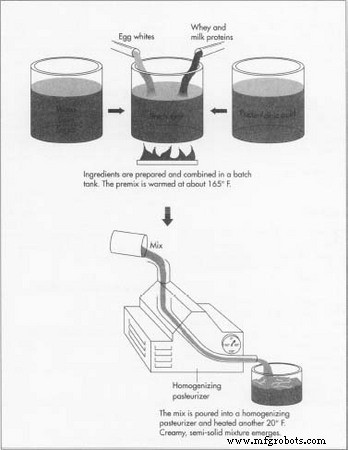
The core of Simplesse® production is a time‑honored microparticulation technique that dates back to ancient culinary practices. In the modern process, the protein blend is heated to just below its coagulation point (≈165 °F/74 °C), then rapidly passed through a homogenizing pasteurizer that subjects it to intense turbulence. This action denatures about half of the proteins, forming 1‑to‑3 µm beads that merge into a creamy, smooth semi‑solid once cooled.
Mixing the Ingredients
- Water, gum, and sugar are blended in a dry mixer and transferred to a batch tank. Egg whites, whey protein concentrate, and skim milk proteins are added, and the pH is adjusted.
- Lethecin, pectin, and citric acid are fully dissolved so that no particle exceeds 1 µm. This fine dispersion is then mixed into the protein blend.
Heating
- The premix is warmed to about 165 °F (74 °C), just below the protein’s coagulation temperature.
- It is then pumped into a homogenizing pasteurizer, heated another 20 °F in under 10 seconds, and continuously stirred in a turbulent field. The result is a gelled mixture that forms beadlets of 1‑3 µm.
- After pasteurization, the mixture is cooled, yielding the final Simplesse® product—creamy, smooth, opaque, and semi‑solid.
Quality Control
Whey is a key but costly ingredient because it contains ~90 % water. Removing this moisture is expensive and can pose environmental disposal issues. One solution is to heat whey to denature and coagulate it, allowing separation into byproducts and reducing waste. Since Simplesse® relies on natural ingredients, it is generally considered safe, but strict sterile manufacturing is essential to avoid bacterial contamination.
The Future
In 1991, the fat‑replacer market was valued at roughly $100 million; projections estimate a three‑fold increase by 1996. The broader reduced‑fat food sector is expected to reach nearly $30 billion. NutraSweet projects that full adoption of Simplesse® could cut U.S. fat consumption by 14 % and cholesterol intake by 5 %. Although Simplesse® is not yet approved for cooked, baked, or fried applications—due to its heat instability—it remains a promising ingredient for frozen desserts and other low‑fat products.
Manufacturing process
- What is VMC Machining? An Expert Overview of Vertical Machining Centers
- Expert Guide to Aluminum Laser Marking: Precision, Durability, and Industry Applications
- MIG vs. TIG Welding: Selecting the Right Arc Welding Technique for Your Project
- Simplesse®: The Protein‑Based Fat Substitute Transforming Low‑Fat Foods
- Lean Shutdowns: 10 Proven Strategies to Trim Costs and Optimize Operations
- Ashwagandha: The Indian Herb That Helps You Burn Belly Fat and Boost Weight Loss
- Small-Angle Scattering Reveals Structure of Deterministic Nanoscale Fat Fractals
- Understanding the Key Differences Between Fat Lime and Hydraulic Lime
- Fast, Reliable RAL 9005 Jet Black Powder‑Coat Alternatives for Your Custom Parts
- Streamlining Production: How Material Handling Robots Cut Costs and Waste