



Magnets: Types, Materials, Manufacturing, and Future Applications
Background
A magnet is a material that exerts a noticeable magnetic force on other substances without physical contact. This force can attract or repel, and while many materials produce a faint magnetic effect, only certain materials generate a strong enough field to be considered magnets. The Earth itself behaves as a giant magnet.
Permanent magnets retain their magnetic properties after the external field is removed. The ancient lodestone—iron ore magnetite—remains magnetized naturally. Modern permanent magnets are produced by aligning the magnetic domains of specific alloys or ferrites and then freezing that alignment in place.
Electromagnets, in contrast, generate a magnetic field only while an electric current flows through a coil wrapped around a core material. Once the current stops, the magnetic field collapses, leaving the core essentially non‑magnetic.
All magnets possess two poles—north and south—where the magnetic field is strongest. This principle underpins the earliest navigational compasses and remains fundamental to countless technologies today, from electric motors and transformers to MRI scanners and loudspeakers.
History
Lodestone was first documented by Greek scholars around 500 B.C. The term "magnet" originates from the Greek "magnetis lithos," meaning "stone of Magnesia," after the region in present‑day Turkey where these magnetic stones were found.
European use of the lodestone as a compass dates to roughly 1100–1200 A.D. The word "lodestone" itself comes from the Anglo‑Saxon meaning "leading stone." In Icelandic, the term "leider‑stein" was similarly used for navigation.
In 1600, William Gilbert confirmed the existence of magnetic poles and proposed that the Earth is a giant magnet. The 1820s saw a breakthrough when Hans Christian Oersted discovered the link between electricity and magnetism, followed by André‑Ampère’s further development of the theory.
The 20th century brought the first powerful permanent magnets. The 1930s introduced Alnico alloys, offering 5–17× the force of natural magnetite. The 1970s saw the advent of rare‑earth ceramic magnets, and the 1980s refined these into the modern high‑performance variants.
Today, magnetic materials are engineered to meet specific performance criteria, enabling a wide range of applications.
Raw Materials
Choosing the right raw material is often more critical than the manufacturing process. Permanent magnets typically use “hard” materials—resistant to demagnetization—while electromagnets rely on “soft” materials that can be easily magnetized and demagnetized.
Permanent Magnet Materials
Lodestone contains magnetite, a hard, crystalline iron ferrite that derives its magnetism from the Earth’s magnetic field. Modern permanent magnets include:
- Alnico alloys (Al–Ni–Co) produced in the 1930s; these deliver 5–17× the force of magnetite.
- Ceramic (ferrite) magnets made from barium or strontium ferrite powder. By aligning the particles in a strong field during pressing, they achieve magnetic strength comparable to Alnico while offering easy shaping.
- Flexible magnets that embed ferrite powder in rubber or PVC binders, enabling flexible shapes for custom applications.
- Samarium‑cobalt magnets (1970s) fuse powdered samarium‑cobalt under heat. Their hexagonal crystal structure aligns magnetic domains naturally, yielding forces 50× that of magnetite and excellent high‑temperature performance.
- Neodymium‑iron‑boron (NdFeB) magnets (1980s) produce forces almost 75× that of magnetite, and are the strongest commercially available permanent magnets.
Electromagnet Materials
Electromagnets commonly use pure iron or iron alloys. Silicon‑steel and specially treated iron‑cobalt alloys are preferred for low‑frequency power transformers. In magnetic recording, a special gamma iron oxide is coated onto a polyester film, along with cobalt‑modified iron oxides or chromium dioxide, to produce high‑density magnetic tapes.
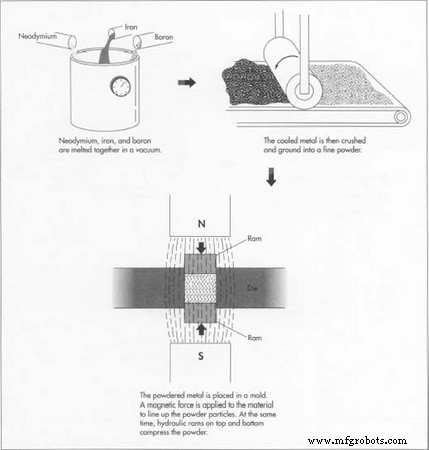
The image below illustrates the powdered‑metallurgy process used to create powerful neodymium‑iron‑boron permanent magnets.
Other Magnetic Materials
Magnetic fluids are produced by encapsulating fine ferrite particles in a single‑molecule polymer shell. The particles remain suspended in water or oil, sliding past one another with minimal friction. Such ferrofluids are used as sealants, lubricants, and vibration dampers.
The Manufacturing Process
Manufacturing methods vary by magnet type. Electromagnets are typically cast using standard metal‑casting techniques. Flexible permanent magnets are formed via plastic extrusion, while powerful permanent magnets are often produced through a modified powdered‑metallurgy route.
The following steps outline the typical powdered‑metallurgy process for neodymium‑iron‑boron magnets (cross‑section 3–10 sq in / 20–65 sq cm):
Preparing the Powdered Metal
- 1. Neodymium, iron, and boron are melted together in a vacuum to prevent contamination.
- 2. The molten alloy is cooled, crushed, and ball‑milled into a fine powder.
Pressing
- 3. The powder is placed in a die matching the final magnet dimensions. A magnetic field aligns the particles, and hydraulic or mechanical rams compress the material to within 0.125 in (0.32 cm) of its final thickness, applying 10,000–15,000 psi (70–100 MPa). Some shapes are formed by isostatic compaction using liquid or gas pressure.
Heating (Sintering)
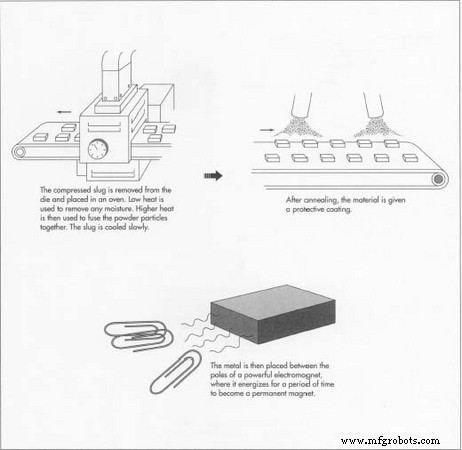
- 4. The compressed “slug” is sintered in an oven. The process involves three stages: initial low‑temperature heating to remove moisture, a second stage at 70–90% of the alloy’s melting point held for hours to fuse particles, and controlled cooling to prevent cracks.
Annealing
- 5. A second heat‑treat step removes residual stresses and strengthens the magnet.
Finishing
- 6. The near‑net shape is machined to final dimensions, surfaces are smoothed, and a protective coating is applied.
Magnetizing
- 7. The annealed piece is placed between the poles of a powerful electromagnet and oriented for the desired polarity. Energizing the electromagnet aligns the magnetic domains, converting the material into a permanent magnet.
Quality Control
Each manufacturing step is rigorously monitored. Temperature and time controls during sintering and annealing are critical to achieving the required mechanical and magnetic properties.
Hazardous Materials, Byproducts, and Recycling
Barium and its compounds, used in barium ferrite magnets, are toxic and must be handled with strict safety protocols during storage, handling, and disposal.
Electromagnets can be recycled by salvaging iron cores and copper wiring. Partial recycling of permanent magnets is possible by reusing components from obsolete equipment, but comprehensive recycling methods for high‑performance magnets remain under development.
The Future
Research continues to push magnetic performance limits. Stronger permanent magnets could enable compact, high‑torque electric motors for battery‑powered industrial robots and laptop disk drives. More powerful electromagnets might facilitate magnetic levitation (maglev) trains, reducing friction and noise, or even enable satellite launch systems that rely on pulsed magnetic fields instead of conventional rockets.
Intense pulsed magnetic fields are already employed in nuclear fusion experiments to contain hot plasma and in materials science to study semiconductor behavior at the micro‑scale.
Manufacturing process
- Mastering Electromagnetic Induction: Build, Measure, and Analyze Magnetic Fields
- Understanding Relay Construction: From Solenoids to Industrial Applications
- Electromagnetism: From Oersted’s Discovery to Modern Applications
- The Evolution of Videotape: Revolutionizing Media & Home Entertainment
- Understanding Toy Slime: Chemistry, History, and Production
- The Evolution of Floppy Disks: From Magnetic Media to Optical Storage
- What Is a Superconductor? Types, Materials, and Key Properties
- Types of Magnetometers: From Scalar to Advanced Vibrating‑Sample Devices
- Understanding Magnetic Chip Conveyors: Function, Features, and Applications
- Understanding Brittleness in Materials: Causes, Consequences, and Testing